
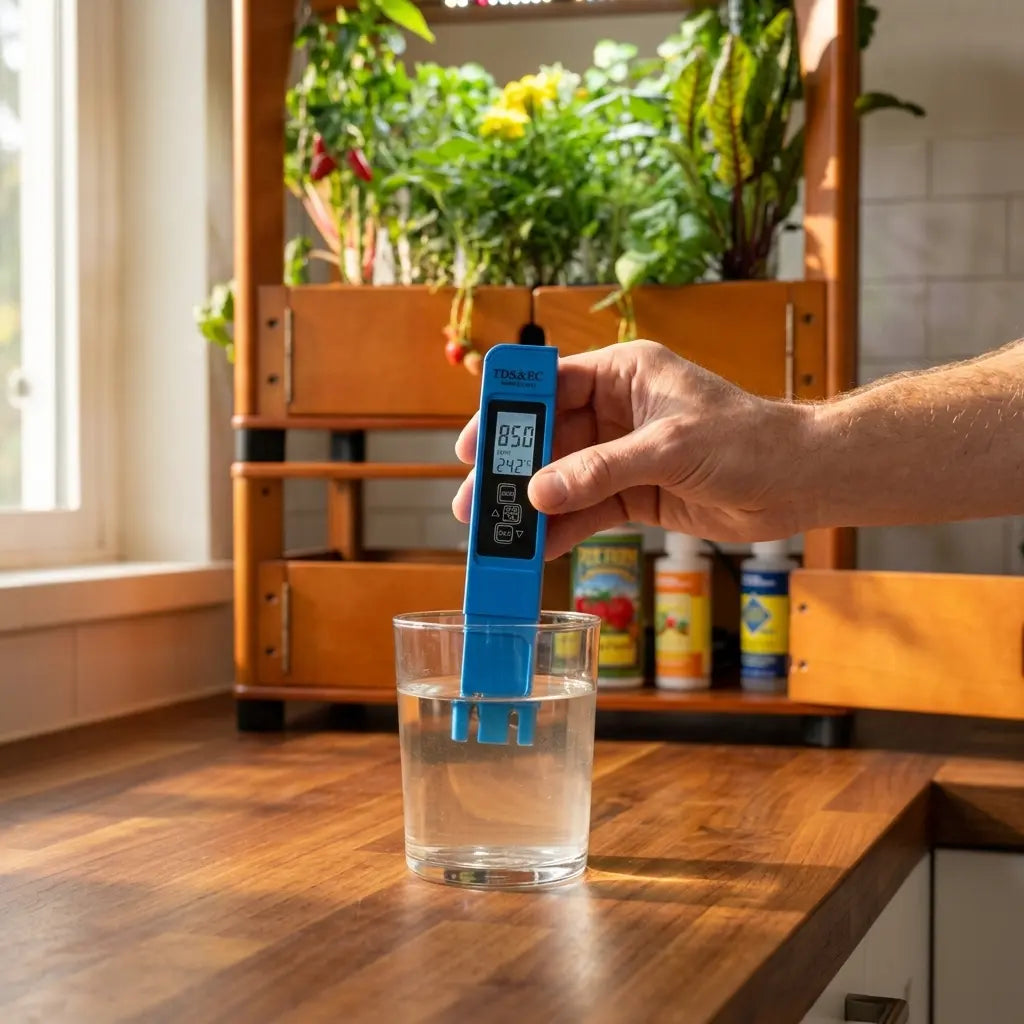
Two hydroponic reservoirs can look identical, same clear water, same tidy roots, same schedule, and still produce completely different results. One grows a thriving plant. The other grows a stunted, stressed one.
The difference usually comes down to a number most beginners never check: the actual concentration of nutrients dissolved in the water, measured as EC or PPM. Following the mixing instructions on a nutrient bottle gets you close, but it does not confirm what actually ended up in the reservoir.
This guide explains what EC and PPM actually measure, why the number matters more than just following the label, the ideal ranges for different plant types, and how to build a quick testing habit around it.
What EC and PPM Actually Measure
EC stands for electrical conductivity. Pure water conducts almost no electricity, but dissolved mineral salts, including the nutrients you mix in, carry a charge and let water conduct a small electrical current. The more nutrient dissolved, the higher that conductivity reads.
PPM stands for parts per million, a more familiar way of expressing roughly how much dissolved material is in the water by weight. Ec and ppm are two ways of describing the same underlying thing: how concentrated your nutrient solution actually is.
A useful reference point is your own tap water before anything is added to it. Many municipal water supplies read somewhere between 50 and 300 PPM on their own, purely from naturally dissolved minerals, before a drop of nutrient concentrate goes in. Knowing that baseline number helps you understand how much of your final reading actually came from the nutrients you added.
Meters convert the raw EC reading into a PPM number using a conversion factor, most commonly 500 or 700, depending on which scale the meter uses. This is why the same reservoir can show a different PPM number on two different meters even though the EC itself agrees, and it is worth checking which scale your specific meter uses before comparing readings against a chart.
Why Different Meters Show Different Numbers
A single EC reading of 1.5 mS/cm converts to roughly 750 PPM on a 500 scale meter, but roughly 1050 PPM on a 700 scale meter. Same water, same actual nutrient concentration, two very different numbers displayed on screen.
This is not a defect in either meter. Both scales are legitimate ways of estimating dissolved solids from conductivity, they just use different assumed relationships between the two. The practical takeaway is simple: always compare your readings to charts and guidelines that use the same scale as your own meter, and if you are not sure which scale yours uses, the manufacturer's manual or product listing will say.
Some growers sidestep the confusion entirely by tracking EC instead of PPM, since EC has no scale ambiguity. Either approach works as long as you stay consistent with whichever number you choose to track over time.
Why This Number Matters More Than Just Following the Bottle
Nutrient bottle instructions assume a specific water source and mixing ratio, but tap water already contains dissolved minerals before you add anything, and that starting point varies significantly by location. Two people following the same instructions with different source water end up with different actual concentrations.
Too weak a solution starves the plant slowly. Growth stalls, older leaves pale, and the plant simply does not have the raw material to keep producing new growth at a normal pace.
Too strong a solution is more damaging and often faster. Excess dissolved salts pull water out of root cells through osmosis rather than letting the roots absorb water normally, a stress commonly called nutrient burn, which shows up as crisped, browning leaf edges.
Checking EC and PPM after mixing, rather than trusting the bottle's ratio blindly, is the only way to know which side of that range your reservoir actually landed on.
Nutrient strength also needs to increase gradually as a plant matures rather than staying fixed at one number for its entire life. A seedling given full-strength adult nutrient solution on day one is far more likely to show burn than one eased into higher concentrations over several weeks as its root system develops.
Ideal EC and PPM Ranges by Plant Type
Different plants tolerate different nutrient strengths, and young seedlings in particular need a much weaker solution than an established, actively growing plant.
| Growth Stage / Plant Type | EC Range (mS/cm) | PPM Range (500 scale) |
| Seedlings and fresh transplants | 0.4 to 0.8 | 200 to 400 |
| Leafy herbs (basil, parsley, mint family) | 1.0 to 1.6 | 500 to 800 |
| Leafy greens (lettuce, kale, chard) | 1.2 to 1.8 | 600 to 900 |
| Fruiting plants (peppers, tomatoes, strawberries) | 1.8 to 2.4 | 900 to 1100 |
These ranges are starting points rather than exact rules. A plant that looks pale and slow at the low end of its range often responds well to a gradual increase, tested and adjusted a little at a time rather than jumped all at once.
How to Measure EC and PPM the Right Way
Testing takes seconds once the habit is set, and it belongs in the same routine as checking pH, right after mixing nutrients and before the water goes back to feeding the plant.
Rinse the meter's probe tip with clean water before dipping it into a sample, since residue from a previous, differently concentrated reservoir can skew the next reading.
Dip the probe into a sample of the freshly mixed reservoir water, swirl gently, and wait a few seconds for the reading to settle before recording the number.
The Aquager PPM/EC Meter reads TDS, EC, and water temperature together in one dip, which is useful since temperature can shift the reading slightly and it helps to know both numbers at once rather than testing twice.

If the reading comes back low, add a small additional amount of nutrient concentrate, stir thoroughly, and retest rather than guessing at a larger addition all at once.
Building a Reliable Nutrient Routine
Consistent nutrient strength depends on measuring the same way every time, which is easier with the right tools kept together in one place.
The Aquager Plant Nutrients concentrate is formulated for the ratios used in these ranges, so mixing according to the label gets you close, and testing with the PPM/EC Meter confirms exactly where you landed before the water goes back to the reservoir.
Keeping the meter within reach of the reservoir, rather than stored away, makes it far more likely that a test happens every time nutrients are mixed rather than only when a plant already looks unhealthy.
A full reservoir change, rather than just topping off with water, is also worth doing on a regular interval, typically every one to two weeks for a small home system. Nutrients get depleted unevenly as plants selectively absorb what they need, so even a reservoir that reads a correct EC can have a skewed balance of individual nutrients after enough time passes without a full refresh.
Common Mistakes Beginners Make With EC and PPM
Comparing a reading against the wrong scale is the most frequent mixup. A meter using a 700 conversion factor and one using a 500 factor produce different PPM numbers from the exact same EC, so a chart built for one scale can look alarming when read against a meter using the other.
Testing before nutrients are fully mixed in is another common error. Concentrate needs a minute or two of stirring to distribute evenly through the reservoir, and testing too early can show a lower reading than the water actually settles at.
Assuming a strong smell or dark color in a nutrient solution reflects concentration is a mistake as well. Color and smell come from the specific ingredients in a formula, not from how concentrated the mix is, so only a meter reading confirms actual strength.
Ignoring water temperature is a smaller but real factor. EC readings shift somewhat with temperature, which is part of why a combined meter that reads temperature alongside EC and TDS gives a more complete picture than a basic single-purpose tester.
Adjusting nutrient strength based on how a plant looks, rather than what the meter reads, is a subtler mistake. A plant can look slightly pale for reasons unrelated to nutrient concentration, such as low light or a recent transplant, and pushing the nutrient strength higher in response can turn a minor unrelated issue into an actual case of nutrient burn.
Not accounting for runoff or top-up water is another one. Topping off a reservoir with plain water as it evaporates dilutes the nutrient concentration over several days, even though nothing was done incorrectly, which is exactly why periodic retesting between full reservoir changes matters.
EC and PPM FAQ
What is a good PPM for hydroponics?
It depends on the plant and its growth stage. Seedlings do best around 200 to 400 PPM, while established fruiting plants like peppers can handle 900 to 1200 PPM.
Is EC or PPM more accurate?
EC is the direct measurement. PPM is a calculated conversion from EC, so EC is technically the more precise number, though PPM tends to be the more commonly referenced figure on nutrient labels.
Why do two meters give different PPM readings for the same water?
They likely use different conversion scales, commonly 500 or 700. Checking which scale your meter uses before comparing it to a chart avoids a lot of confusion.
What happens if nutrient concentration is too high?
Excess dissolved salts pull water out of root cells rather than letting the roots absorb water normally, which shows up as crisped or browning leaf edges, often called nutrient burn.
How often should I test EC or PPM?
Every time you mix a fresh batch of nutrients, similar to how often you would test pH. A quick recheck partway through the week is also useful for an established reservoir.
Does topping off a reservoir with plain water change the nutrient concentration?
Yes. As water evaporates and you top it off with plain water rather than a fresh nutrient mix, the remaining nutrients become diluted across the added volume, which gradually lowers EC and PPM over several days.
Can I use EC and PPM readings instead of watching for visual symptoms?
They work best together. A meter reading catches a concentration problem before it produces a visible symptom, while visual signs like leaf burn or pale growth confirm a problem that has already been developing for a while.
Getting Comfortable With the Number
EC and PPM feel technical the first few times, but the underlying idea is simple: it is a direct check on how much nutrient actually made it into the water, rather than trusting a mixing ratio to have worked out correctly on its own.
Once testing becomes part of the regular nutrient mixing routine, dialing in the right strength for whatever you are growing becomes a quick, repeatable habit rather than a guessing game.
Pair it with regular pH testing and the two readings together tell you almost everything you need to know about whether a reservoir can actually support healthy growth, since concentration and availability both have to be right at the same time, not just one or the other.
For the setup steps this routine builds on, our beginner's guide to setting up hydroponics covers getting a system running from scratch, and our piece on why plant roots need oxygen in hydroponics explains the other environmental factor that determines how well roots can actually use the nutrients in front of them.
If you are still working through some of the basic assumptions of how hydroponic systems behave, our common hydroponic gardening myths post is worth a read alongside this one.

A reservoir mixed and checked correctly every time produces the kind of steady, predictable growth that makes the whole nutrient question fade into the background.
Author: Aquager · Published: July 5, 2026 · Updated: July 5, 2026














0 comments