
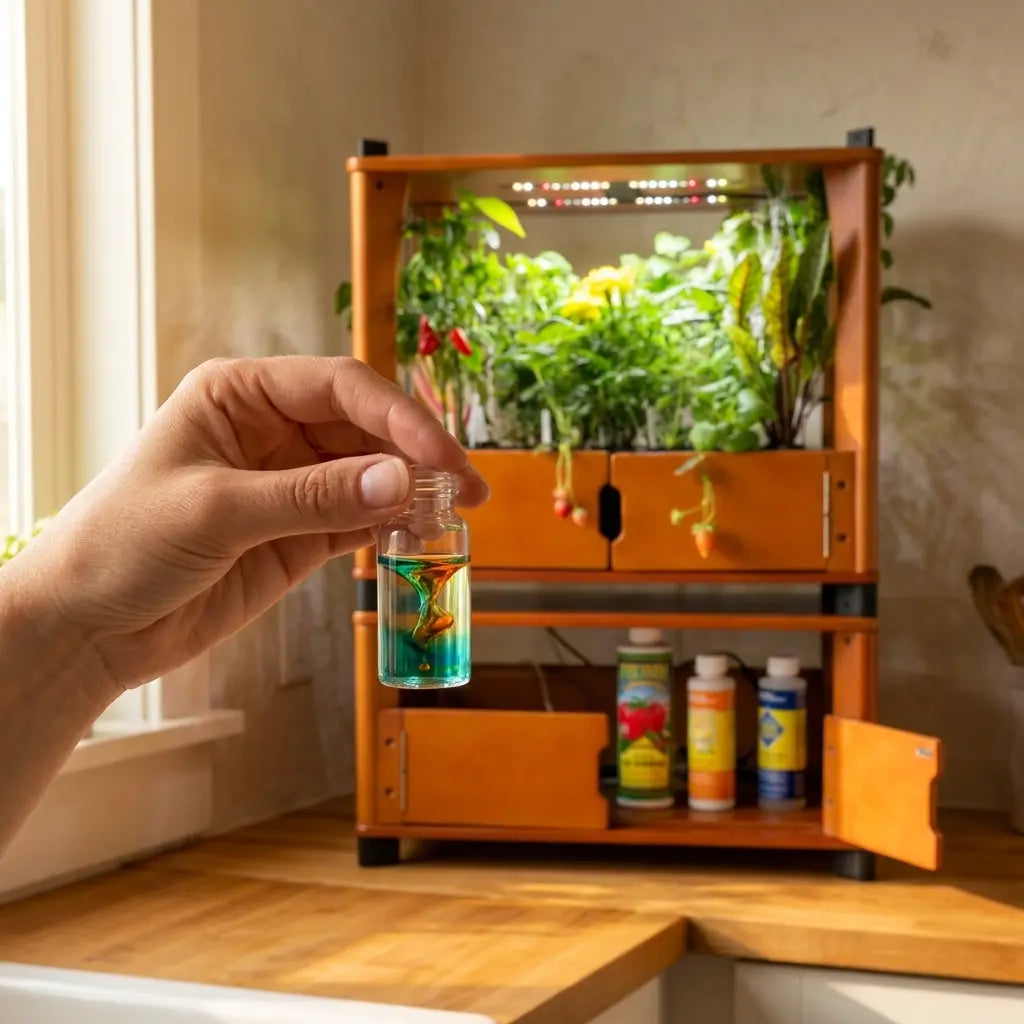
Plants growing in perfectly balanced nutrient water can still starve. It sounds contradictory, but it happens constantly in home hydroponic systems, and the cause is almost never the nutrients themselves.
The real problem is pH. When the water in a reservoir drifts outside a narrow range, the roots lose the ability to absorb nutrients that are sitting right next to them, dissolved and ready to use. The plant wilts, yellows, or stalls, and a well-meaning grower doubles the nutrient dose, which makes the problem worse.
This guide covers what pH actually does to nutrient uptake, the ideal range for a home hydroponic farm, how to test reservoir water with a hydroponic pH tester, how to adjust it safely, and the single beginner mistake that causes more failed harvests than any other.
Why pH Controls Nutrient Availability
Nutrients dissolved in water do not stay in a form roots can absorb at every pH level. Each nutrient, from nitrogen to iron to calcium, has a specific pH window where it stays chemically available. Outside that window, the nutrient is still physically present in the water, but it reacts into a form the plant's roots cannot take up.
This is why nutrient availability and pH are inseparable in hydroponics. A reservoir can be mixed at the exact recommended nutrient strength and still starve a plant if the pH sits at the wrong number, because the plant simply cannot access what is there.
Iron is usually the first casualty. It becomes unavailable outside a fairly narrow band, which is why new yellowing between the veins of upper leaves is often the first visible sign of a pH problem rather than a nutrient problem.
Different nutrients drop out of availability at different points, which is why a single pH swing rarely causes just one symptom. Here is roughly where the major nutrients start becoming harder for roots to absorb:
| Nutrient | Becomes Less Available When | Common Symptom |
| Iron | pH rises above 6.5 | Yellowing between veins on new leaves |
| Calcium | pH drops below 5.5 | Weak stems, distorted new growth |
| Magnesium | pH drops below 5.5 | Yellowing between veins on older leaves |
| Phosphorus | pH rises above 7.0 | Dark, dull leaves and slow growth |
| Nitrogen | pH drops below 5.0 | Overall pale, stunted growth |
This overlap is exactly why a single out-of-range reading can produce what looks like several unrelated problems at once, when the real cause is one number.
Signs Your Reservoir's pH Has Drifted
Plants show pH problems before a test ever confirms them, which is useful for catching a drift early if you know what to look for.
New growth that yellows between the veins while the veins themselves stay green is the most common early sign, usually pointing to iron becoming unavailable as pH climbs. This shows up on the newest leaves first, since they are the most dependent on a steady, current nutrient supply.
Older, established leaves yellowing while new growth still looks fine points more toward magnesium, which the plant can pull from older leaves and relocate to newer ones when supply gets tight. Stunted, generally pale growth across the whole plant, without a clear yellowing pattern, often points toward the low end of the range and nitrogen availability.
None of these symptoms are exclusive to pH problems, which is exactly why testing the water directly is more reliable than trying to diagnose the cause from leaf appearance alone.
The Ideal pH Range for Hydroponics
Most hydroponically grown herbs and vegetables do best between 5.5 and 6.5, with 6.0 as a reasonable target for a mixed home farm growing several plant varieties at once. This range keeps the widest number of nutrients simultaneously available.
Some plants tolerate a slightly wider range. Basil and most leafy greens are forgiving between 5.5 and 6.5, while a few herbs, like rosemary and lavender, lean toward the higher end near 6.5 to 7.0. Staying within the general 5.5 to 6.5 band is the safest default for a home system growing a mix of herbs and vegetables.
Tap water alone is rarely in this range. City water commonly tests above 7.0, and mixing in nutrient concentrate shifts it further, which is exactly why testing after mixing, not before, matters.
Well water and filtered or reverse osmosis water behave differently from each other, too. Well water often carries dissolved minerals that push pH and hardness higher, while reverse osmosis water starts essentially neutral and unbuffered, which means it can swing more easily once nutrients are added. Neither is wrong to use, but each benefits from its own baseline test before you assume the starting point.
How to Test Your Hydroponic pH
Testing reservoir water takes under a minute once the routine is familiar, and it should happen every time the reservoir is refilled or nutrients are added, not just when a plant already looks unhealthy.
Draw a small sample of reservoir water into a clean container, away from the main tank so the drops used for testing never contaminate the water your roots are sitting in.
Add the recommended number of drops of a liquid pH test indicator to the sample and swirl gently. The water changes color within seconds, and that color is compared against a printed reference chart to read the approximate pH.
The Aquager pH Test Indicator uses this same drop-test method, and it needs no calibration, batteries, or storage in a special solution between uses, which makes it a dependable option for a home grower who just wants a quick, accurate read before every reservoir refill.
Test at the same time relative to mixing nutrients each time, ideally a few minutes after mixing rather than immediately, since pH can drift slightly as the nutrient solution fully dissolves.
How to Adjust pH Up or Down
Once a reading falls outside 5.5 to 6.5, it needs correcting before the reservoir goes back to feeding the roots. Adjusting is a small, incremental process, not a single large correction.
If the reading comes back above 6.5, the water is too alkaline and needs a pH Down solution. If it comes back below 5.5, the water is too acidic and needs a pH Up solution. Add a few drops at a time, stir the reservoir thoroughly, wait two to three minutes, and retest before adding more.
The Aquager pH Down Solution and pH Up Solution are both dosed for small home reservoirs, so a little goes a long way and it is easy to overshoot if you add too much at once.

Overshooting is common with a ph up and down kit the first few times it is used. Adding half the amount you think you need, retesting, and repeating in small steps avoids the common beginner pattern of swinging the water back and forth between too acidic and too alkaline over a single session.
The Full Routine in Five Steps
Once each individual step is familiar, the whole test-and-adjust routine collapses into a quick habit that takes barely any time out of a reservoir refill:
1. Draw a small water sample from the reservoir into a separate clean container, away from the main tank.
2. Add the recommended number of drops of pH test indicator and swirl gently.
3. Compare the resulting color against the reference chart to read the approximate pH.
4. If the reading falls outside 5.5 to 6.5, add a few drops of pH Up or pH Down, stir the full reservoir, and wait two to three minutes.
5. Retest, and repeat step four in small increments until the reading settles comfortably in range.
Written out, it looks like more steps than it feels like in practice. Most growers finish the entire routine well under five minutes once it becomes part of the regular refill habit rather than a special occasion.
The Complete pH Control Kit
Testing and adjusting pH are really one routine, not two separate tasks, which is why keeping the test indicator and both adjustment solutions together in one place saves time on every reservoir refill.
The Aquager pH Control Kit bundles the pH Test Indicator, pH Up Solution, pH Down Solution, and a dropper into a single kit, so a new grower has everything needed for the full test-and-adjust routine without buying each piece separately.
Keeping the full kit within reach of the reservoir, rather than stored in a cabinet, makes the habit of testing before every refill far more likely to actually happen.
The Most Common Beginner Mistake
Testing pH once, at setup, and never again is the single biggest reason new hydroponic growers run into nutrient problems a few weeks in. pH is not a set-and-forget number. It drifts as plants take up nutrients unevenly, as water evaporates and concentrates what remains, and as tap water refills shift the balance again.
A reservoir that reads a perfect 6.0 on day one can easily drift to 6.8 or 5.2 by day ten with no visible warning until a plant already shows stress. Testing only when something looks wrong means the correction always arrives after damage has already started.
The fix is simple: test every time water or nutrients are added, not on a calendar schedule and not only when troubleshooting. This single habit change prevents the majority of pH-related nutrient problems before they ever produce a symptom.
A smaller but related mistake is letting a liquid pH test indicator sit in direct sunlight or a hot spot near a window. Heat and light exposure gradually degrade the indicator solution, which leads to color readings that no longer match the reference chart accurately. Storing the bottle somewhere cool and out of direct light keeps every future reading trustworthy.
A closely related mistake is confusing a pH reading with a nutrient strength reading. A PPM or EC meter measures how concentrated the nutrient solution is, while a pH test measures whether that concentration is actually usable by the plant. Both matter, but they answer different questions, and treating a good PPM reading as proof that pH is also fine leads growers to skip the pH test entirely.
Why pH Keeps Drifting Even When You Don't Touch It
A reservoir left completely alone still moves in pH over several days, which surprises a lot of new growers who assume a stable-looking system means a stable number.
Plants absorb nutrients unevenly. As roots pull in certain ions faster than others, the remaining solution shifts in pH as a side effect, typically drifting upward over time in most home hydroponic setups.
Evaporation adds a second factor. As water evaporates from an open or lightly covered reservoir, the nutrients left behind become more concentrated in a smaller volume of water, which can shift pH even though nothing was technically added or removed on purpose.
A thin layer of biofilm or algae on the inside of the reservoir, more likely in a system that gets some direct light on the water, also releases compounds that gradually shift pH over the course of a week. Keeping the reservoir shaded from direct light slows this considerably.
pH Testing FAQ
How often should I test hydroponic pH?
Every time you refill the reservoir or add nutrients, and ideally a quick recheck every few days in between for an established system.
What pH is too high for hydroponics?
Above 6.5 starts limiting the availability of iron and several micronutrients. Above 7.0, multiple nutrients become significantly less available even though they remain dissolved in the water.
What pH is too low for hydroponics?
Below 5.5 starts to limit calcium and magnesium availability, and below 5.0 can begin stressing roots directly in addition to the nutrient lockout.
Can wrong pH damage roots even if nutrients look fine on paper?
Yes. A correct nutrient mix at the wrong pH still results in a hungry plant, since the nutrients are present but chemically unavailable for uptake at that pH level.
Do I need to calibrate a liquid pH test indicator?
No. Liquid drop test indicators like Aquager's read pH through a color change against a reference chart and require no calibration, unlike electronic pH probes which do need periodic calibration with buffer solutions.
How much pH Up or pH Down should I add at once?
Start with just a few drops in a small home reservoir, stir thoroughly, wait a couple of minutes, and retest before adding more. Small, incremental adjustments prevent overshooting the target range.
Why does my reservoir's pH keep drifting even when I don't add anything?
Uneven nutrient uptake by the roots, water evaporating and concentrating what remains, and light-driven algae or biofilm growth all shift pH gradually on their own, which is why regular retesting matters even between refills.
Is a slightly off pH reading actually a problem, or does it need to be exact?
A small drift of a tenth or two within the 5.5 to 6.5 range is not a concern. The issue starts once a reading moves clearly outside that band, since that is where nutrient availability starts dropping off measurably.
Building the Testing Habit
Nutrient availability and pH are tied together closely enough that skipping pH testing effectively undoes a correctly mixed nutrient reservoir. Getting the number right matters as much as getting the nutrient concentration right.
The routine itself is short: draw a sample, add drops, compare the color, adjust in small steps if needed, and retest. Once it becomes part of every reservoir refill, it stops feeling like an extra chore and becomes as automatic as checking the water level.
The growers who avoid pH-related problems long term are rarely the ones with the most precise equipment. They are the ones who test consistently enough that a drift gets caught and corrected within a day or two, long before a plant ever shows a symptom.
For a full walkthrough of getting a hydroponic system running from scratch, our beginner's guide to setting up hydroponics covers the setup steps this routine builds on, and our piece on why plant roots need oxygen in hydroponics explains the other half of what keeps roots able to actually use the nutrients in front of them.
If you are still working through the basics of how hydroponic systems work day to day, our common hydroponic gardening myths post clears up a few other assumptions worth revisiting early on.

A reservoir kept in range consistently produces the kind of steady, unremarkable growth that never gives you a reason to think about pH at all, which is really the goal of the whole routine.
Author: Aquager · Published: July 5, 2026 · Updated: July 5, 2026













0 comments