
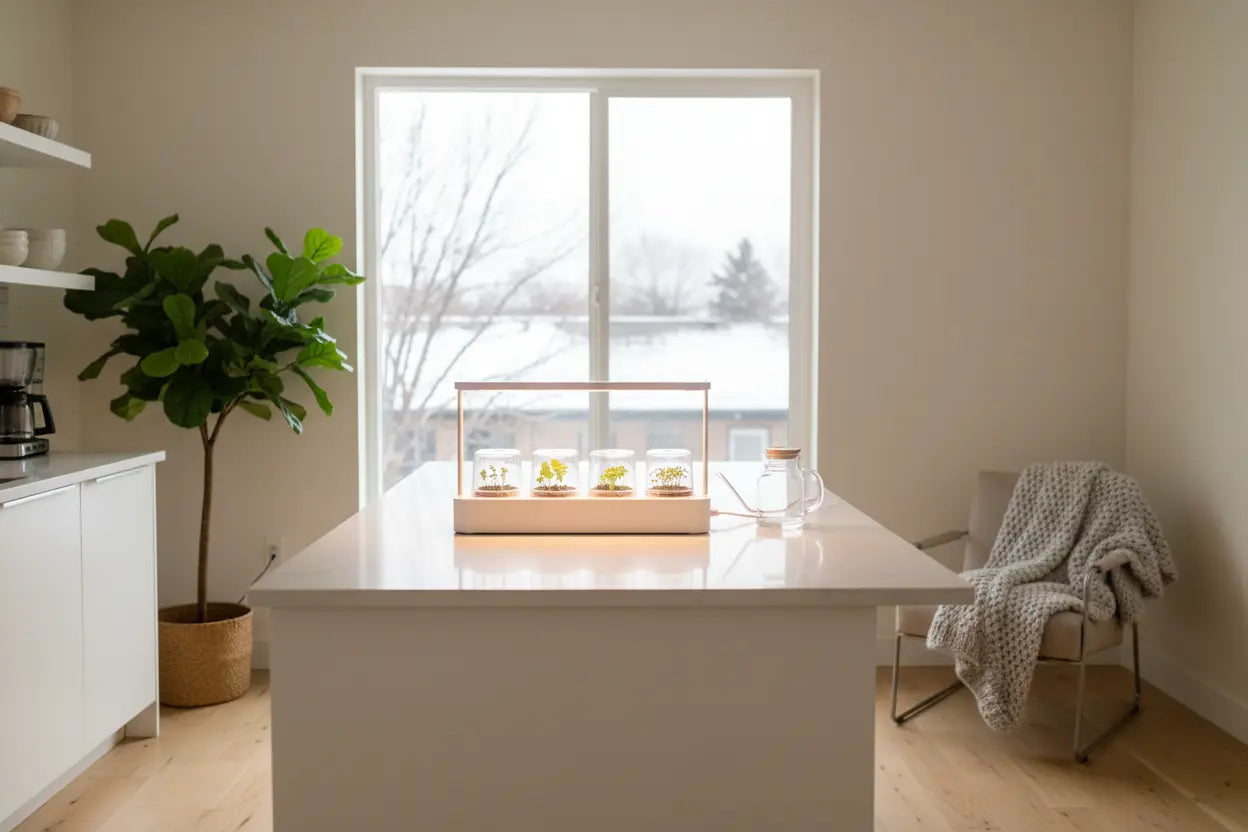
A Fresh Start That Feels Harder Than It Should
Every January, the same intention resurfaces: this year, I want to grow some of my own food. In 2026, that intention is stronger than ever—driven by rising grocery costs, quality concerns, and a growing interest in self-sufficiency.

And yet, for many beginners, starting an indoor garden in 2026 feels confusing almost immediately.
You read guides, watch videos, and follow instructions.
Still, something feels off.
In short: starting an indoor garden feels harder than expected not because you're doing it wrong—but because indoor growing has tighter margins than most advice admits.
Why Indoor Gardening Feels Different
(and Often Frustrating)
This confusion shows up much faster indoors, where light, airflow, and watering margins are tighter. That's why beginners often think they're failing—even when they're following advice correctly.
Outdoors, nature absorbs mistakes. Indoors, it doesn't.
When you try to grow food indoors:
- Light is fixed, not dynamic
- Airflow is limited
- Containers behave differently than ground soil
- Small mistakes compound quickly
Advice that works “in general” can fail quietly indoors.
This is the first mental shift many new indoor gardeners in 2026 haven't made yet: indoor growing isn't harder, but it is less forgiving.
How to Think About Growing Food Indoors in 2026
Most beginner advice focuses on what to do.
What’s missing is how to think about it.
Indoor gardening works best when you think in terms of constraints, not enthusiasm.
Instead of asking:
- “What can I grow?”
- “What does this plant need?”
Ask:
- “What stays consistent in my space?”
- “How often do I realistically want to interact with this?”
Indoor food growing succeeds when:
- Light is predictable
- Water behaves the same way every time
- The routine fits into daily life
In 2026, the most successful beginners aren’t trying harder. They’re choosing approaches that reduce decision-making.

Common Beginner Mistakes
(That Aren’t Really Mistakes)
If you’ve tried to grow food indoors before and struggled, it usually falls into one of these patterns:
Trying to Do Too Much at Once
Multiple plant types, different containers, mixed advice—all at once. Indoors, complexity increases failure risk.
Relying on Window Light
Window light feels natural, but it’s inconsistent. Seasonal angle changes alone can derail growth.
Overwatering “Just in Case”
Indoor containers hold moisture longer. Overwatering is one of the fastest ways to cause problems.
Expecting Outdoor Behavior Indoors
Plants behave differently when airflow, evaporation, and soil depth change.
None of these mean you’re bad at growing plants. They mean the environment changed, but the expectations didn’t.

What a “Fresh Start” Actually Looks Like in 2026
A realistic fresh start for an indoor garden in 2026 doesn’t begin with equipment or plant lists. It begins with alignment.
A good reset looks like:
- Starting with fewer variables
- Choosing plants that grow fast and predictably
- Matching the setup to your space and schedule
- Accepting that indoor success comes from consistency, not optimization
This is why many people who struggled before succeed later—not because they learned more, but because they simplified.
If you’re restarting this year, the goal isn’t to master indoor gardening.
It’s to remove the reasons people usually quit.

When Indoor Growing Becomes a Bigger Issue
If confusion persists, it’s usually a sign that the question you’re asking has changed.
You may have started with:
- “Can I grow food indoors?”
But now you’re asking Why:
- "does this feel inconsistent?”
- “do results vary so much?”
- “does advice contradict itself?”
At this point, piecemeal tips stop helping. What’s needed is a clear mental model of how indoor food growing works over time.
That’s the moment to step back from tactics and look at the bigger system.
Mini FAQ (People Also Ask)
Is indoor gardening harder than outdoor gardening?
Not harder—but less forgiving of inconsistency.
Why do indoor plants fail even when I follow instructions?
Because indoor environments amplify small mismatches in light and water.
Is growing food indoors worth trying again in 2026?
Yes, especially if you approach it with simpler expectations and fewer variables.
Do I need to know what system to use right away?
No. Understanding how indoor growing works comes first.
Where to Go Next (Important)
If you’re serious about growing food indoors—and want to understand why some approaches work reliably while others don’t—the next step is building structured understanding.
👉 How to Grow Food Indoors Year-Round
https://aquagertech.com/pages/how-to-grow-food-indoors-year-round
That page explains:
- How indoor growing systems behave over time
- Why consistency matters more than effort
- What actually determines success indoors
This article isn’t about making a decision.
It’s about making sense of the problem you’re experiencing.
Author: Aquager Team · Published: February 10, 2026 · Updated: August 1, 2026 · Reviewed: August 1, 2026 (Phase 2)











0 comments