
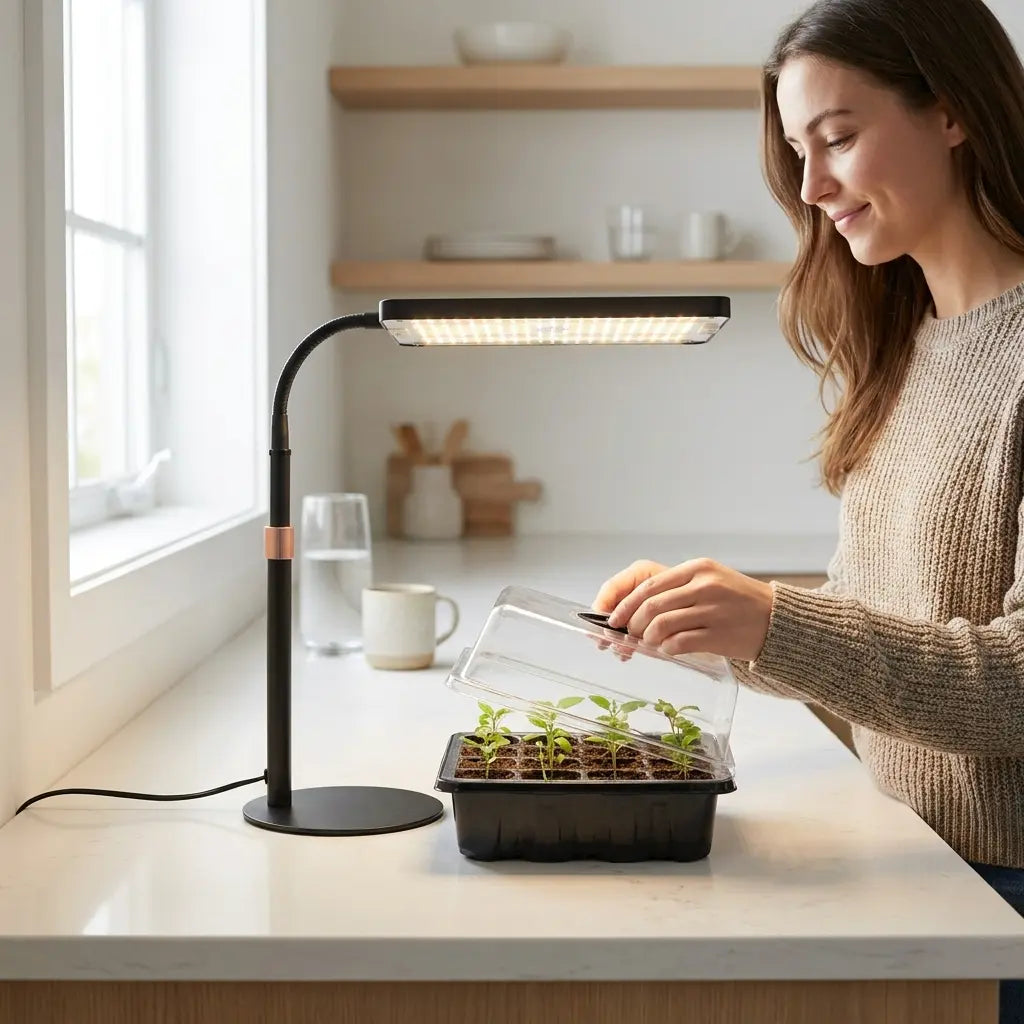
Most seeds don't fail because they're bad. They fail because of a few simple mistakes that almost everyone makes without realizing it.
You plant them, water them, wait — and nothing happens. Or they sprout, then suddenly stop growing, stretch, or die within days.
The truth is, indoor seed starting is very predictable once you know what actually matters. Here are the 5 mistakes that quietly kill seeds before they ever have a chance — and exactly how to fix them.
Want to avoid most of these mistakes from the start?
The Indoor Seed Starter Kit (2-Pack) creates a balanced environment right out of the box — breathable medium, humidity dome, and consistent cell depth included.
→ Shop the Indoor Seed Starter Kit — $17.99Mistake 1: Using the Wrong Growing Medium
Most people assume any soil will work. It won't.
Seeds need two things at the same time: moisture and oxygen. Regular potting soil is too dense — it blocks airflow and traps seeds in wet conditions where they rot instead of sprout.
Garden soil is even worse. It forms a hard crust on the surface, so seeds may germinate underground but never push through.
What works is a light, breathable medium that stays evenly moist without compacting. That balance is what allows seeds to sprout quickly and grow into strong seedlings.
→ Shop the Indoor Seed Starter Kit — designed for consistent moisture and airflow from day one.
Mistake 2: Overwatering (or Letting Seeds Dry Out)
Both extremes kill seeds. And both can happen in the same tray at the same time.
Overwatering fills the air pockets seeds rely on for oxygen. Without oxygen, they rot below the surface — and it looks like nothing is happening.
Too much moisture also creates perfect conditions for mold. If you see a white fuzzy layer forming on the surface, the tray is too wet and lacking airflow.
Letting seeds dry out is just as bad. Unlike established plants, seeds don't recover from even one dry period during germination. A single gap can stop the whole tray.
What works: keep the medium consistently damp — not wet, not dry. A humidity dome reduces evaporation and maintains stable conditions automatically.
→ Shop the Indoor Seed Starter Kit — comes with a humidity dome to hold steady moisture levels.
Mistake 3: Not Using Enough Light
Seeds don't need light to germinate. But seedlings need strong light the moment they emerge — and most indoor spaces don't provide nearly enough.
A windowsill looks bright, but to a seedling it's often too dim. The result is leggy growth — tall, thin stems that can't support the plant and eventually bend or fall over.
By the time you notice stretched growth, it's already too late to fix it. Seedlings set their structure in the first few days. Strong light has to be there from the start.
What works: 10–14 hours of direct light per day from an LED grow light. Consistent, close, and reliable — not dependent on weather or season.

→ Shop the Indoor Seed Starter Kit — designed to work with grow lights for consistent, even coverage.
Mistake 4: Planting Seeds Too Deep (or Too Shallow)
Seeds contain a limited amount of stored energy. Plant them too deep and they run out of fuel before reaching the surface — they germinate underground but never emerge.
Plant them too shallow and they dry out before finishing the job. Seeds near the surface lose moisture faster than seeds properly seated in the medium.
Inconsistent depth across the tray makes it worse. When each cell is planted at a different level, seeds germinate at different rates — or some don't germinate at all.
What works: plant at a depth roughly equal to the size of the seed. Very small seeds go on or just below the surface. Consistent depth across all cells is what gives you even results.
→ Shop the Indoor Seed Starter Kit — 72-cell tray with uniform cell depth for consistent planting every time.
Mistake 5: Ignoring Temperature and Environment
Even when everything else is right, an unstable environment can still stop germination cold.
Seeds need warmth to activate. Temperatures that drop at night — especially near windows — slow germination significantly or stop it entirely. Most people don't notice the fluctuation, but seeds do.
Environments that run too warm cause the opposite problem: moisture evaporates too fast, and the medium cycles from damp to dry before seeds can finish sprouting.
Airflow matters too. Too little traps moisture and invites mold. Too much — like placing trays near a vent or fan — dries everything out too quickly.
What works: a stable, controlled micro-environment. Consistent warmth, balanced humidity, and gentle airflow from the start.
→ Shop the Indoor Seed Starter Kit — the dome creates a stable micro-climate that protects seeds from temperature swings and moisture loss.
Conclusion
Most indoor seed starting failures come down to the same five problems: wrong growing medium, inconsistent watering, insufficient light, incorrect planting depth, and an unstable environment.
Fix those five things and the process becomes predictable. Seeds sprout faster, seedlings grow stronger, and you stop guessing what went wrong.
The easiest way to eliminate most of these variables at once is a setup built for indoor growing.
→ Shop the Indoor Seed Starter Kit (2-Pack) — $17.99
FAQ
Why are my seeds not sprouting indoors?
Most seeds fail due to inconsistent moisture, poor airflow, or incorrect planting depth. Fixing these factors usually leads to quick improvement.
How often should I water seeds indoors?
Seeds should stay consistently moist, not soaked. The surface should remain slightly damp at all times without standing water.
Do seeds need light to germinate?
Most seeds do not need light to germinate, but they require strong light immediately after sprouting to grow properly.
Is a windowsill enough for seedlings?
Sometimes, but it's often not reliable. Light levels can be too low, leading to weak or stretched growth.
What is the easiest way to start seeds indoors?
Using a controlled setup — like the Indoor Seed Starter Kit — helps maintain stable conditions and makes the process much simpler for beginners.
Last Updated: May 9, 2026




0 comments