
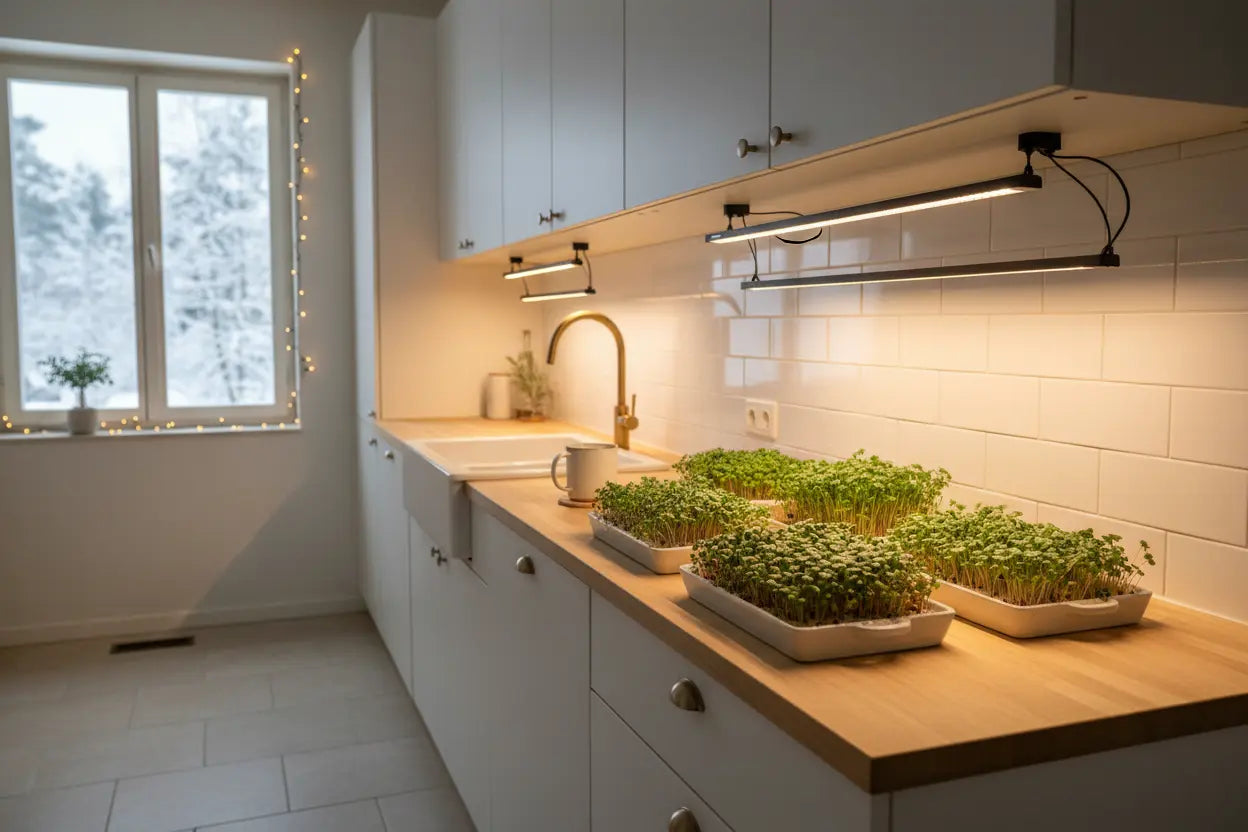
Winter has a way of making growth feel distant.
Outdoor gardens are frozen. Soil is dormant. Daylight feels short. Grocery produce feels repetitive and disconnected from freshness. Many people mentally postpone growing food until "real spring" arrives.
But here's the overlooked truth: you do not need spring to grow food. And you certainly don't need a yard.
You can grow microgreens indoors in winter, consistently and reliably, without outdoor soil, without raised beds, and without waiting for warmer weather.
In short, microgreens thrive in controlled indoor environments, and winter often provides more stability than outdoor seasons ever could.
Indoors, environmental variables are smaller, measurable, and adjustable, which means winter becomes a controlled growing season rather than a limitation.
If you've been waiting for spring to feel ready, you may be postponing progress unnecessarily.
Why Winter Is Actually Ideal for Indoor Microgreens
Most people associate gardening with soil, seasons, and sunshine. But microgreens don't follow traditional gardening rules.
They are harvested at the seedling stage, long before flowering, fruiting, or deep root expansion occurs. That changes their dependency on outdoor climate entirely.
Unlike mature vegetables, microgreens do NOT:
- require deep soil systems
- depend on seasonal soil warming
- need months of outdoor sunlight
- need pollination
That compressed timeline is the key. Short cycles reduce exposure to seasonal stress.
Winter also provides advantages that outdoor gardeners often don't consider:
- Indoor heating maintains steady temperature
- There is little to no pest pressure
- Outdoor pathogens are minimal
- You spend more time indoors monitoring progress
- Environmental shifts are gradual, not extreme
While outdoor soil rests, indoor growing can remain active, and predictable.
In many ways, winter makes indoor growing simpler. There are fewer external variables to account for. Your environment becomes a controlled system.

What "Growing Microgreens Indoors in Winter" Really Means
It does not mean recreating a greenhouse or simulating summer conditions.
It is designing a compact, repeatable system.
Microgreens require:
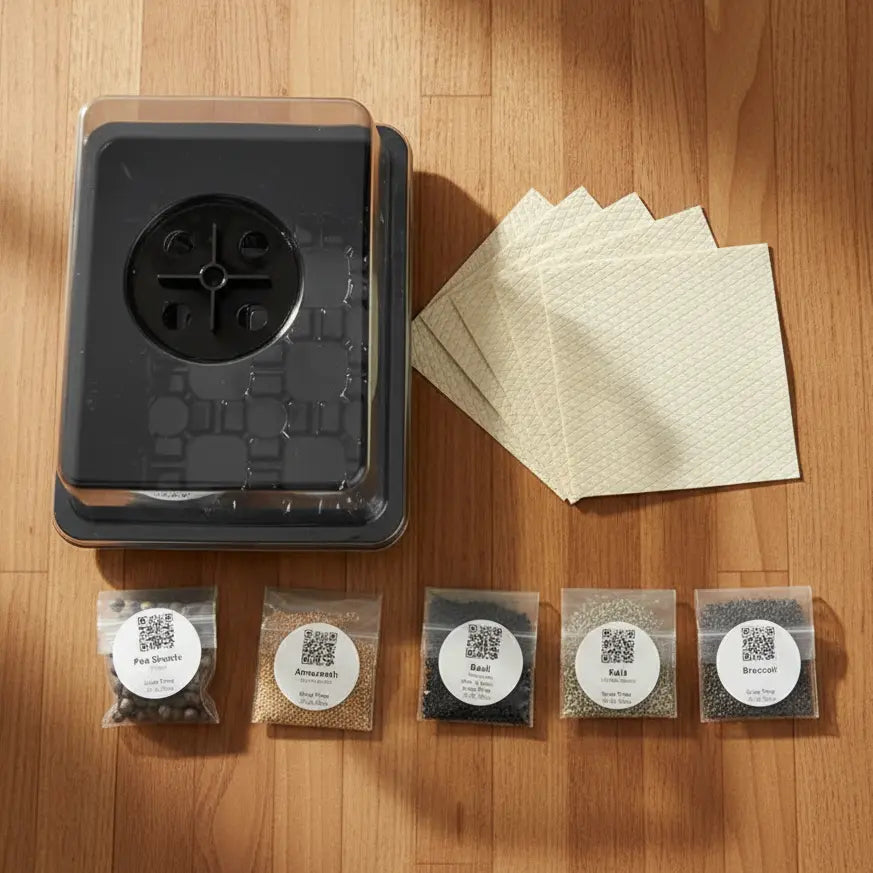
- A shallow tray
- A stable growing medium
- Even seed distribution
- Controlled moisture
- Consistent light
- Moderate airflow
Because they are harvested early, they never enter long-term stress phases. You are growing seedlings, not sustaining a plant for months.
This is important psychologically.
When you grow tomatoes indoors in winter, you fight seasonality. When you grow microgreens, you work within short biological cycles that remain stable regardless of outdoor climate.
That's why microgreens don't need spring. They need consistency.
Winter becomes irrelevant when your system is small, repeatable, and controlled.
Step 1: Start With One Tray, Not an Entire System
One of the most common beginner mistakes, especially in winter, is overcomplicating.
Motivation spikes. You order multiple seed varieties, set up shelves, try to create a full indoor garden in one weekend.
That complexity increases risk.
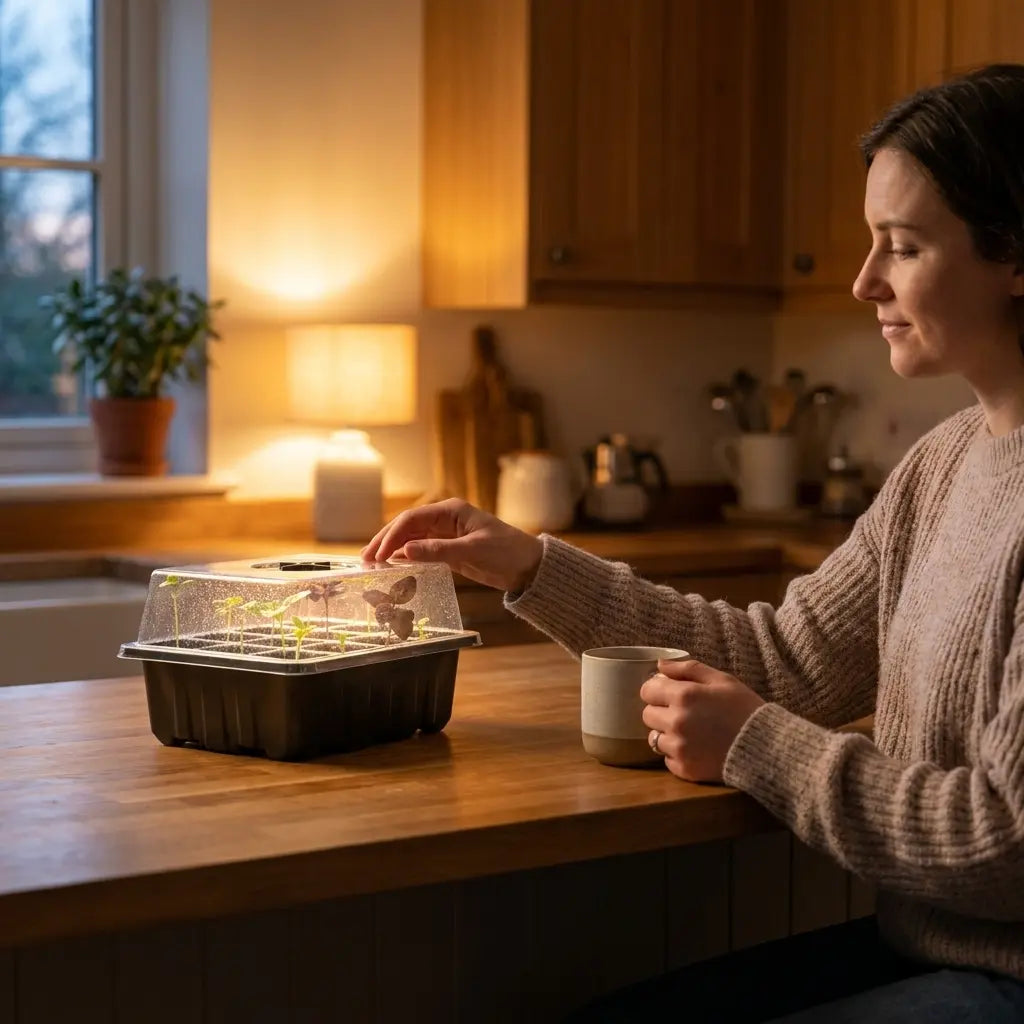
Instead, start with one shallow tray.
One tray allows you to:
- Learn moisture balance
- Observe germination speed
- Adjust light positioning
- Understand density control
- Harvest within 7–10 days
That single cycle teaches more than five simultaneous experiments.
Winter growing works best when you:
- keep systems compact
- repeat cycles
- refine gradually
Consistency beats ambition.
If you're entirely new to indoor microgreens, a structured overview can help you understand the fundamentals before scaling:
👉 Microgreens for Beginners: The Easiest Way to Grow Food Indoors
Step 2: Use Winter Stability to Your Advantage
Winter indoor environments are surprisingly predictable.
Heating systems keep temperatures in the 65–72°F range. Indoor humidity remains moderate. Daylight, while shorter, remains consistent.
Microgreens prefer moderate, stable temperatures.
Extreme summer heat often increases mold risk and accelerates drying unevenly. Winter reduces that instability.
However, winter air can be dry. That dryness increases evaporation at the surface level while shallow trays retain moisture below.
This is where moisture control becomes critical.
Water deeply enough to hydrate the medium. Avoid leaving standing water. Allow gentle airflow. Avoid daily shallow watering that saturates the top layer repeatedly.
Winter stability becomes an advantage when your system balances moisture and airflow correctly.
Consistency in winter builds skill that transfers to every other season.

Step 3: Choose Fast, Resilient Varieties for Winter
Not all seeds perform equally in indoor winter environments.
When growing microgreens indoors in winter, choose varieties that:
- Germinate quickly
- Develop strong stems
- Resist mold
- Form dense but breathable canopies
Examples include:
- Radish
- Broccoli
- Pea shoots
- Kale
These varieties compress your learning curve.
Speed reduces risk. If you harvest within 7 days, there is less time for imbalance to develop.
Pea shoots, for example, contain large seeds with significant stored energy. That energy supports aggressive early growth even under moderate light.
Radish develops thick stems that resist collapse.
Broccoli germinates uniformly.
Winter success often depends less on climate and more on biological resilience.

Why Waiting for Spring Delays Skill Development
Many beginners assume that spring light will solve indoor growing challenges.
But indoor light is always filtered through windows. Even in spring, it remains inconsistent.
When you grow microgreens indoors in winter, you learn HOW TO:
- position trays relative to light
- maintain moisture balance
- adjust airflow
- monitor density
Those skills don't require spring. They require repetition.
By the time spring arrives, you won't be experimenting. You'll already be harvesting consistently.
Waiting for better conditions doesn't accelerate learning. Practice does.
Short cycles give you rapid feedback. Rapid feedback builds mastery.
Common Winter Microgreens Mistakes (And Why They Happen)
Winter growing often fails due to misunderstanding moisture.
Because air feels dry, beginners overwater. But shallow trays trap moisture easily.
Another issue is lack of airflow. Closed indoor spaces allow humidity to sit near the surface.
Seed density also matters. Overcrowded seeds reduce oxygen flow and increase mold susceptibility.
Winter doesn't create these problems, it reveals them.
When trays are balanced, winter becomes one of the most stable indoor seasons.
In short, microgreens fail due to system imbalance, not cold weather.

The Psychological Advantage of Growing Before Spring
Winter can feel stagnant. Growth feels postponed.
Growing microgreens changes that dynamic.
You see visible sprouting within 48 hours, harvest within a week, and repeat the process quickly.
That rapid cycle builds momentum.
Instead of waiting for external seasons to shift, you create internal progress.
Microgreens compress the feedback loop between effort and reward.
That compression builds confidence.
When spring finally arrives, you aren't beginning. You are continuing.
When Winter Growing Reveals Structural Weakness
If microgreens consistently fail, winter exposes design flaws quickly.
Trays without drainage suffocate roots.
Oversaturated medium promotes mold.
Inconsistent light creates weak stems.
Poor airflow traps humidity.
Because cycles are short, weaknesses appear rapidly.
That is not discouraging, it is diagnostic.
Microgreens provide fast feedback. Fast feedback allows rapid correction.
If you want a clear, structured breakdown of indoor microgreens system design, start here:
👉 Microgreens for Beginners: The Easiest Way to Grow Food Indoors
In Short
You do not need: spring, soil beds, and outdoor warmth.
You can grow microgreens indoors in winter.
Start with one tray.
Choose resilient seeds.
Balance moisture.
Maintain light consistency.
Repeat short cycles.
By the time spring arrives, you won't be starting. You'll already be harvesting.
Mini FAQ
Can I grow microgreens indoors in winter without sunlight?
Yes. Consistent indoor lighting supports reliable growth.
How long do winter microgreens take to grow?
Most varieties are ready within 5–10 days.
Is mold more common in winter?
Only if moisture is excessive and airflow is restricted.
Do microgreens require warm conditions?
They prefer moderate indoor temperatures, which winter heating typically provides.
Winter is not a pause.
It is preparation.
And microgreens are one of the simplest, most controlled ways to grow fresh food indoors, before spring ever arrives.
Author: Aquager Team · Published: March 3, 2026 · Updated: August 2, 2026 · Reviewed: August 2, 2026 (Phase 2)








0 comments