
Too much seed and you get a mat of stems fighting each other for light, with mold moving in before the true leaves show up. Too little and you get a sparse, patchy tray that barely covers a salad. Seeding density is the one variable most beginners guess at, and it is the one that matters most.
The good news is that microgreens seeding is really a math problem, not a feel problem. Once you know how much a given variety needs per square inch of tray, you can scale that number up or down for any container you own. There is no trial and error required once you have the baseline number for a variety.
This guide gives you the exact ounce ranges by variety, organized into simple seed size categories, plus the formula to convert those numbers to whatever tray you are actually using.
Why Seeding Density Matters (and How to Measure It Right)
Sow too heavy and seeds compete for space before they even germinate. Crowded stems stay wet longer after watering, since there is nowhere for air to move between them, and that moisture is exactly what mold needs to take hold.
Sow too light and you waste half a tray's worth of growing medium and light on a crop that will never fill in. A thin, uneven tray also harvests messier, since there is more growing medium exposed between plants for your scissors to catch.
Eyeballing a sprinkle of seed across a tray feels intuitive, but it is the least consistent way to hit the right density. A tablespoon of tiny basil seed and a tablespoon of large sunflower seed cover wildly different amounts of surface area, since volume and weight do not scale together across seed types.
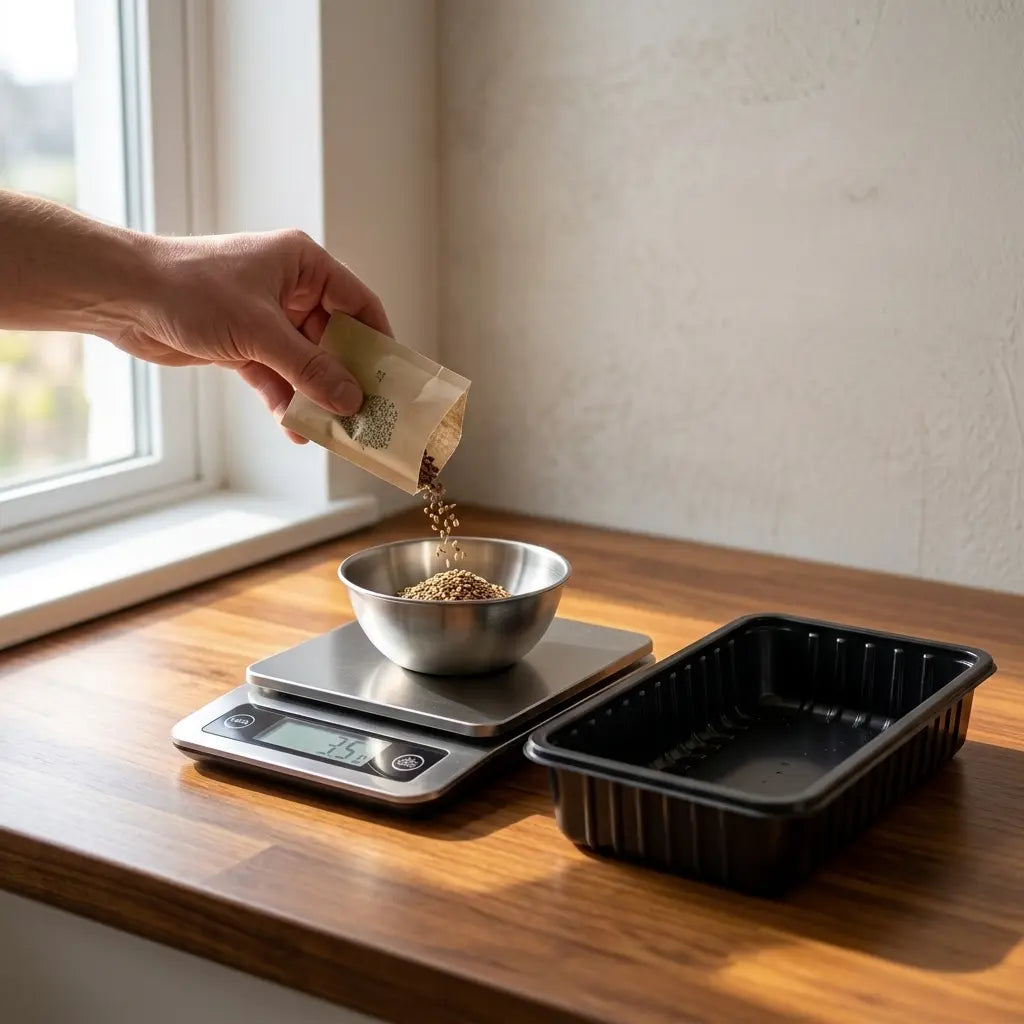
Weighing seed on a small kitchen scale removes the guesswork entirely. Once you know the target ounces for a variety and a tray size, you are measuring against a number instead of a feeling, and that is what makes a crop repeatable from one grow to the next.
A tablespoon works fine once you already know roughly how a variety fills a tray, but it is a poor starting point. Seed catalogs and grow guides that give volume measurements like "two tablespoons" are really giving you an average for one specific seed, and that average breaks down the moment you swap varieties.
You do not need a lab-grade scale for this. Most kitchen scales that read down to a gram or a hundredth of an ounce are precise enough for every variety in the chart below, including the lightest ones like amaranth and basil. Set the empty tray on the scale, zero it out, then add seed until you hit the target weight.
Common Seeding Mistakes to Avoid
The most common mistake is reusing the same scoop or spoon across different varieties without adjusting for seed size. A level tablespoon of amaranth weighs almost nothing compared to a level tablespoon of sunflower, so a measuring habit that works for one variety will badly overseed or underseed the next.
The second common mistake is judging density by how the tray looks right after sowing, before the seed has swelled or germinated. Dry seed looks sparser than it actually is, which tempts growers to add extra "just in case," and that extra is usually what causes overcrowding a few days later. If this is your first tray, our guide on growing your first microgreens tray in 7 days covers the basics this article builds on, including light, water, and harvest timing.
The Microgreens Seed Density Chart: Ounces Per Tray by Variety
Seed size is the biggest factor in how much you need, more than the specific variety itself. Small, light seeds cover a tray with very little weight. Large, heavy seeds need far more weight to reach the same coverage. All the ranges below are based on a standard 10x20 inch tray, which gives you 200 square inches of growing surface, the same footprint as the Aquager Microgreens Tray.
| Variety | Seed Size Category | Ounces per 10x20 Tray |
|---|---|---|
| Amaranth (Garnet Red) | Small | 0.2 to 0.3 oz |
| Basil (Genovese, Red Rubin, Bicolor, Lemon) | Small | 0.3 to 0.4 oz |
| Kale (Kalefetti Mix) | Small | 0.4 to 0.5 oz |
| Mustard | Small | 0.4 to 0.5 oz |
| Arugula | Small | 0.4 to 0.5 oz |
| Broccoli | Small | 0.4 to 0.5 oz |
| Kohlrabi Purple | Small | 0.4 to 0.5 oz |
| Dill | Small | 0.4 to 0.6 oz |
| Clover | Small | 0.5 to 0.6 oz |
| Radish (Confetti Mix) | Medium | 1.0 to 1.5 oz |
| Borage | Medium | 1.0 to 1.5 oz |
| Cilantro (Monogerm) | Medium | 1.5 to 2.0 oz |
| Wheatgrass (Cat Grass) | Large | 3.0 to 4.0 oz |
| Sunflower (Black Oil) | Large | 4.0 to 6.0 oz |
| Pea Shoots (Field) | Large | 6.0 to 8.0 oz |
These are typical ranges used by home and small-scale growers, not exact figures tied to a single seed lot. Seed age, humidity, and how thick you personally like your stand all shift the number slightly, so treat the low end as a starting point if you are trying a variety for the first time.
The 10x20 inch tray is the baseline here because it is the standard size used across the microgreens industry, from home growers to small commercial operations. Using one consistent baseline also means you only need to learn one number per variety, then apply the same formula below no matter what size you actually grow in.
Germination speed varies by variety too, independent of how much seed you use. Radish and broccoli tend to show first growth within 2 to 3 days, while cilantro and borage can take closer to a week, so do not judge whether you seeded correctly until each variety has had its typical germination window to catch up.
Small Seed Varieties: Basil, Brassicas, and Amaranth
Most of Aquager's catalog falls into this category. Basil, the brassica family (broccoli, kale, mustard, arugula, kohlrabi), dill, clover, and amaranth are all light enough that a fraction of an ounce covers a full 10x20 tray. Amaranth is the extreme case here. Its seed is so fine that even 0.2 ounces spreads further than you would expect.
Because these seeds are so light, a small weight still means an enormous seed count. A quarter ounce of basil seed can be tens of thousands of individual seeds, which is why the weight-based approach works so much better than trying to count or eyeball coverage across this category.
Medium Seed Varieties: Radish, Cilantro, and Borage
Radish, cilantro, and borage sit in the middle. Their seeds are noticeably larger and heavier than the brassica family, so they need two to four times the weight of a small-seed variety to reach the same coverage. Cilantro in particular runs on the heavier end of this range, since coriander seed is round and dense.
Unlike the large-seed category below, these varieties do not require soaking, though a short 4 to 6 hour soak can shave roughly a day off germination for radish and cilantro if you are in a hurry. Borage tends to germinate reliably either way.
Large Seed Varieties: Sunflower, Pea Shoots, and Wheatgrass
Sunflower, pea shoots, and wheatgrass need several ounces per tray, largely because these seeds are commonly soaked for 8 to 12 hours before sowing, which adds weight and helps trigger faster, more even germination. Pea shoots sit at the top of the entire chart since the seed itself is the largest of any variety Aquager carries.
Black oil sunflower seed still has its hull attached, which adds bulk to the weight without adding much edible material underneath. Some growers rub the loosened hulls off the tray surface a day or two after germination for a cleaner-looking harvest, though it is entirely optional and does not affect flavor.
The Seeding Calculator Formula: Any Tray Size, Any Variety
Every number in the chart above is based on a 10x20 inch tray, which works out to 200 square inches of growing surface. If your container is a different size, you can scale any of those figures with one formula.
Seed needed (oz) = (Your tray's square inches ÷ 200) × Chart amount (oz)
Start by multiplying your tray's length and width in inches to get its square inches. Divide that number by 200 to get your scaling ratio, then multiply the chart's baseline amount for your variety by that ratio.
Example 1: A 5x5 inch mini tray of basil. 5 times 5 equals 25 square inches. Divide by 200 for a ratio of 0.125. Basil's baseline is 0.35 oz, so 0.35 times 0.125 comes to about 0.04 oz, roughly a heavy pinch.
Example 2: A 10x10 inch half tray of radish. 10 times 10 equals 100 square inches. Divide by 200 for a ratio of 0.5. Radish's baseline is 1.25 oz, so 1.25 times 0.5 comes to about 0.6 oz.
Example 3: A 20x20 inch double tray of sunflower. 20 times 20 equals 400 square inches. Divide by 200 for a ratio of 2. Sunflower's baseline is 5 oz, so 5 times 2 comes to 10 oz for the full tray.
This works because seeding density is fundamentally a rate, ounces per square inch, not a fixed amount tied to one specific tray. Scaling by area keeps that rate constant no matter what container you are using, which is the same principle commercial growers use when sizing a recipe up from a trial tray to a full production run.
When the math lands on an awkward number, round up slightly rather than down. A little extra seed costs a few cents. Too little seed leaves bald patches you cannot fix once a tray is already growing, since you cannot easily add more seed to an established mat without disturbing the roots underneath.

The same formula works in reverse if you already know how much seed you have and want to know what size tray it will cover. Divide your seed weight by the chart's baseline, then multiply that ratio by 200 to get the square inches your seed will fill.
As a quick sanity check, compare your result against the chart's original 10x20 number before you commit to it. If your calculated amount for a smaller tray comes out heavier than the full 10x20 baseline, you have likely mixed up a measurement somewhere, since a smaller tray should always need less seed, not more.
The Easiest Way to Get Seeding Right Every Time
The formula above only works cleanly if your actual tray matches the baseline the chart is built on. That is where a lot of home growers lose accuracy without realizing it, since repurposed containers rarely land on a clean 200 square inches, and estimating an odd-shaped container's area introduces its own margin for error before you have even weighed a single seed.
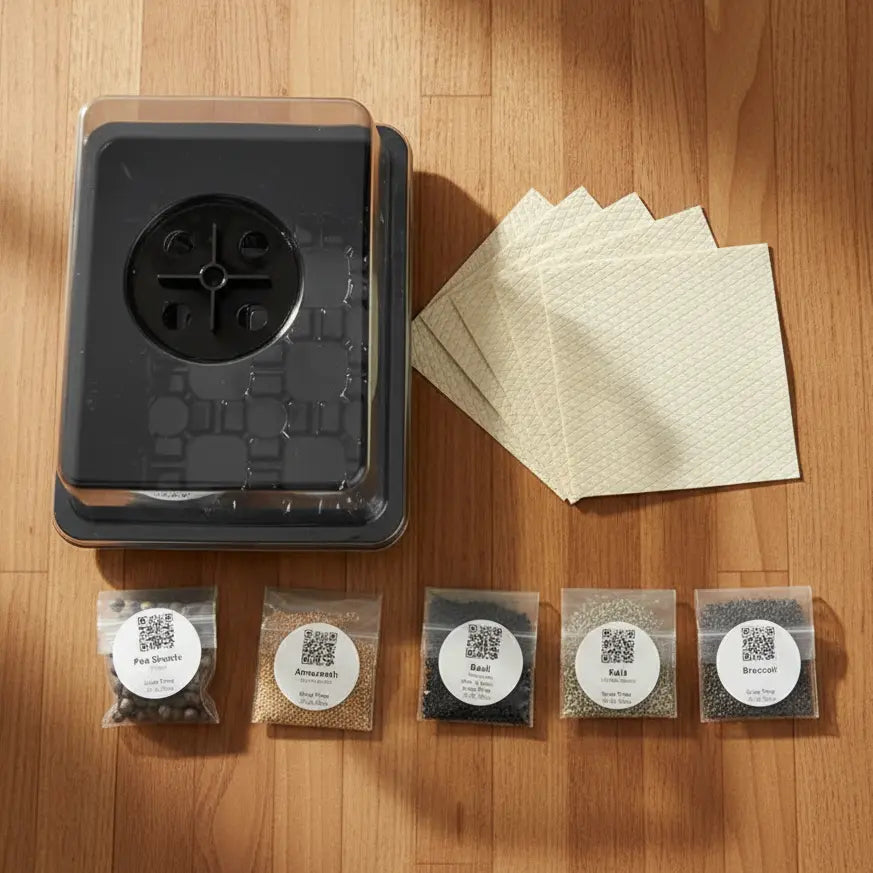
The Aquager Microgreens Starter Kit comes with trays sized to the same 10x20 inch footprint every ounce figure in this guide is based on. That means you can use the chart numbers directly, with no square-inch math required, and get a consistent result on your very first grow.
Pairing the tray with a small digital kitchen scale is the other half of the equation. Even an inexpensive scale accurate to a gram is enough to hit these targets reliably, and it is the single upgrade that does the most to fix inconsistent microgreens crops.
Once a tray is seeded correctly, the rest of the grow mostly takes care of itself. Our guide to harvesting microgreens without wasting your crop picks up right where this one leaves off, covering the cutting technique that gets the most usable microgreens out of an evenly seeded tray.
FAQ: Quick Answers on Microgreens Seeding Density
What happens if I use too much seed?
Overcrowded stems compete for light and airflow, which slows growth and raises the risk of mold during the humid blackout period. You will also get a denser mat that is harder to cut cleanly at harvest, and stems near the center often come out pale from fighting for light.
What happens if I use too little seed?
The tray fills in patchy and thin, with gaps of bare growing medium between plants. You will get less usable harvest per tray and a less even look, since some areas mature faster than others and the exposed growing medium can crust over between waterings.
Do I need a scale to measure seed accurately?
A scale makes it far more consistent, especially for small-seed varieties like basil or amaranth where a teaspoon can be off by a wide margin. Measuring cups work in a pinch for larger seeds like sunflower or pea shoots, where the volume-to-weight ratio is more forgiving, but a scale is worth the small investment if you grow regularly.
Should I use the same seed density for every variety?
No. Seed size drives density more than anything else, which is why the chart above is organized by size category rather than a single blanket number. Using a large-seed amount on a small-seed variety would massively overcrowd the tray, and the reverse would leave it far too sparse.
Does soaking seed change how much I need?
Soaking adds water weight, so soaked seed weighs more than dry seed by volume. The ranges above already account for this for sunflower, pea shoots, and wheatgrass, since those varieties are typically soaked before sowing rather than sown dry like the rest of the chart.
Conclusion: Consistent Seeding Makes Consistent Crops
Most of what looks like bad luck with microgreens, patchy trays, mold, or a harvest that barely fills a bowl, traces back to how much seed went down in the first place. Get the density right and nearly everything downstream gets easier.
Keep the chart above as your reference point, and use the formula whenever you are working with a tray that is not the standard 10x20 size. Once you have run the numbers on your first tray, most growers find they do not need the calculator again for that variety, since the weight becomes second nature after a grow or two.
If you are still deciding which variety to grow first, our breakdown of the fastest-growing microgreens pairs well with this chart, since harvest speed and seeding density are the two numbers most worth knowing before you start a new tray.
If you want a beginner-friendly place to put this chart to use, the Radish Confetti Mix is one of the most forgiving varieties to start with. It sits in the middle of the seeding range, germinates fast, and gives you a clear, visible result within days of getting the density right.

Author: Aquager · Published: July 18, 2026 · Updated: July 18, 2026












0 comments