
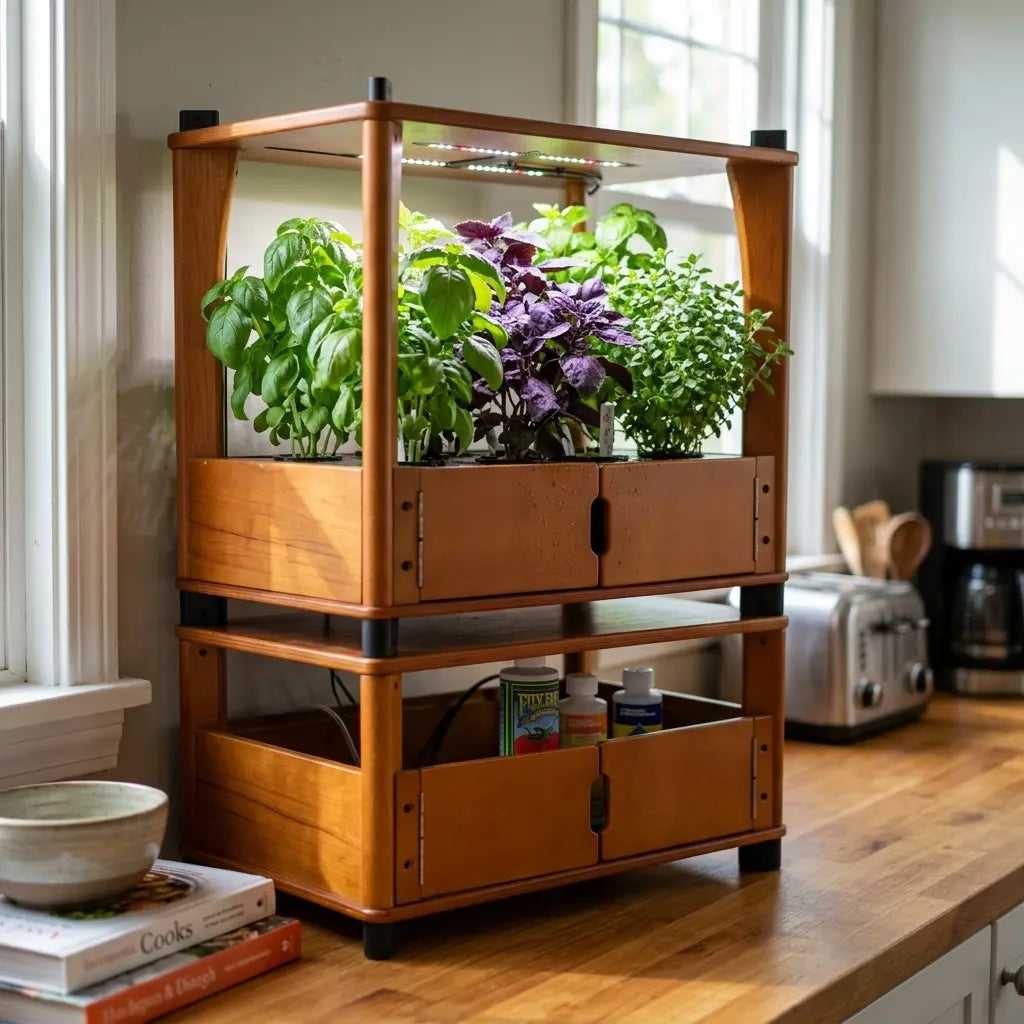
Basil is not one plant. It is a whole family of basil varieties with real differences in flavor, leaf color, and how forgiving each one is to grow, and picking the wrong one first is a common reason new growers give up on the herb entirely.
Aquager currently offers seven basil varieties, each pre-seeded and ready to grow: Genovese Aroma 2, Red Rubin, Sweet Thai, Holy Tulsi (Kapoor), Lime, Aromatto, and Aya Prospera. Every one of them will grow indoors, but they are not interchangeable in the kitchen.
Most people encounter this decision the same way: they search for "basil seeds," see a handful of unfamiliar variety names, and default to whichever one appears first without understanding what actually separates them. That default is not necessarily wrong, but it is often accidental rather than informed.
This guide compares all seven on flavor, culinary use, and difficulty, then ends with a straightforward recommendation for whichever one to grow first.
None of the seven require different equipment or a fundamentally different growing approach. The differences that matter are in the kitchen, not in the tray, which is why this comparison focuses mostly on flavor and use rather than growing mechanics that are covered elsewhere.
How to Think About Choosing a Basil Variety
Flavor is the most obvious difference between basil varieties, ranging from the familiar sweet Italian profile most people already know to sharper anise, citrus, and clove notes that show up in less common types.
Culinary use matters just as much as flavor. A variety built for Italian cooking will underperform in a Thai curry, and a variety built for tea or ceremonial use is not the right pick for a caprese salad.
Difficulty varies less dramatically than flavor does, since all seven grow well in the same hydroponic conditions. Still, some varieties are more forgiving of inconsistent watering or light than others, which matters more for a first attempt than for an experienced grower.
Keeping these three factors in mind, rather than picking based on name alone, is the difference between a first basil plant that gets used every week and one that sits mostly untouched until it bolts.
It also helps to think honestly about how often you actually cook with basil already. Someone who makes pesto every couple of weeks has very different needs than someone buying their first basil plant mostly out of curiosity, and the right variety differs accordingly.
One more factor worth naming directly: basil is one of the faster herbs to bolt, meaning it sends up a flower stalk and turns bitter once it matures past its peak. All seven varieties covered here share this trait to some degree, so regular harvesting matters regardless of which one you choose.
The 7 Aquager Basil Varieties, Compared
Genovese Aroma 2
The Aquager Basil (Genovese Aroma 2) Seeds are the classic sweet Italian basil most people picture when they think of the herb, with large, tender leaves and a strong, sweet aroma.
It is the default choice for pesto, caprese salad, and most Italian and Mediterranean cooking, and it is also one of the more forgiving varieties for a first time grower. If you only grow one basil, this is the safest starting point.
Difficulty wise, Genovese tolerates minor inconsistencies in watering and light better than some of the more delicate varieties on this list, which is part of why it remains the standard recommendation for anyone new to growing basil indoors. It also responds well to regular harvesting, producing new growth quickly after leaves are picked.
Red Rubin
The Aquager Basil (Red Rubin) Seeds produce deep purple, almost burgundy leaves with a flavor close to Genovese but slightly more peppery.
Red Rubin is a strong pick for anyone who wants a basil that also functions as a garnish, since the color contrast against green herbs or a light colored dish adds visual interest that green basil cannot provide on its own. It works in the same dishes as Genovese, with a slightly bolder bite.
Growing difficulty is comparable to Genovese, though the darker leaf pigment can make early nutrient deficiencies slightly harder to spot visually. It is still a reasonable choice for a second variety rather than a first, once you already have a feel for how basil responds to your setup.
Sweet Thai
The Aquager Basil (Sweet Thai) Seeds bring a distinct anise and licorice note that Italian basil simply does not have, making it the right choice for Thai curries, stir fries, and Vietnamese noodle dishes.
Using Sweet Thai in place of Genovese in an Italian recipe, or the reverse, produces a noticeably different result, since the anise flavor changes the character of a dish rather than just adding a milder version of the same taste.
It grows with a similar level of ease to Genovese, tolerating typical indoor conditions well. The main consideration is less about growing difficulty and more about whether the anise forward flavor actually fits how you cook, since it is a poor substitute in recipes built specifically around a sweet Italian profile.
Holy Tulsi (Kapoor)
The Aquager Basil (Holy Tulsi, Kapoor) Seeds grow a variety used traditionally in Ayurvedic practice and Indian cooking, with a peppery, slightly clove-like flavor that is distinct from every other variety on this list.
Tulsi is most commonly brewed as a tea rather than used as a cooking herb, though it also appears in some Indian dishes. It is a reasonable pick for someone specifically interested in herbal tea rather than culinary basil in the traditional sense.
Holy Tulsi grows a bit more slowly than Genovese and benefits from slightly warmer conditions, making it a marginally less forgiving choice for a complete beginner. It is still manageable in a typical indoor hydroponic setup, just worth going in with the expectation that it is not identical to growing a standard culinary basil.
Lime
The Aquager Basil (Lime) Seeds carry a bright citrus note that works well in fish dishes, cocktails, and fruit forward salads where a standard Italian basil would feel out of place.
It is a narrower use case than Genovese or Thai basil, better suited to someone who already has a specific citrus forward dish in mind rather than a general all purpose herb.
Growing difficulty is on par with Genovese, with no special requirements beyond standard care. The consideration here is entirely about fit with your cooking rather than ease of growing, since Lime basil is straightforward to raise but limited in how many recipes actually call for it.
Aromatto
The Aquager Basil (Aromatto) Seeds produce one of the darkest, most intensely colored purple leaves of any variety Aquager carries, paired with a bold, slightly spicy flavor.
Aromatto works well anywhere a strong visual statement matters as much as flavor, from a garnish on a plated dish to an infused vinegar or oil where the deep color carries through. It is a less common choice than Genovese or Red Rubin, which is exactly what makes it a good pick for someone who already has one or two basil plants and wants something visually distinct rather than another variation on a familiar flavor.
Like Red Rubin, its dark pigment can make early signs of stress a little harder to spot at a glance, so it rewards a grower who is already comfortable checking a plant closely rather than relying purely on visual cues from a distance.
Aya Prospera
The Aquager Basil (Aya Prospera) Seeds are bred for vigorous, high volume growth, producing more usable leaf per plant than most of the other varieties on this list.
For anyone who goes through basil quickly, whether for a household that cooks Italian food often or someone who wants to make a large batch of pesto to freeze, Aya Prospera is the variety built for volume rather than a specific flavor niche.
Its vigorous growth also makes it relatively forgiving for beginners, since a plant that produces more leaf overall has a bit more cushion if a harvest is slightly heavier or a watering cycle is slightly off. The tradeoff is a flavor profile closer to standard basil than a distinctive one.

Do These Varieties Need Different Growing Conditions?
Mostly no. All seven varieties grow well in the same standard indoor hydroponic setup, with consistent light, water, and nutrients doing most of the work regardless of which basil is in the tray.
The small differences that do exist are worth knowing rather than treating as a reason to avoid a variety. Holy Tulsi prefers slightly warmer conditions and grows a touch more slowly than the others, which matters more for patience than for actual difficulty.
The dark leafed varieties, Red Rubin and Aromatto, can make early signs of nutrient stress a little harder to catch visually, simply because yellowing or spotting shows up less obviously against purple or near black foliage. This is a minor consideration rather than a real growing obstacle, and it mostly means checking the plant a bit more closely rather than relying on leaf color alone.
Light consistency matters across every variety on this list more than any other single factor. A setup that provides steady light for six to eight hours a day will grow any of the seven successfully, while inconsistent light is the most common reason a first basil plant underperforms, regardless of which variety was chosen.
Which Basil Should You Grow First?
For most people, Genovese Aroma 2 is the right starting point. It is the most versatile in the kitchen, the most forgiving to grow, and the variety every other basil recipe assumes you are using unless stated otherwise.
If a specific dish is the whole reason you want basil, let that dish guide the choice instead. Sweet Thai for anything Southeast Asian, Lime for fish and cocktails, or Aromatto if you want a variety that doubles as a garnish.
Aya Prospera is worth considering as a second variety once you know you go through basil quickly, rather than as a first plant, since its main advantage is volume rather than a distinct flavor profile beginners are usually looking for.
Red Rubin and Aromatto are both reasonable third or fourth additions once you have a couple of plants established, mainly for the visual variety and slightly bolder flavor they add rather than as a replacement for a more versatile everyday basil.
Holy Tulsi sits apart from the rest of this list and is worth a separate mention. If your interest in basil is really an interest in tea or a specific cultural or ceremonial use, it is worth growing regardless of where it ranks on general versatility, since it is solving a different problem than the other six varieties.
Basil Varieties FAQ
What is the most versatile basil variety to grow?
Genovese Aroma 2 is the most versatile, working in the widest range of dishes and matching what most basil recipes assume by default.
Which basil variety is best for Thai or Asian cooking?
Sweet Thai, with its distinct anise and licorice notes, is built specifically for curries, stir fries, and Vietnamese dishes.
Is Red Rubin basil the same as regular basil with different color?
Mostly. Red Rubin has a flavor close to Genovese with a slightly more peppery edge, so it works in most of the same dishes with a visual difference.
Which basil variety produces the most leaves?
Aya Prospera is bred specifically for vigorous, high volume growth, producing more usable leaf per plant than the other varieties.
Can I grow more than one basil variety at the same time?
Yes. Different basil varieties grow well side by side in the same hydroponic conditions, so running two or three trays at once is a reasonable way to compare them directly.
What is Holy Tulsi basil typically used for?
Holy Tulsi is most often brewed as a tea in Ayurvedic tradition, rather than used as a cooking herb the way Italian or Thai basil are.
Is purple basil like Red Rubin or Aromatto harder to grow than green basil?
Not fundamentally. The main difference is that dark pigmented leaves can make early nutrient deficiencies slightly harder to spot visually, but growing requirements are otherwise similar to green varieties.
Which basil variety is best for making pesto?
Genovese Aroma 2 is the traditional choice, though Aya Prospera works well if you want enough volume to make a large batch to freeze.
Do all basil varieties bolt at the same rate?
Roughly, yes. All basil bolts once it matures past its peak or experiences temperature stress, though regular harvesting slows this down across every variety on this list.
Finding Your Basil
Seven basil varieties is more choice than most people expect from a single herb, but the decision does not need to be complicated. Match the variety to how you actually plan to use it, and the rest tends to sort itself out.

Genovese Aroma 2 remains the safest first choice for the overwhelming majority of home cooks, since it is forgiving to grow and works in more dishes than any other variety on this list.
For anyone who already knows their cooking leans toward a specific cuisine, starting with the variety built for it, Sweet Thai for Southeast Asian dishes or Lime for fish and cocktails, will likely get more actual use than a default choice that does not match how you cook day to day.
There is also no rule against starting with two varieties at once rather than committing to a single plant. Running Genovese alongside Sweet Thai, for example, covers both a familiar everyday use case and a more distinctive one, giving a clearer sense of how the varieties actually differ before deciding what to grow next.
Once you have a first basil plant established, our guides on how to grow basil indoors, how much basil one plant actually produces, and making fresh pesto at home are the natural next steps.
Author: Aquager · Published: July 5, 2026 · Updated: July 5, 2026














0 comments