
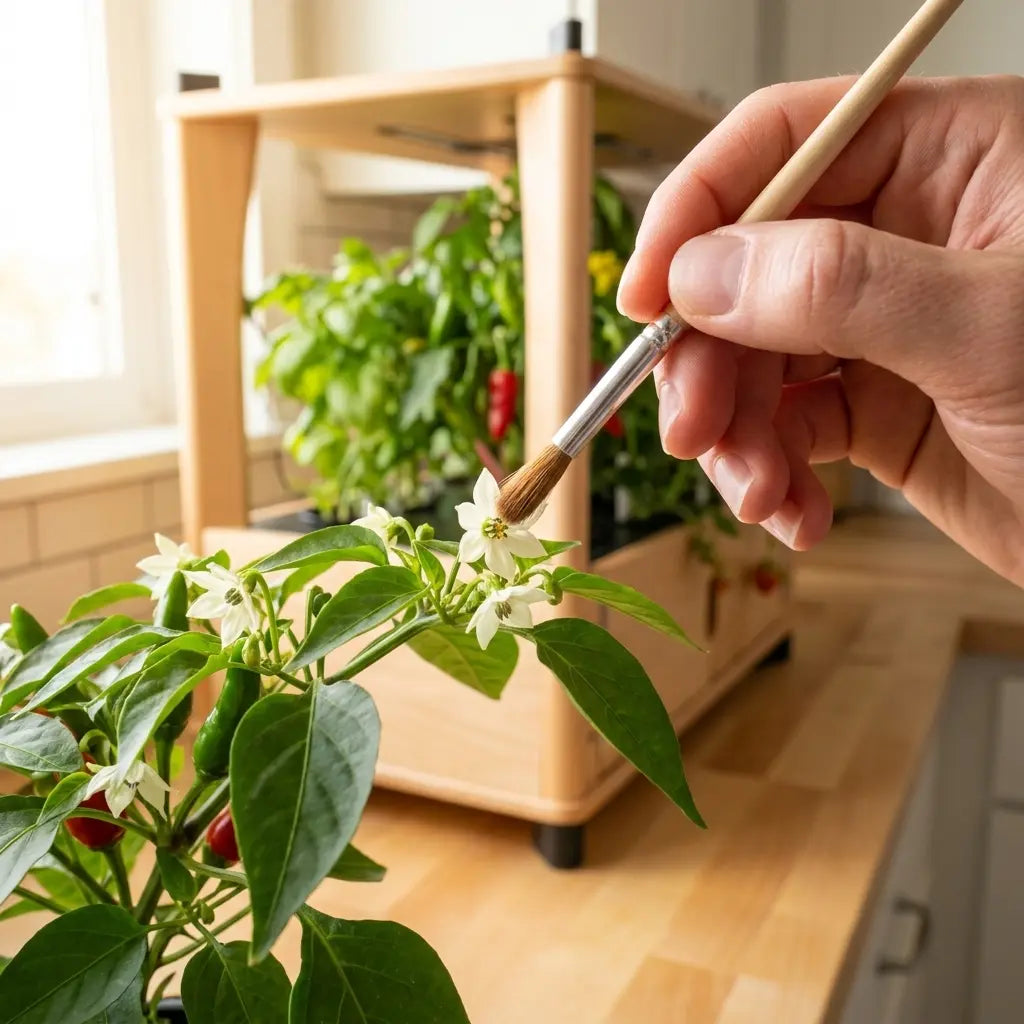
An indoor pepper plant can look perfectly healthy, covered in flowers, and still produce nothing. That's not bad luck. It's usually a missing pollinator.
Pepper flowers rely on wind and bees to move pollen and set fruit outdoors. Indoors, neither of those exist, so flowers open, sit unpollinated, and eventually drop off the plant without ever becoming a pepper. Hand pollination is the single most important technique for anyone growing peppers indoors, full stop.
This guide covers why indoor pepper flowers need help in the first place, how to tell when they're ready, and a full step-by-step process for hand-pollinating them so flowers turn into fruit instead of falling to the counter.
Why Indoor Pepper Flowers Need Help
Pepper plants are self-fertile, meaning a single flower contains both the male and female parts needed to produce fruit. In theory, that should make pollination simple. In practice, the pollen still has to physically move from the flower's anthers to its stigma, and that movement doesn't just happen on its own.
Outdoors, wind does a lot of that work, shaking flowers just enough to dislodge pollen and let it settle where it needs to. Bees and other insects handle the rest, brushing against flowers as they forage and carrying pollen along with them.
An indoor growing space has neither. Still air and no pollinators mean pepper flowers can bloom perfectly, look completely healthy, and never get pollinated. When that happens, the plant treats the flower as a failed effort and drops it, redirecting energy elsewhere.
This is the single biggest reason new indoor pepper growers get plenty of flowers but few or no peppers. It's not a disease, a nutrient problem, or bad luck. It's simply a missing step that outdoor growing handles for free.
Bees pollinate many flowering vegetables through a specific motion called buzz pollination, vibrating their flight muscles against the flower at a frequency that shakes pollen loose more effectively than a simple touch. Peppers benefit from this same kind of vibration, which is part of why some of the more effective hand-pollination methods, like an electric toothbrush against the stem, work as well as they do.
Tomatoes, eggplants, and other nightshade relatives share this same self-fertile flower structure and the same indoor pollination gap. If you're growing any of these alongside peppers, the same hand-pollination routine applies across all of them.
How to Tell When Pepper Flowers Are Ready to Pollinate
A pepper flower is ready once it's fully open, with its petals spread flat rather than still folded or curled. At this stage, the small central structure, the stigma, is exposed and receptive, and the ring of anthers around it is releasing pollen.
Flowers typically stay in this receptive window for just a day or two, so timing matters. Checking your plants every day or two once flowering starts is enough to catch most flowers at the right stage.
A healthy, ready flower looks bright and firm rather than wilted or yellowing at the edges. If a flower already looks like it's starting to fade, pollination is less likely to succeed, though it's still worth trying since there's little downside.
Flowering timing also varies somewhat by variety. Smaller, thinner-walled peppers tend to flower earlier and more prolifically than larger, thick-walled bell peppers, which means a mixed pepper collection won't necessarily hit peak flowering all at the same time. Checking each plant individually rather than assuming they're all on the same schedule catches more flowers at the right moment.
How to Hand-Pollinate Pepper Flowers, Step by Step
Hand pollination is simple, quick, and doesn't require any special skill. Here's the full process.
Step 1: Choose the Right Tool
A small, soft-bristled Pollination Brush is the easiest and most reliable tool for the job. Its soft bristles pick up pollen without damaging the delicate flower structure, which matters more than it might seem since a bruised flower is less likely to set fruit even after successful pollination.
A cotton swab or even a small, clean paintbrush works in a pinch, but a dedicated pollination brush is inexpensive and built specifically for this task, which makes the whole process faster once you're doing it across several plants.
Step 2: Gently Swirl the Brush Inside Each Open Flower
Insert the brush tip into the center of an open flower and gently swirl it in a small circle for a second or two. This motion picks up pollen from the anthers and transfers it directly onto the stigma in the same movement.
There's no need to press hard or spend a long time on each flower. A light touch is not only sufficient, it's actually more effective, since aggressive handling can damage the flower's delicate parts.
Step 3: Move Between Flowers on the Same Plant
Since pepper flowers are self-fertile, you don't need to move pollen between different plants, though doing so doesn't hurt anything either. Simply repeat the swirling motion on each open flower you find, using the same brush without needing to clean it between flowers on the same plant.
Working through all your open flowers takes just a couple of minutes once you have a rhythm, even with several pepper plants going at once.
Step 4: Repeat Every One to Two Days During Flowering
Pepper plants don't flower all at once. New flowers keep opening over several weeks, so hand pollination isn't a one-time task. Checking your plants and pollinating any newly opened flowers every one to two days keeps up with the plant's natural flowering pace.
Missing a day here and there isn't a disaster since flowers stay receptive for a day or two, but a consistent routine produces noticeably more fruit than pollinating sporadically.
Step 5: Watch for Signs Pollination Was Successful
Within a few days of successful pollination, the base of the flower begins to swell slightly, the first visible sign that a tiny pepper is forming underneath the fading petals. The petals themselves will typically dry up and fall away on their own as the pepper develops.
An unpollinated flower, by contrast, dries up and drops entirely, taking the whole flower with it rather than leaving a swelling base behind. Learning to spot this difference makes it easy to tell within about a week whether a given pollination attempt worked.

Other Hand-Pollination Methods Worth Knowing
A brush isn't the only way to achieve artificial pollination, and it's worth knowing the alternatives in case you're pollinating without one on hand.
Gently shaking or tapping the plant's stems mimics the effect of wind, dislodging pollen so it can settle on nearby stigmas. This works reasonably well but is less precise than direct contact with a brush, so results tend to be less consistent.
An electric toothbrush, held against the stem just behind a flower for a second or two, creates a vibration similar to what bumblebees do during what's called buzz pollination. This method works particularly well for pepper flowers and is a favorite trick among experienced indoor growers.
Whichever method you choose, consistency matters more than the specific technique. A plant checked and pollinated every couple of days will out-produce one pollinated occasionally, regardless of which tool does the job.
A small fan set to low and pointed gently at flowering plants for a portion of the day can also help, simulating the light air movement that would naturally occur outdoors. This isn't a full substitute for direct hand pollination, but it adds a small amount of passive pollen movement between flowering sessions.
Common Pollination Problems and How to Fix Them
Even with regular hand pollination, a few issues can still crop up.
Flowers dropping despite pollination attempts is sometimes a temperature issue rather than a pollination one. Pepper flowers can abort even after successful pollination if temperatures swing too far outside their comfort range, generally above 85 or below 55 degrees Fahrenheit.
Flowers that never fully open are usually a sign of inconsistent watering or low humidity. Keeping moisture levels steady, rather than letting the plant dry out between waterings, tends to resolve this over the following flowering cycle.
Very few flowers appearing at all often points to a light issue. Peppers need strong, consistent light to flower well, and a plant getting inconsistent or insufficient light may barely flower regardless of how carefully you pollinate what does appear.
Fruit that starts forming but then drops before maturing is sometimes the plant self-thinning under stress, shedding some developing peppers to focus energy on others. This is more common when a plant is carrying a heavy fruit load and is generally not something to worry about.
Low humidity can also interfere with pollen viability, even when hand pollination is done correctly. Pollen grains can dry out and become less effective in very dry indoor air, particularly during winter months when heating systems pull moisture out of a room. A light misting near, not directly on, flowering plants can help in especially dry conditions.
Overly vigorous brushing is a less common but real issue. Pressing too hard or scrubbing at a flower rather than gently swirling can damage the delicate reproductive structures, ironically reducing your pollination success rate. A light touch consistently outperforms a heavy-handed one.
Why the Pollination Brush Makes the Difference
Without hand pollination, an indoor pepper plant can flower beautifully all season and still produce little to nothing, which is a frustrating and avoidable outcome. A two-minute daily habit with the right tool solves the entire problem.
The Pollination Brush is purpose-built for this exact job, small enough to handle delicate flowers precisely and durable enough to use across an entire growing season. It's a small, inexpensive tool that directly determines whether your pepper plants actually produce peppers.
This matters most for popular indoor varieties like Early Jalapeno Pepper Seeds, which flowers reliably indoors but depends entirely on hand pollination to convert those flowers into a harvest. For jalapeno-specific care beyond pollination, including germination timing and harvest windows, see our complete guide to growing jalapenos indoors. If peppers are part of a broader indoor kitchen garden, this salsa garden guide covers pairing peppers with other salsa staples.
Hand-Pollination FAQ
Why are my indoor pepper plant's flowers falling off?
This almost always means the flowers were never pollinated. Without wind or bees indoors, pepper flowers need to be hand-pollinated or they'll drop without producing fruit.
How often should I hand-pollinate pepper plants?
Checking and pollinating open flowers every one to two days during the flowering period keeps up with how frequently new flowers open.
Do I need more than one pepper plant to pollinate them?
No, pepper flowers are self-fertile and contain everything needed to produce fruit within a single flower. A single plant can be fully hand-pollinated on its own.
What's the best tool for hand-pollinating peppers?
A small, soft-bristled pollination brush is the most reliable option, though a cotton swab, gentle shaking, or even an electric toothbrush against the stem can work as alternatives.
How do I know if pollination actually worked?
A pollinated flower will begin to swell slightly at its base within a few days and eventually develop into a small pepper. An unpollinated flower will simply dry up and drop off.
Can I over-pollinate a pepper flower?
Not really. A light, gentle touch once per flower is enough, but there's little risk in touching a flower more than once if you're unsure whether it's already been pollinated.
Does temperature affect pollination success?
Yes, pepper flowers can abort even after pollination if temperatures swing too far outside their comfort range, generally above 85 or below 55 degrees Fahrenheit. Keeping conditions stable improves fruit set overall.
Do tomatoes and eggplants need the same hand-pollination treatment?
Yes, tomatoes, eggplants, and peppers all share a similar self-fertile flower structure and the same indoor pollination gap, so the same brush or vibration technique works across all of them.
Conclusion
Hand pollination is the one technique that separates a pepper plant covered in flowers from one covered in actual peppers. Without wind or bees indoors, that job falls entirely to you, and it takes only a couple of minutes every day or two to keep up with it.
A simple Pollination Brush and a consistent routine turn flower drop from a frustrating mystery into a solved problem, and turn every open flower into a real shot at fruit.

Author: Aquager Team · Published: July 11, 2026 · Updated: September 11, 2026 · Reviewed: September 11, 2026 (Phase 2)












0 comments