
Almost every indoor garden pest problem traces back to one of four culprits: spider mites, aphids, whiteflies, or fungus gnats. Once you know which one you are dealing with, treating it is usually straightforward.
The bigger question for anyone growing herbs and vegetables they plan to eat is how to treat a pest problem without spraying something you would rather not have on food. Organic pest control gives a real answer to that question.
This guide covers how to identify each of the four common indoor garden pests, how to use neem oil correctly, and the organic prevention habits that stop most infestations before they ever take hold.
Why Organic Pest Control Works Better for Edible Plants
Synthetic pesticides work by disrupting an insect's nervous system, which is effective but leaves residue that is a real concern on plants you plan to harvest and eat within days or weeks.
Neem oil, by contrast, works primarily by disrupting an insect's hormone system and feeding behavior rather than acting as a nerve toxin, and it breaks down naturally within days of application, which matters a great deal for a kitchen herb garden.
Organic pest control is also generally gentler on the beneficial insects and overall balance of a growing space, which matters more for an ongoing indoor garden than a one-time outdoor pest emergency.
There is also a practical resistance argument for going organic first rather than reaching for the strongest synthetic option available. Pests exposed repeatedly to the same synthetic chemical class tend to build resistance faster than they do to a botanical oil like neem, which works through multiple mechanisms at once rather than a single targeted pathway.
Identifying the Four Common Culprits
Correct identification matters because each pest responds slightly differently to treatment, and misidentifying the problem wastes time on a fix that was never going to work.
A useful habit before treating anything is to look at three things in order: the leaves themselves for webbing, speckling, or clusters of insects, the undersides of those same leaves where most pests actually feed and breed, and finally the surface of the growing medium, since that last check is what separates a fungus gnat problem from the other three.
Spider Mites
Spider mites are tiny, often invisible to the naked eye until an infestation is well underway. The clearest sign is fine, spider-web-like webbing on the undersides of leaves and between stems, along with small yellow or bronze speckling across the leaf surface.
Spider mites thrive in warm, dry conditions, which makes an indoor kitchen environment with forced-air heating or cooling a fairly hospitable environment for them if left unchecked.
Their life cycle moves fast in warm conditions, sometimes completing egg to adult in under two weeks, which is why a light, barely visible webbing one week can become a serious infestation within a month if it goes unaddressed.
Aphids
Aphids are small, soft-bodied insects, usually green, black, or pale, that cluster on new growth and the undersides of leaves. A sticky residue called honeydew on nearby leaves or surfaces is a strong secondary indicator, since aphids excrete it as they feed.
Aphid populations can grow extremely fast, since many species can reproduce without mating, which is why an aphid problem noticed early is far easier to manage than one left for even a week or two.
Ants are sometimes an indirect clue to an aphid problem, since some ant species actively farm aphids for the honeydew they produce and will defend a colony of them from natural predators, inadvertently making a small infestation worse.
Whiteflies
Whiteflies look like tiny white moths and are most obvious when a disturbed plant releases a small cloud of them into the air. They cluster on leaf undersides and, like aphids, leave sticky honeydew behind.
Whiteflies are especially prone to building resistance to repeated treatments with the same product, which is part of why rotating between neem oil and other organic methods works better than relying on a single approach indefinitely.
Gently disturbing a plant and watching for a small burst of tiny white insects taking flight is one of the more reliable quick tests for whiteflies, since they scatter noticeably when the leaf they are resting on is moved.
Fungus Gnats
Fungus gnats are small, dark flies that hover near the growing medium rather than on the leaves themselves, and their larvae live in the top layer of moist growing medium rather than on the plant.
Since fungus gnats have their own distinct life cycle and treatment approach centered on growing medium moisture rather than foliar spraying, our dedicated guide to fungus gnats in indoor plants covers that pest in the depth it deserves.
How to Use Neem Oil Correctly
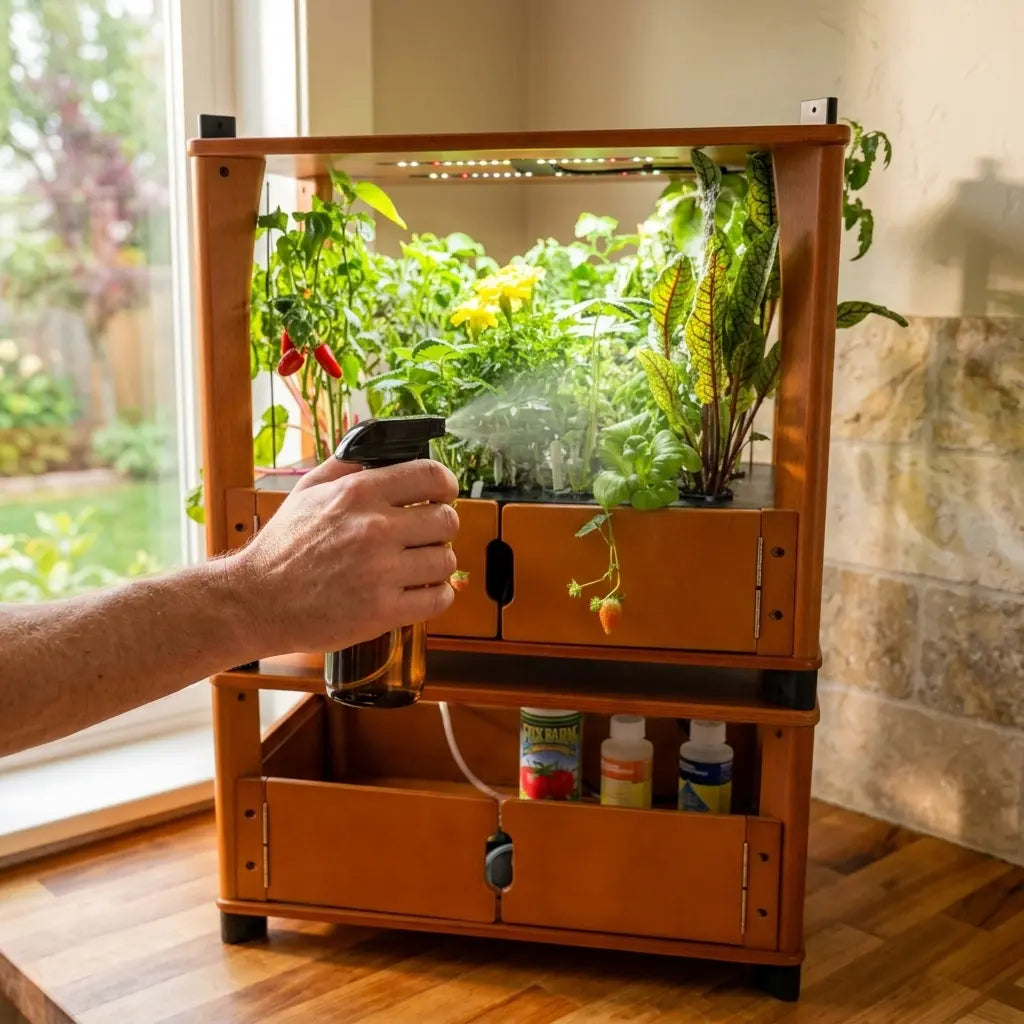
Neem oil needs to be diluted before use. Most concentrates call for roughly one to two teaspoons per quart of water along with a small amount of mild soap to help the oil disperse evenly rather than beading up on the leaf surface.
Spray thoroughly, focusing specifically on the undersides of leaves, since that is where spider mites, aphids, and whiteflies spend most of their time and where a light top-only spray misses the actual problem.
The Aquager Neem Oil Spray comes pre-formulated and ready to use, which removes the guesswork of getting the dilution ratio right on your own.

Apply in the evening or in indirect light rather than under direct, intense light, since neem oil combined with strong direct light can occasionally stress leaf tissue on some sensitive plants.
Repeat every five to seven days for two to three applications, since neem oil breaks down relatively quickly and a single spray rarely addresses an entire pest life cycle, including eggs that were not yet hatched at the time of the first treatment.
Signs that a neem oil treatment is working typically show up gradually rather than overnight. Fewer live insects visible on the undersides of leaves at each check, less new webbing or honeydew appearing between applications, and sticky traps catching fewer new insects week over week are all reasonable indicators that the population is declining rather than holding steady or growing.
If two to three applications produce no visible improvement at all, it is worth double-checking the identification, since a treatment aimed at the wrong pest, or a fungus gnat problem being sprayed on the leaves instead of addressed at the growing medium, will not show progress no matter how faithfully the spray schedule is followed.
Other Organic Methods Worth Knowing
Neem oil is the most versatile single option, but a few other organic methods round out a complete approach, particularly for rotating treatments against pests like whiteflies that build resistance.
Insecticidal soap works similarly to neem oil by disrupting an insect's outer coating on contact, and it can be a useful rotation partner since it works through a slightly different mechanism than neem oil's hormone disruption.
Diatomaceous earth, a fine powder made from fossilized algae, works well against fungus gnats specifically when applied to the top layer of dry growing medium, since it damages the exoskeleton of larvae crawling through it.
Introducing natural predators, like ladybugs for aphids, is a more involved approach better suited to a larger growing space than a typical kitchen counter setup, though it is worth knowing about as an option for anyone scaling up.
| Method | Best Against | How It Works |
|---|---|---|
| Neem oil | Spider mites, aphids, whiteflies | Disrupts hormones and feeding behavior |
| Insecticidal soap | Aphids, whiteflies, soft-bodied mites | Breaks down protective outer coating on contact |
| Diatomaceous earth | Fungus gnat larvae | Abrasive powder damages exoskeleton |
| Sticky traps | All four, for monitoring | Adhesive surface traps flying adults |
Rotating between two or three of these methods rather than relying on just one is generally the most effective long-term strategy, particularly for whiteflies, which are the most prone of the four pests to building resistance against a single repeated treatment.
Building a Simple Weekly Routine
A consistent weekly routine does more to prevent serious pest problems than any single product, since most infestations are caught and stopped early rather than treated after they have already spread.
Early in the week, a quick visual check of leaf undersides and the surface of the growing medium takes only a minute or two per plant and is the single highest-value habit in this entire guide.
Mid-week, checking any sticky traps placed near the growing area confirms whether anything is building up before it becomes visible to the naked eye on the plants themselves.
If a treatment is underway, the repeat neem oil application typically falls somewhere in this weekly cycle as well, five to seven days after the previous spray, which keeps the treatment schedule from being forgotten between one week and the next.
Monitoring and Catching Problems Early
Sticky traps are a simple, chemical-free way to monitor for pest activity before an infestation becomes visible on the plants themselves.
The Aquager Sticky Traps catch fungus gnats, whiteflies, aphids, and fruit flies on contact, which makes them useful both as an early warning system and as a way to reduce an active population alongside neem oil treatment.
Placing a trap near the base of the growing area and checking it weekly gives an early signal that something is building up, well before webbing, honeydew, or visible clusters appear on the leaves themselves.
Keeping a simple mental or written note of when a trap was last checked and what, if anything, was caught helps distinguish a one-off stray insect from the start of an actual population, since a single gnat on a trap one week is very different from three or four appearing every week in a row.
For a more severe infestation that has already spread across several plants, combining neem oil spraying with sticky trap monitoring and a short isolation period for the worst-affected plant tends to bring things under control faster than any single method used on its own.
Prevention Habits That Stop Pests Before They Start
Inspecting new plants closely before introducing them to an established garden prevents the most common way pests actually arrive in the first place, hitchhiking in on a new addition.
Keeping humidity and airflow reasonable discourages spider mites, which prefer dry, still air, while avoiding overly soggy growing medium discourages fungus gnats, which need consistently moist conditions to complete their life cycle.
A regular visual check of leaf undersides, done at the same time as watering or nutrient mixing, catches most problems in their earliest, easiest-to-treat stage rather than after a population has already established itself.
Isolating a newly acquired or visibly struggling plant from the rest of an indoor garden for a week or two, rather than placing it directly alongside established plants, gives enough time for a hidden pest problem to become visible before it has a chance to spread.
Common Pest Control Mistakes
Spraying only the tops of leaves is the most common application mistake, since nearly all four pests spend the majority of their time on the undersides where a quick, careless spray never reaches them.
Treating once and assuming the problem is solved is another frequent error. A single application rarely addresses eggs that have not yet hatched, which is why the repeat treatment schedule matters as much as the first spray.
Misidentifying the pest before treating wastes time and delays an effective fix, since a treatment aimed at the wrong culprit, foliar spray for a fungus gnat problem centered in the growing medium, for example, does not address the actual issue.
Spraying during the hottest, brightest part of the day is a smaller but real mistake, since neem oil combined with intense direct light and heat is more likely to stress leaf tissue than the same application made in the evening or under indirect light.
Ignoring a newly purchased plant's quarantine period is a mistake that undoes otherwise good pest management, since a single untreated new arrival can reintroduce a problem to an otherwise pest-free growing space.
Pest Control FAQ
Is neem oil safe for edible herbs and vegetables?
Yes, neem oil is widely used on edible plants and breaks down naturally within days, though rinsing harvested leaves before eating is still good general practice.
How often should I apply neem oil?
Every five to seven days for two to three applications addresses most active infestations, since a single spray rarely reaches eggs that hatch after the first treatment.
What is the fastest way to tell spider mites from other pests?
Fine, spider-web-like webbing on leaf undersides and between stems is unique to spider mites among the four common indoor pests.
Can sticky traps get rid of an infestation on their own?
They help reduce numbers and are excellent for early detection, but combining them with neem oil treatment addresses an active infestation more completely than traps alone.
Why do whiteflies keep coming back after treatment?
Whiteflies build resistance to repeated identical treatments, so rotating neem oil applications with sticky trap monitoring and other organic methods tends to work better than one method alone over time.
How do I know when a pest problem is actually resolved?
No new webbing, honeydew, or visible insects across two consecutive weekly checks after the last treatment is a reasonable sign the population has been brought under control, though continuing to monitor with sticky traps for another few weeks is still worthwhile.
Can I use neem oil as a preventive spray even without a visible pest problem?
Yes, a light preventive application every couple of weeks is a common practice for gardens that have had recurring pest issues in the past, though it is not strictly necessary for a garden with no history of infestations.
Keeping Your Indoor Garden Pest-Free
Organic pest control comes down to correct identification, thorough application focused on leaf undersides, and consistent follow-up rather than a single spray and forget approach.
Spider mites, aphids, and whiteflies all respond well to a proper neem oil routine, while fungus gnats need a slightly different approach centered on growing medium moisture rather than foliar spraying.
For more on building a resilient indoor garden overall, our organic gardening versus indoor growing comparison covers the bigger picture of growing without synthetic inputs, and our beginner's guide to setting up hydroponics is a good starting point if pest problems are part of a larger setup question.

A little regular attention, a weekly leaf check and a sticky trap or two, keeps most indoor gardens from ever needing a serious treatment in the first place.
Author: Aquager · Published: July 6, 2026 · Updated: July 6, 2026












0 comments