
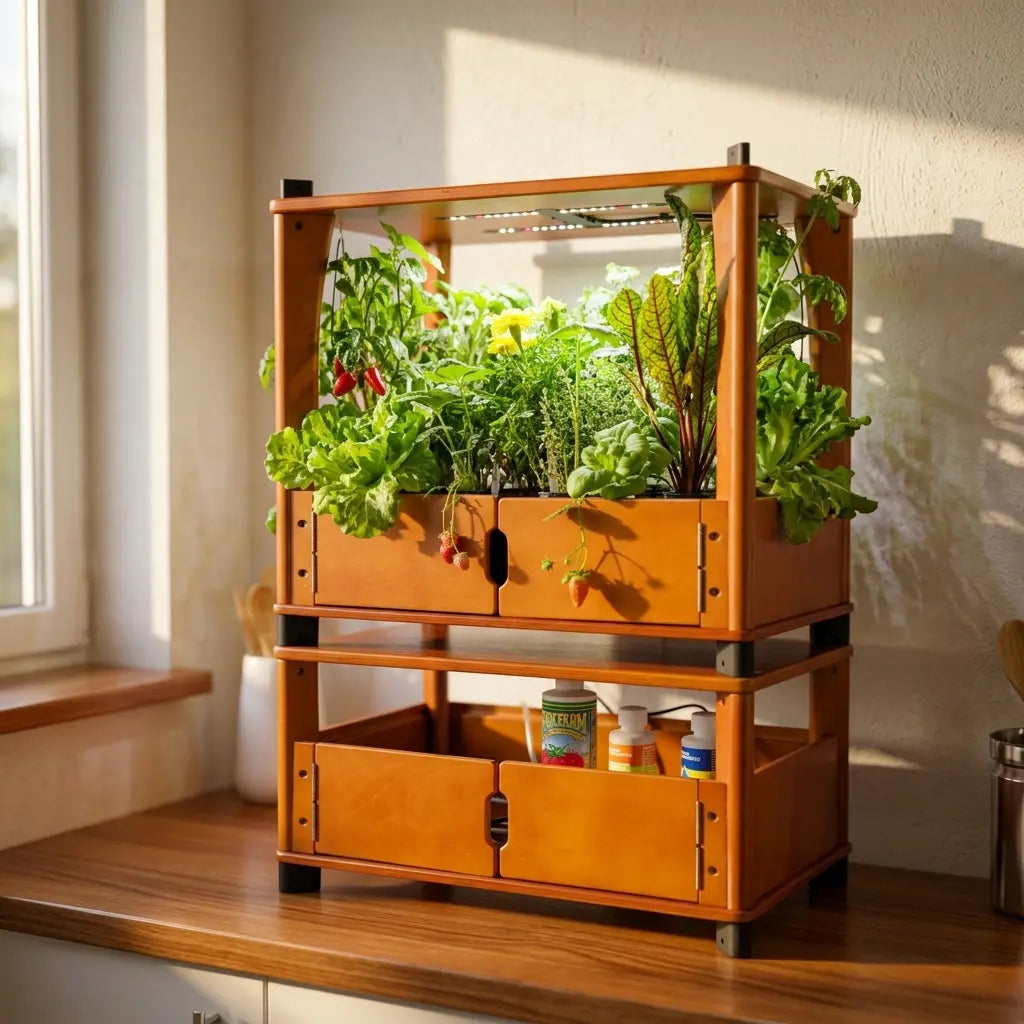
A small indoor garden has a fixed amount of space, but it does not have a fixed amount of yield. The difference between a countertop system that produces a handful of herbs and one that produces a steady stream of food all year usually comes down to strategy, not square footage.
Succession planting is the single biggest lever most beginners never pull. Instead of planting everything at once and harvesting everything at once, staggering sowing dates keeps a small garden producing continuously rather than in one big burst followed by empty space.
This guide covers five strategies that work together in a small indoor garden: succession planting, pairing slow and fast crops, aggressive pruning, staged nutrients, and light rotation. None of them require more space. All of them require a slightly different approach to the space already available.
Why Small Indoor Gardens Need a Different Yield Strategy
Outdoor gardens can often solve a yield problem by simply adding more beds. A small indoor garden, whether it is a single tray on a windowsill or a full hydroponic system on a kitchen counter, does not have that option.
The only real levers available are time, plant selection, and how efficiently the existing space and light are used. Each of the five strategies below pulls one of those levers, and together they compound into meaningfully more food from the same footprint.
It also helps to think in terms of total yield over a season rather than yield from any single harvest. A small garden planted once and harvested once might look productive on the day of that harvest, but a garden using these five strategies together is productive on most days across the entire growing season.
None of these strategies are exclusive to hydroponic systems, but a controlled indoor environment, where light, temperature, and nutrient delivery are all consistent and adjustable, tends to make each one more predictable than trying to apply the same ideas to an outdoor bed exposed to weather and seasonal light changes.
1. Succession Planting
Succession planting means starting new plants on a staggered schedule rather than sowing an entire garden on the same day. When everything is planted together, everything also finishes together, which creates a glut followed by a gap.
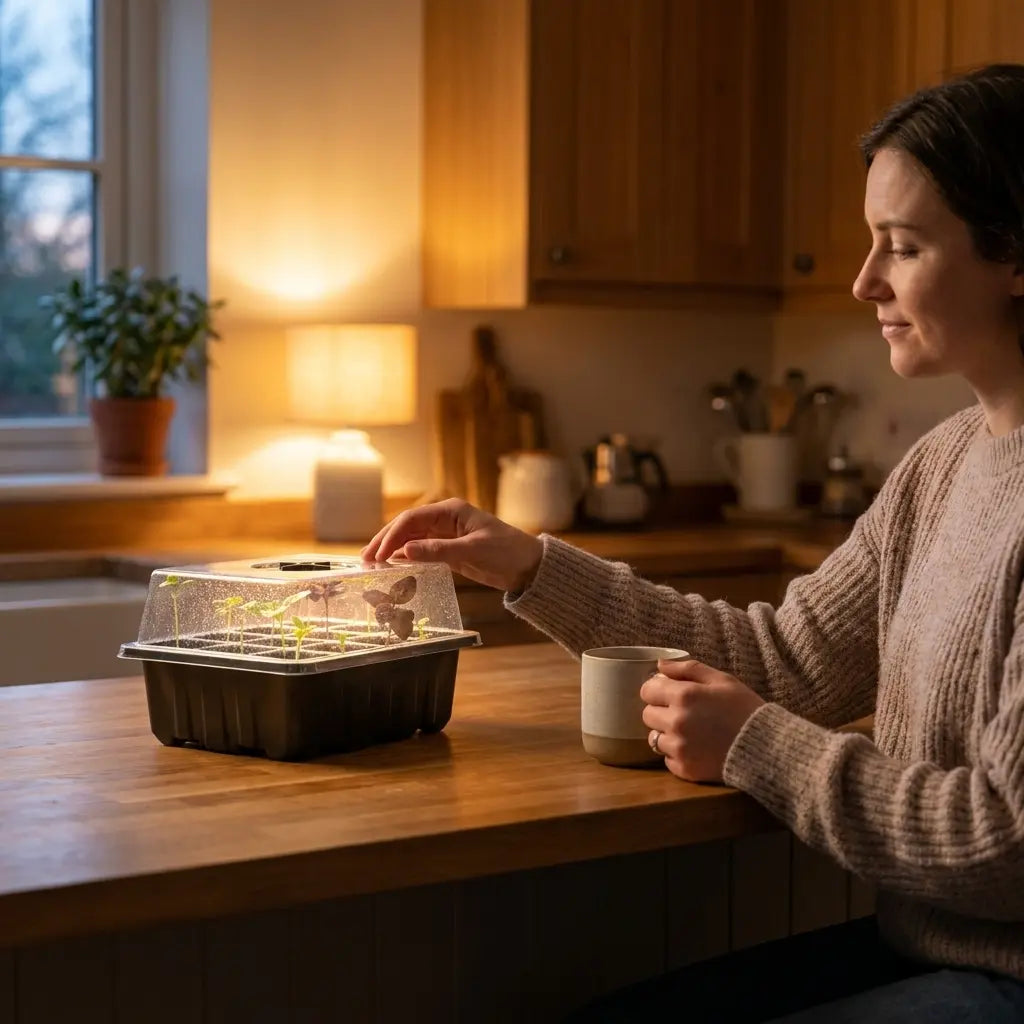
In a small indoor garden, this usually means reserving a few open slots at all times rather than filling every position the moment it becomes available. As soon as one plant is harvested or removed, a new seedling goes into that same spot instead of waiting for a larger batch planting day.
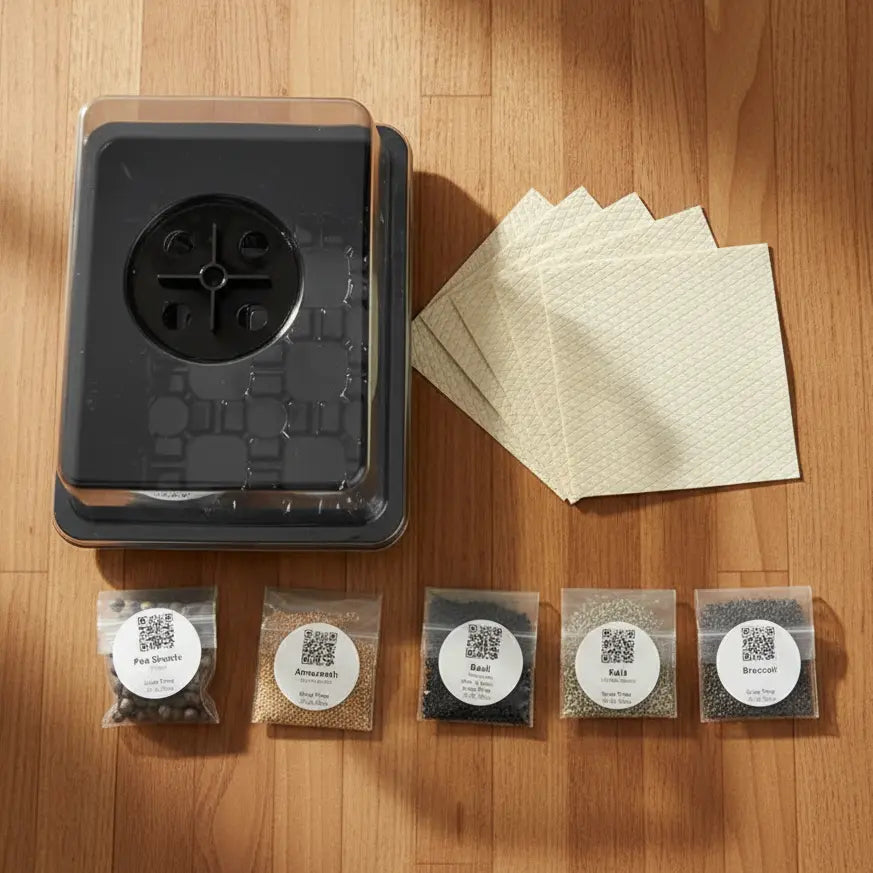
Fast-growing greens like lettuce, arugula, and cilantro are ideal candidates for succession planting because their short life cycle means a new planting every one to two weeks keeps a continuous supply moving through harvest without ever overwhelming the kitchen all at once.
| Crop | Days to Harvest | Suggested Restart Interval |
|---|---|---|
| Lettuce, arugula | 25 to 35 days | Every 1 to 2 weeks |
| Cilantro, basil (harvested young) | 20 to 30 days | Every 2 weeks |
| Kale, chard | 40 to 55 days | Every 3 to 4 weeks |
A simple way to start is picking just one or two of these crops and staggering only those, rather than trying to build a full rotation across every plant in the garden on the first attempt.
Keeping a simple written log, even just a few notes on which slot was planted and when, removes the need to track multiple overlapping timelines from memory and makes it easy to see at a glance which position is due for its next planting.
2. Pairing Slow and Fast Growing Crops
A related strategy is deliberately growing crops with different maturity timelines side by side rather than filling an entire system with plants that all finish at the same time.
Fast crops like basil and cilantro reach a usable size within a few weeks, while slower crops like rosemary or kale take considerably longer to establish. Growing both together means the fast crops fill in the gaps and get harvested first, while the slower crops continue developing in the background using the same light and nutrient cycle.
This pairing approach also smooths out the succession planting rotation described above, since the fast crops create the frequent turnover slots while the slow crops provide a stable, longer-term backbone to the garden.
A practical starting pair for a small system is basil alongside rosemary or oregano. The basil gets harvested and replanted repeatedly across a season, while the rosemary or oregano stays in place for months, slowly growing into a larger, more established plant in the background.
Avoid pairing two slow crops together in a small system without also including at least one fast crop, since that combination leaves long stretches where nothing is ready to harvest and the garden feels unproductive even though it is growing normally.
3. Aggressive Pruning for Continuous Branching
Pruning is one of the most underused yield strategies in a small garden, largely because most people prune reactively, cutting a stem only when it gets in the way, rather than as a deliberate growth strategy.
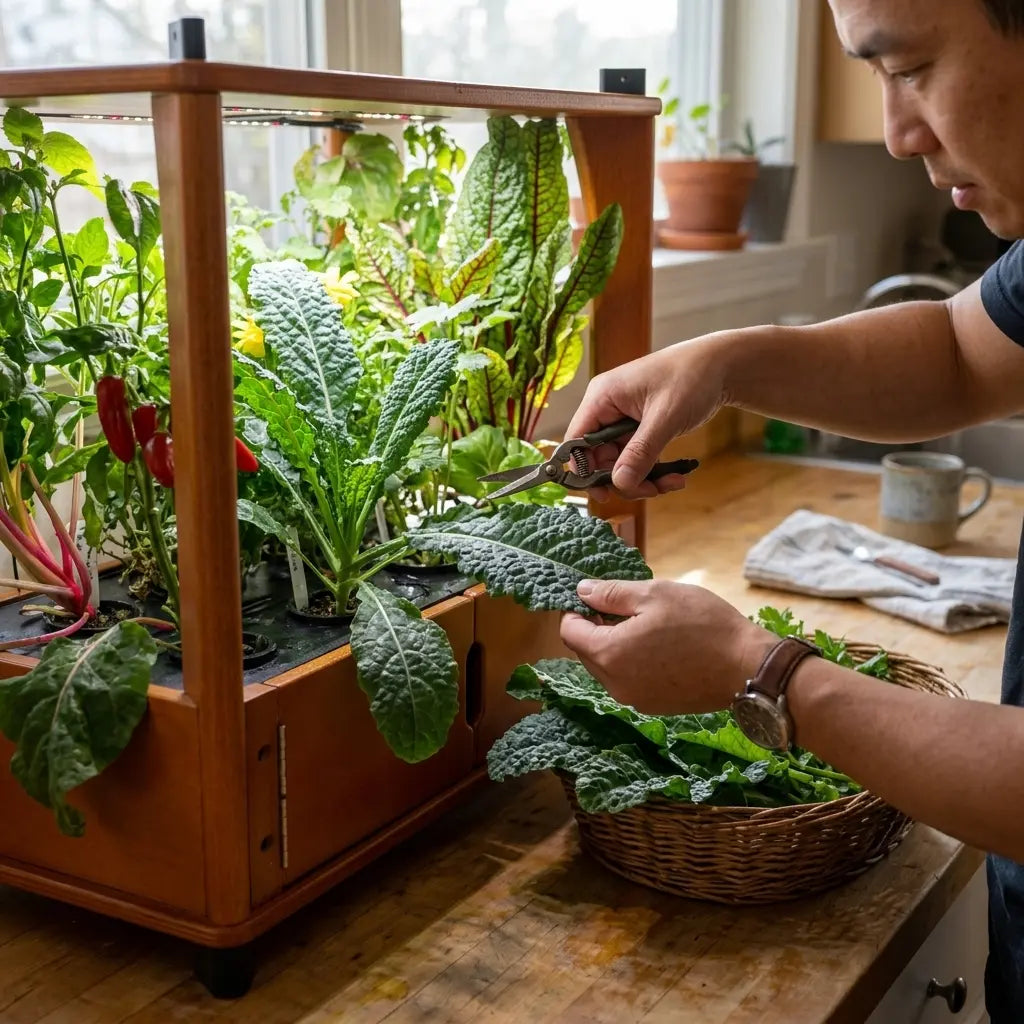
Cutting a stem just above a leaf node removes the plant's dominant growing tip and triggers two new growth tips to develop at that node instead of one. Repeated over a season, this branching effect can turn a single leggy stem into a dense, multi-stem plant producing far more total leaf area.
The Aquager Pruning Shears make it easy to place these cuts precisely, which matters more in a small garden than a large one since every stem is doing more work per square inch of available space.
Soft-stemmed herbs like basil branch quickly and tolerate frequent pruning, typically every one to two weeks. Woody herbs like rosemary need a gentler approach, cutting only into newer green growth and leaving established woody stems alone.
Being aggressive with pruning does not mean cutting constantly. It means cutting deliberately and on a schedule, rather than only when a stem happens to get in the way, so that branching compounds across the whole season instead of happening occasionally by accident.
4. Staged Nutrient Feeding
Feeding every plant the same nutrient concentration regardless of its growth stage is a common way small gardens leave yield on the table. A young seedling and a mature, fruiting plant have genuinely different nutritional needs.
Staging nutrients means adjusting concentration and ratio as plants move through their life cycle, typically a lighter, nitrogen-leaning feed during early vegetative growth, followed by a stronger, more balanced feed as plants mature and begin producing at full capacity.
The Aquager Plant Nutrients concentrate makes this staging straightforward to control, since concentration is adjusted by how much is measured out rather than needing multiple separate products for each growth stage.
Checking nutrient strength with the Aquager PPM/EC Meter before and after each feeding adjustment removes the guesswork of whether a stronger mix is actually landing in the right range for that growth stage.
Pale, slow-growing seedlings often indicate a feed that is too weak for their stage, while dark, curling leaf edges on a mature plant can indicate a feed that has become too strong. Reading these signals and adjusting concentration accordingly is the core of staged feeding.

5. Light Rotation and Positioning
Even under a single full-spectrum LED grow light, light intensity is rarely perfectly even across an entire growing area. Positions directly under the light typically receive noticeably more light than positions near the edges.
Rotating plants within the growing space every week or two, moving edge plants toward the center and center plants toward the edges, evens out that light exposure over time rather than letting the same few plants dominate growth while others lag behind.
This matters more in a small indoor garden than a large greenhouse simply because the light source is fixed and close, so the difference in intensity between the center and the edges of the growing area is proportionally larger.
A plant that is consistently stretching, growing tall and thin with pale, widely spaced leaves, is often a sign it has been sitting in a lower-light position for too long and would benefit from being rotated closer to the center.
Common Mistakes That Cap Yield in Small Gardens
Planting everything at once, then wondering why the garden goes quiet for weeks after one big harvest, is the single most common mistake, and it is solved directly by the succession planting strategy above.
Growing only one type of crop, or several crops that all mature on the same timeline, removes the natural staggering effect that pairing fast and slow crops provides, even when succession planting is otherwise being done correctly.
Feeding every plant an identical nutrient mix regardless of age or size wastes the extra capacity a staged feeding approach would otherwise unlock, particularly for plants that are further along in their growth cycle.
Leaving plants in the same position for an entire growing cycle without ever rotating them lets a small handful of favorably positioned plants dominate growth while others quietly underperform in the same system.
Trying to implement all five strategies perfectly from the very first week is a subtler mistake, since it tends to create more tracking overhead than a small garden actually needs at the start. Adding one strategy at a time, and letting it become routine before layering in the next, tends to stick better over the long run.
A Sample Week Combining All Five Strategies
On a planting day, one or two new seedlings go into whatever slots were harvested that week rather than waiting for a larger batch, keeping succession planting moving continuously.
Mid-week, a quick pruning pass targets any stem that has reached a good node for cutting, focusing on fast growers like basil first since they respond and rebranch the quickest.
Feeding day involves checking PPM with the meter before mixing, then adjusting concentration up or down slightly depending on whether more seedlings or more mature plants are currently in the system.
At the end of the week, a short rotation moves any plant that has spent more than a week or two in an edge position toward the center, and vice versa, to keep light exposure balanced across the whole system.
Putting It All Together in a Small-Footprint System
All five of these strategies work best when the underlying system is designed to support them. A 24-plant capacity gives enough room to stagger plantings, pair fast and slow crops, and rotate positions without constantly running out of space.
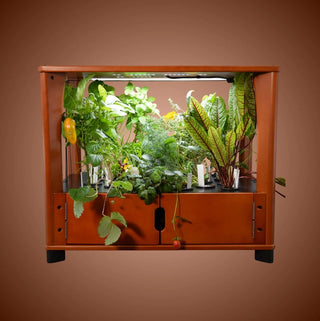
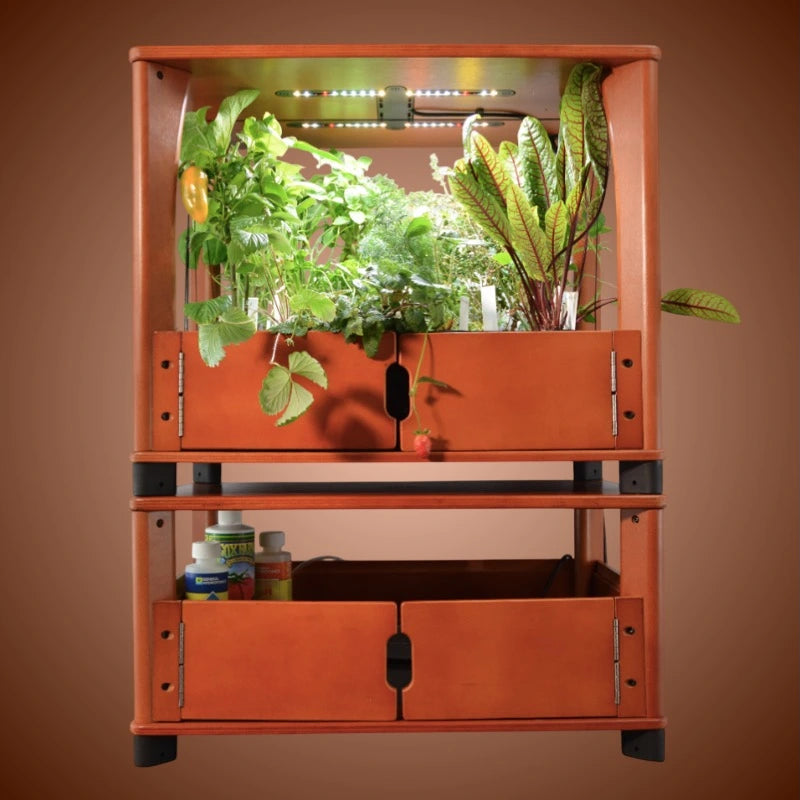
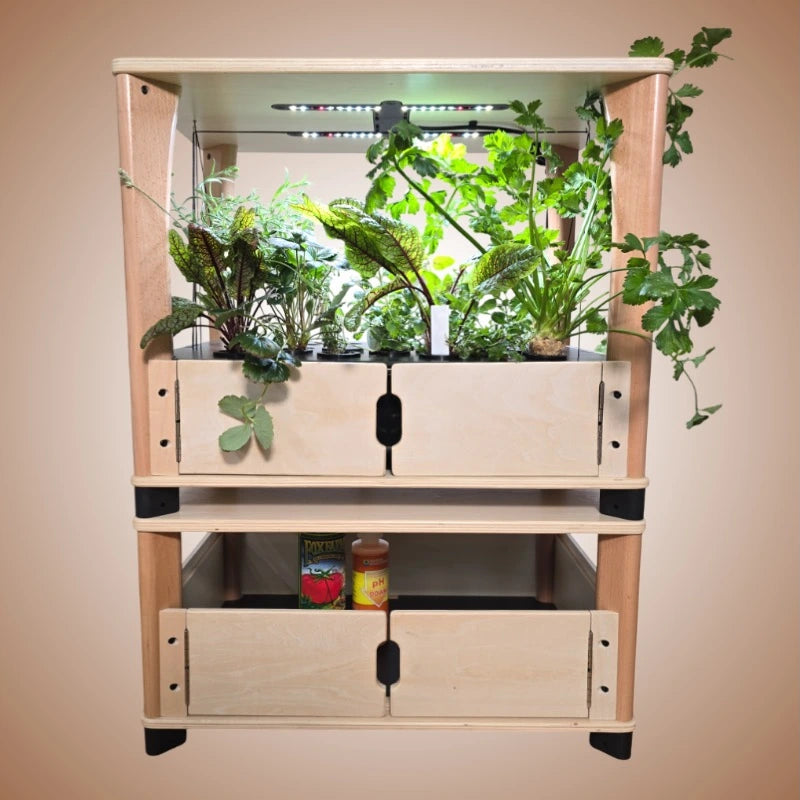
The Aquager Home Farm bundle is built around exactly this kind of flexible, multi-plant layout, giving a small kitchen counter the same strategic options usually reserved for larger growing setups.
With 24 growing positions in a single system, there is enough room to dedicate several slots to a rotating succession of fast greens, a few to slower herbs providing a steady long-term backbone, and still leave a small buffer of open positions for whatever needs replanting that week.
That buffer matters more than it seems. A system running at absolute full capacity all the time has nowhere to put a new seedling the moment something is harvested, which quietly breaks the succession planting rhythm even when every other strategy is being followed correctly.
Small Indoor Garden Yield FAQ
What is the fastest way to increase yield in a small indoor garden?
Succession planting is usually the fastest change to implement, since it requires no new equipment, just a staggered planting schedule instead of planting everything on the same day.
How many different crops should I grow at once in a small system?
Pairing two or three crops with different maturity timelines, such as one fast leafy green and one slower herb, is enough to smooth out the harvest rhythm without overcomplicating the rotation.
Does pruning actually increase total yield, or just plant shape?
Both. A correctly placed cut above a leaf node increases the plant's total number of productive stems, which increases total yield rather than just changing how the plant looks.
Do I need different nutrient products for different growth stages?
Not necessarily. A single concentrated nutrient product measured out at different strengths for different growth stages can cover most of a small indoor garden's needs.
How often should I rotate plants for even light exposure?
Every one to two weeks is generally enough to prevent any single position from consistently outperforming or lagging behind the rest of the growing area.
Can I apply all five strategies at once, or should I start with one?
Starting with one, usually succession planting or pruning since both require no new equipment, is a reasonable way to build the habit before layering in the others.
How long does it take to notice a difference in total yield?
Most growers notice a difference within four to six weeks, once the first round of staggered plantings and prunings has had time to mature and produce.
Is it worth tracking these strategies, or is it fine to eyeball it?
A simple log of planting dates and prune dates is worth keeping at first, since it removes the guesswork of remembering multiple overlapping schedules, though many experienced growers eventually manage it by eye alone.
Getting More From the Space You Already Have
None of these five strategies require expanding a small indoor garden's footprint. Succession planting, crop pairing, aggressive pruning, staged nutrients, and light rotation all work within the space that is already there.
Our guide to getting the most out of your Aquager Home Farm goes deeper into system-specific tips, and our study on how much basil you can grow at home shows what these kinds of strategies can add up to over a full season.
For anyone just getting a small indoor garden started, our guide to starting an indoor garden in a small apartment covers the setup basics these five strategies build on.
It is worth revisiting these five strategies periodically rather than setting them up once and forgetting about them. A rotation schedule that worked well for a system growing mostly lettuce may need adjusting once slower herbs take up a larger share of the available positions, and a nutrient staging plan built around seedlings will need updating as more of the garden shifts toward mature, established plants.

A small footprint is not the ceiling on yield that it looks like. The ceiling is usually the strategy being used inside that footprint, and all five of these are free to start applying today.
Author: Aquager · Published: July 7, 2026 · Updated: July 7, 2026












0 comments