
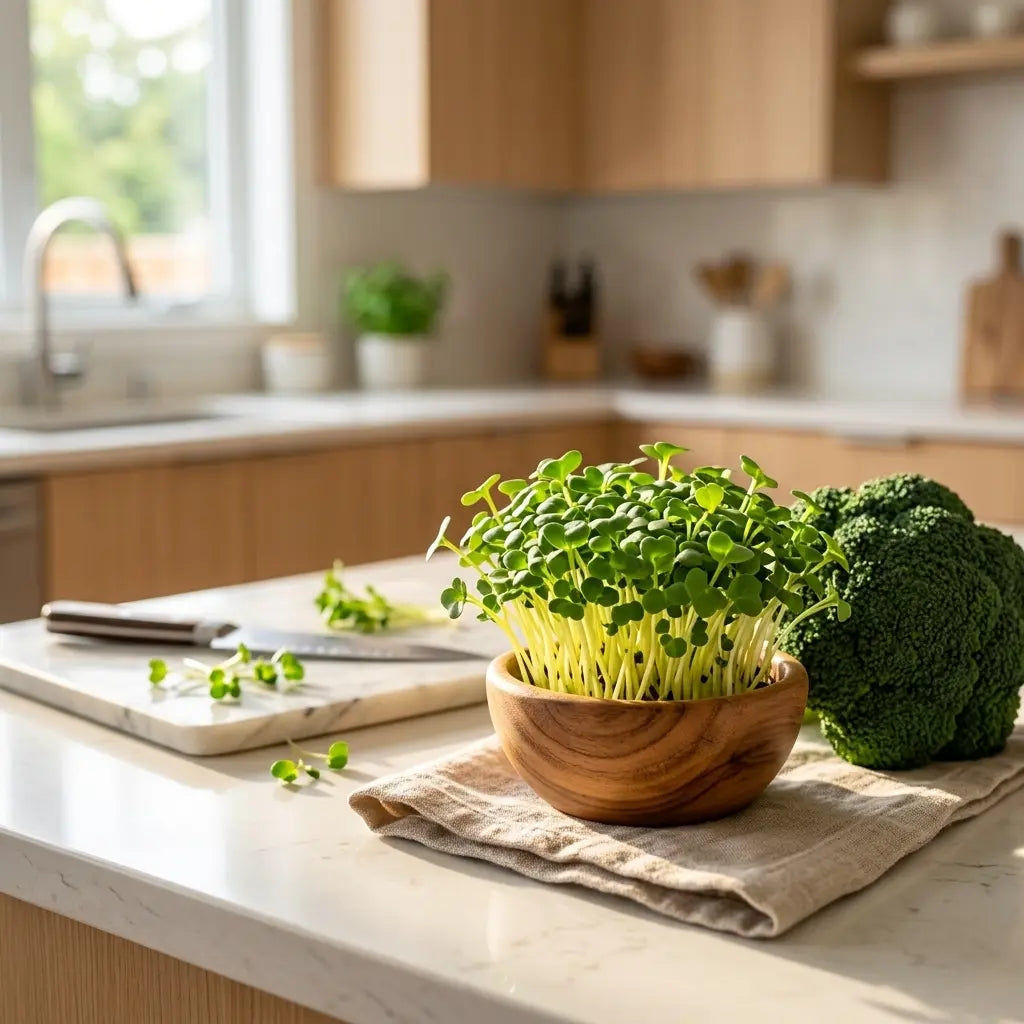
In 1997, researchers at Johns Hopkins University published a finding that quietly changed what we know about functional food. They discovered that broccoli sprouts, the young, 3 day seedlings of the broccoli plant, contained far more sulforaphane precursor than a fully grown head of broccoli, gram for gram.
Sulforaphane is the compound responsible for broccoli's cancer protective reputation, and the highest concentration of it exists in the plant's earliest days, right around when broccoli microgreens are harvested.
This guide is the complete overview: the research, how sulforaphane actually works in your body, why broccoli microgreens concentrate so much more of it than the broccoli in your refrigerator, how to grow your own, and how to eat them without wasting the benefit. For the full research roundup and the full growing walkthrough, this page links out to two deeper resources at the point where you need them.
What Did the 1997 Johns Hopkins Study Find About Broccoli Sprouts?
The 1997 study, published in the Proceedings of the National Academy of Sciences and led by cancer researcher Paul Talalay's lab, identified sulforaphane as a potent inducer of Phase 2 detoxification enzymes, proteins in the liver and gut that neutralize carcinogens before they can damage DNA. The central finding: young broccoli sprouts contained dramatically more glucoraphanin, the sulforaphane precursor, per gram than mature broccoli florets.
That finding has since been replicated and expanded on in dozens of peer reviewed studies, and sulforaphane has become one of the most studied plant derived bioactive compounds in cancer prevention research. For the complete research picture, including specific studies on inflammation, gut health, and detoxification, see our full breakdown: Do Broccoli Microgreens Really Have More Sulforaphane?
What Sulforaphane Actually Does in Your Body
Sulforaphane isn't a vitamin or mineral in the conventional sense. It's an isothiocyanate, a phytochemical that doesn't act directly as an antioxidant but instead activates your body's own antioxidant and detoxification systems.
When you chew or cut broccoli microgreens, glucoraphanin and myrosinase, an enzyme kept separate in intact plant cells, come into contact and react. The result is sulforaphane. Once absorbed, sulforaphane activates Nrf2, a master regulatory protein that switches on genes involved in antioxidant production, inflammation control, and carcinogen removal.
The research is strongest in four areas: cancer prevention (inhibiting tumor initiation, particularly for breast, prostate, and colon cancers), gut protection (antibacterial activity against H. pylori, the stomach bacterium linked to gastric ulcers and cancer risk), inflammation (suppressing the NF-κB pathway tied to cardiovascular disease and arthritis), and liver detoxification (clearing environmental toxins and dietary carcinogens faster). None of this makes broccoli microgreens a treatment or cure, but the evidence is clear and repeated: sulforaphane is one of the most bioactive food derived compounds studied in modern nutritional science.
Why Broccoli Microgreens Outperform Mature Broccoli
Sulforaphane precursors are defense compounds the plant produces to protect itself during its most vulnerable period. Young seedlings lack the thick cell walls and physical defenses of mature plants, so they front load chemical protection. As the plant grows, energy shifts to structural development, and sulforaphane precursor levels per gram of plant mass naturally decline. The 8 to 10 day harvest window for broccoli microgreens captures the plant near its sulforaphane peak, before that dilution effect sets in.
| Form | Sulforaphane Concentration | Notes |
|---|---|---|
| Mature broccoli florets | Baseline (1x) | Standard dietary form |
| Broccoli microgreens (8 to 10 days) | 10 to 100x | High concentration, mild flavor |
| Broccoli sprouts (3 to 5 days) | 10 to 100x | Peak concentration, grown in water |
Broccoli microgreens vs. broccoli sprouts. These are often confused but meaningfully different. Sprouts are grown in water for 3 to 5 days and include the root. Microgreens are grown in a solid medium for 8 to 10 days and include only the stem and leaf. Both are high in sulforaphane precursor, but microgreens carry less bacterial risk since there's no prolonged water immersion, have a milder flavor, and provide more usable plant material per serving. For a full safety and growing comparison between the two, see Microgreens vs Sprouts: The Complete Safety and Growing Guide. For how broccoli stacks up against Aquager's other 17 varieties by nutrient density, see The Most Nutritious Microgreens: All 18 Varieties Compared.

The only way to actually get this concentration fresh is to grow it yourself and harvest it minutes before you eat it. Aquager's Broccoli Microgreens Seeds are the starting point, one pack seeds a full 10x20" tray.
How to Grow Broccoli Microgreens at Home
Broccoli microgreens are among the more straightforward varieties to grow: no pre-soaking required, fast germination, and reliable results on an 8 to 10 day cycle. If you've never grown microgreens of any kind before, our Complete Beginner's Guide to Growing Microgreens at Home covers the basics that apply to every variety.
The short version: moisten an organic grow mat and seed it evenly with broccoli microgreens seeds, keep it covered and dark for the first 4 to 5 days while roots establish, then move it into light once the stems appear and switch to bottom watering. The pale stems green up within a day, and you harvest at day 8 to 10 once the two cotyledon leaves are fully open, cutting just above the mat with clean scissors.
For the full step by step process, including materials, exact timing for each phase, and troubleshooting for mold or slow germination, see our dedicated walkthrough: The Complete Guide to Growing Broccoli Microgreens at Home.

How to Eat Broccoli Microgreens Without Destroying the Sulforaphane
This is the most commonly overlooked part of the research, and the most practical. Sulforaphane forms through an enzymatic reaction between glucoraphanin and myrosinase, and myrosinase is heat sensitive. Cooking broccoli above approximately 140°F (60°C) deactivates the enzyme, preventing glucoraphanin from ever converting to sulforaphane. You're eating the precursor but getting almost none of the active compound.
Best ways to eat broccoli microgreens:
- Raw in salads, grain bowls, or wraps, the optimal method. Chewing triggers the enzyme reaction; the more thoroughly you chew, the more sulforaphane forms.
- In smoothies, blending mechanically ruptures cell walls and activates myrosinase without heat. A large handful in a green smoothie is one of the most efficient sulforaphane delivery methods available.
- As a garnish on warm dishes, add them after the dish has cooled slightly. A finishing layer on soup or pasta is fine; avoid letting them sit in boiling liquid.
- On avocado toast, sandwiches, and eggs, any raw or room temperature application preserves the enzyme.
Avoid: sautéing, steaming, or roasting broccoli microgreens. They're small enough to degrade instantly at heat, and you'll eliminate the sulforaphane benefit entirely.

What's the Easiest Way to Start Growing Broccoli Microgreens at Home?
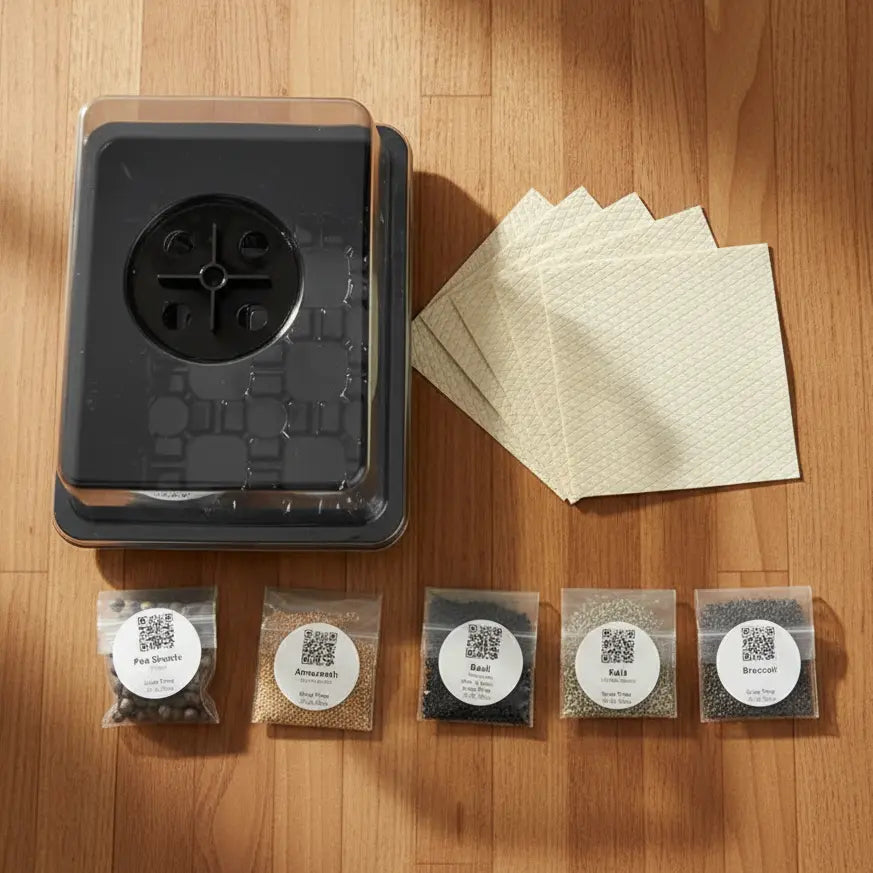
Growing broccoli microgreens at home requires three things: a tray, a dome for germination, and a growing medium that holds moisture evenly. The Microgreens Starter Kit from Aquager includes two trays, a humidity dome, and an organic coco coir grow mat in one package, for $29.99.
The organic coco coir mat holds the right moisture level throughout germination, keeps the growing surface clean, and eliminates guesswork around drainage and over-watering, the most common reason first grows fail.
For seeds, Broccoli Microgreens Seeds from Aquager are $7.99 per pack and include an organic grow mat with each order. One pack yields a full 10x20" tray, approximately 4 to 6 ounces of fresh microgreens at harvest, enough for several generous servings.
Start one tray this week. Your first harvest of sulforaphane rich broccoli microgreens will be ready within 10 days.
Frequently Asked Questions
Do broccoli microgreens actually have sulforaphane?
Yes. Broccoli microgreens are rich in glucoraphanin, the precursor that converts to sulforaphane when you chew or cut them. Research going back to the original 1997 Johns Hopkins study has found broccoli sprouts and microgreens contain up to 100 times more glucoraphanin per gram than mature broccoli, making them one of the most concentrated whole food sources available.
Are broccoli microgreens the same as broccoli sprouts?
No. Sprouts are grown in water for 3 to 5 days; they include the root and carry a higher bacterial risk from warm, moist growing conditions. Microgreens are grown in a solid medium for 8 to 10 days; only the stem and leaf are harvested. Both are high in sulforaphane precursor. Microgreens are the more practical and safer option for most home growers.
How much should I eat to get the sulforaphane benefit?
No clinical dose has been established for whole food broccoli microgreens specifically. Most researchers working with sprout based interventions use 30 to 100 grams several times per week. One 10x20" tray yields approximately 115 to 170 grams. A large handful three to four times per week is a reasonable practical target.
Do broccoli microgreens taste like broccoli?
They're milder than full grown broccoli, slightly earthy with a subtle peppery note. They lack the sulfurous smell of overcooked broccoli entirely. Most people who dislike cooked broccoli find the microgreens version quite approachable eaten raw.
Can I grow them in winter?
Yes. Broccoli microgreens are one of the more cold tolerant varieties and germinate well at 65 to 75°F. A south facing window or a basic LED grow light on a 12 hour cycle is sufficient, no outdoor conditions required year round.
How long do they keep after harvest?
Stored dry in a sealed container in the refrigerator, harvested broccoli microgreens last 5 to 7 days. The key is keeping them dry before storage: rinse, then pat dry or spin in a salad spinner before refrigerating.
The Highest Sulforaphane Food You Can Grow in 10 Days
Sulforaphane supplements exist, but whole food sources consistently outperform them in bioavailability research. The glucoraphanin-myrosinase system works best when both components are present together, exactly as they are in fresh broccoli microgreens.
At under $8 for a full tray of seeds, it's hard to make a more cost efficient case for any functional food. Ten days from planting to harvest. A handful several times a week. No cooking required.
The Microgreens Starter Kit and a pack of Broccoli Microgreens Seeds are everything you need to start. Your first harvest will be ready before the end of next week.
Author: Aquager Team · Published: May 30, 2026 · Updated: August 24, 2026 · Reviewed: August 24, 2026 (Phase 3)












0 comments