
Every home cook who loves Mexican, Caribbean, or South Asian food knows the frustration of trying to grow cilantro. You plant it. It bolts — shooting up a flower stalk before you've taken a single handful. You get one week of usable herb and three weeks of bitter seed production. The solution most people reach for is buying it at the store, where it wilts in three days and half the bunch ends up in the compost.
Cilantro microgreens solve all of this. They let you grow cilantro flavor at home — reliably, year-round, in 10–14 days — without the bolting cycle that makes full cilantro so frustrating. This guide covers why full cilantro bolts, why microgreens don't, how to grow your own in under two weeks, and how to use them in salsa, guacamole, tacos, and ceviche.
Why Cilantro Bolts — The Real Problem
Bolting is a plant's survival response to stress, especially heat. When a cilantro plant senses environmental pressure — hot temperatures, long days, or drought — it shifts energy from leaf production to reproduction. It sends up a tall flower stalk, produces seeds quickly, and dies. The leaves that remain turn bitter and lose their characteristic flavor almost overnight.
The reason cilantro bolts so reliably in home gardens and on windowsills is that most growing conditions work against it. Cilantro is a cool-season annual that evolved in temperate Mediterranean and Central Asian climates. It wants 60–70°F and moderate day length. An indoor kitchen, a summer windowsill, or almost any outdoor plot during warm months provides exactly the conditions that trigger bolting.
Gardeners have tried to work around this — planting slow-bolt varieties, starting seeds every two weeks for succession planting, growing in partial shade. These help but don't eliminate the problem. For more on growing full cilantro indoors, see our guide on growing cilantro without it bolting. But if you want cilantro flavor reliably and immediately, microgreens are the faster answer.
Why Cilantro Microgreens Don't Bolt
Bolting is a response to sustained environmental stress. Cilantro microgreens are harvested in 10–14 days — before the plant ever has time to register that stress and shift into reproductive mode.
The biology is simple: bolting is triggered by a combination of temperature, day length, and the plant's age. Young seedlings at the cotyledon stage have not accumulated enough environmental signals to initiate flowering. You harvest them at day 10–14, right at peak flavor and before any bolting trigger can accumulate.
There's another advantage. Cilantro microgreens are grown indoors, in a controlled environment, with consistent moisture and no direct weather exposure. The conditions that usually trigger bolting — temperature spikes, hot dry wind, intense direct sun — simply don't exist on a kitchen counter.
The result: cilantro flavor without the lifecycle problem. The same bright, citrusy, herbal taste that makes cilantro indispensable in Latin cooking, available on a two-week cycle that resets every time you start a new tray.
How to Grow Cilantro Microgreens in 12 Days
Cilantro microgreens are slightly more demanding than varieties like radish or pea shoots, but the method is straightforward once you understand what they need.
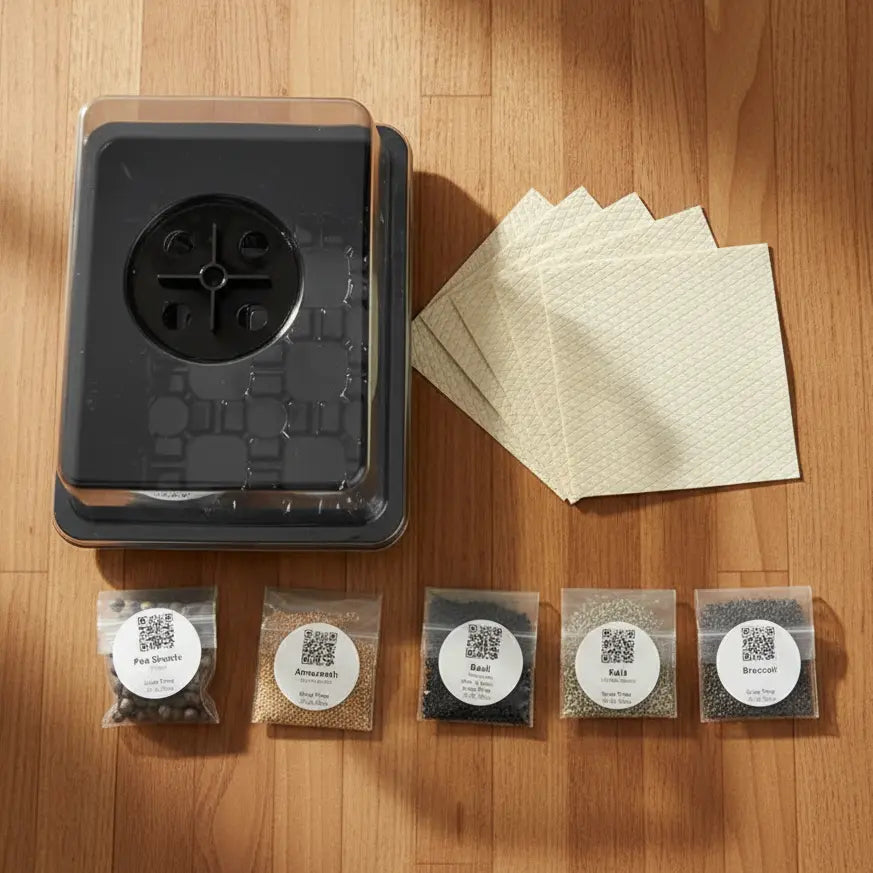
What you'll need: Cilantro Monogerm Microgreens seeds, a growing tray with humidity dome, an organic coco coir grow mat, and clean water at room temperature.
Step 1 — Soak the seeds (6–8 hours before planting). Cilantro microgreens benefit from a pre-soak more than most varieties. Soak seeds in room-temperature water for 6–8 hours before planting. This softens the seed hull, which is harder than most microgreen seeds, and significantly improves germination uniformity.
Step 2 — Seed the tray. Drain the soaked seeds. Wet the grow mat thoroughly — it should feel uniformly damp. Spread seeds evenly across the surface. Cover with the humidity dome and place in a dark, room-temperature spot.
Step 3 — Germination (Days 1–5). Cilantro germinates more slowly than radish or pea shoots. Check the mat daily and mist lightly if it's drying out. Don't expect visible sprouts until Day 3–4. By Day 5, most seeds should show white root tips emerging.
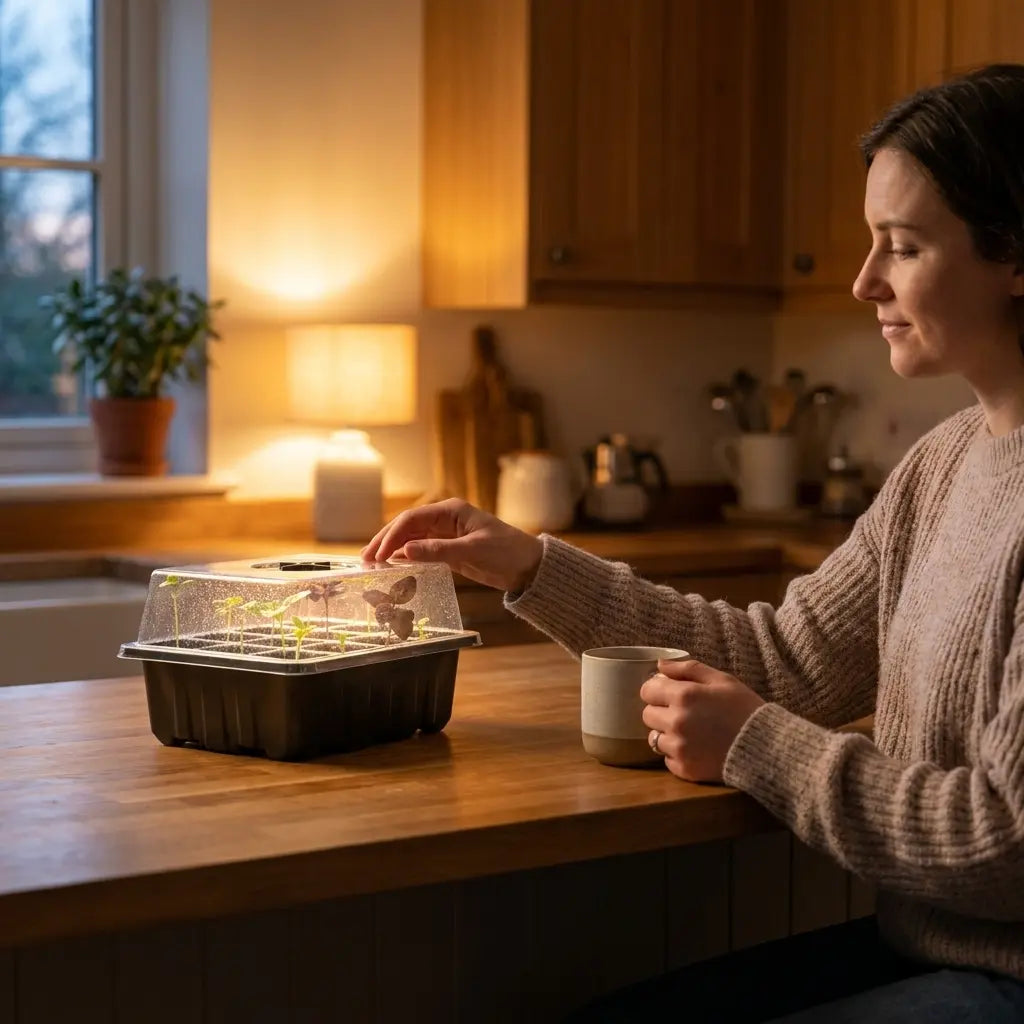
Step 4 — Light introduction (Days 5–8). When most seeds are germinated and the first pale stems appear, remove the dome and move the tray to a bright windowsill or under a grow light. Cilantro microgreens take 2–3 days of light exposure before the canopy turns fully green.
Step 5 — Harvest (Days 10–14). Cilantro microgreens are ready when the cotyledons are fully open and a feathery, slightly divided leaf structure is beginning to emerge. Cut just above the grow mat with clean scissors. The flavor at this stage is concentrated, bright, and true to mature cilantro.
For growing time comparisons across all microgreen varieties, see our fastest-growing microgreens guide.
4 Dishes That Belong With Cilantro Microgreens
These are the foundational uses in Latin cooking — each one is a dish that cilantro defines, and where the microgreens version delivers the same flavor with better texture and presentation.
Fresh Salsa
Fresh salsa depends on cilantro the way it depends on tomato and lime — take it out and the flavor profile collapses. Cilantro microgreens work as a 1:1 substitution for the chopped cilantro component in any salsa recipe, or scattered over the top of a finished salsa as a fresh garnish.
For a simple kitchen salsa: dice ripe tomatoes, white onion, one serrano pepper, and one garlic clove. Add the juice of one lime. Fold in a generous handful of cilantro microgreens, roughly chopped. Season with salt. Rest for 10 minutes before serving. The microgreens wilt slightly and distribute their flavor through the salsa in a way that dried or wilted store cilantro never achieves.
Guacamole
Cilantro is the herb that divides people on guacamole — those who love it really love it, and cilantro microgreens give them more of what they're looking for. The concentrated flavor means you need less volume than fresh cilantro while still getting a prominent herb note.
Add a small handful of cilantro microgreens directly into the guacamole when mashing. Or, for a cleaner presentation, scatter them across the top of a finished guacamole bowl just before serving with chips.
Tacos
Cilantro is as integral to tacos as the tortilla. Street tacos — carne asada, al pastor, carnitas — are finished with a pinch of fresh cilantro and diced white onion. Cilantro microgreens do this better: more flavor per gram, better visual impact, and a delicate texture that doesn't overwhelm the filling.
Pile them directly on the taco as a final topping. They pair especially well with anything braised or char-grilled, where the freshness of the herb cuts through the richness of the meat.
Ceviche
Cilantro is foundational to Mexican, Peruvian, and Caribbean ceviche. In ceviche, the herb is typically used as a finishing element rather than a cook-in ingredient, which is exactly where cilantro microgreens excel.
Add a generous handful to the ceviche in the final minute before serving. They hold their texture briefly against the lime juice before softening, delivering fresh herb flavor with each bite. Scatter a few whole sprigs on top for presentation.
Everything You Need to Start Growing
Two products make a complete cilantro microgreens setup.
Cilantro Monogerm Microgreens Seeds — $3.99. Monogerm seeds are the preferred variety for microgreens because each seed produces a single, even sprout rather than the clustered germination of regular cilantro seeds. This produces a cleaner, denser tray. Includes an organic grow mat with each order.
The Microgreens Starter Kit — $24.99. Includes the 10×20" growing tray, humidity dome, and organic coco coir grow mat. The dome is particularly important for cilantro, which benefits from humidity and dark conditions during its slower germination phase.
Start on a Sunday and you'll be harvesting by the end of the following week — just in time for Taco Tuesday.
Frequently Asked Questions
Do cilantro microgreens taste like regular cilantro?
Yes — the flavor profile is identical to fresh cilantro, just more concentrated. For the classic cilantro flavor in dishes, harvest at the cotyledon stage (Day 10–12). Waiting until early true-leaf development intensifies the flavor further.
What about people who hate cilantro?
The "cilantro tastes like soap" experience is caused by a genetic variant (OR6A2 gene) in approximately 4–14% of people. Cilantro microgreens have the same flavor chemistry as full cilantro, so if someone dislikes cilantro, the microgreens will taste the same to them. For the people who love cilantro, however, microgreens give them more of it.
Can I use cilantro microgreens in cooked dishes?
They're at their best raw or added as a finishing element after cooking. Heat quickly wilts and dulls their flavor. Add them to soups, curries, or stir-fries at the very last moment before serving.
How much do I get per tray?
One 10×20" tray yields approximately 3–4 ounces of cilantro microgreens — roughly equivalent to two or three large bunches of store cilantro in terms of usable herb flavor, at a fraction of the cost.
How long do harvested cilantro microgreens last?
5–7 days, refrigerated in a sealed container with a dry paper towel at the bottom. Rinse just before using, not before storage.
Fresh Cilantro, On Your Schedule
The bolting cycle is the reason most home cooks give up on growing cilantro. Cilantro microgreens remove that cycle entirely. Start a tray Sunday night. Harvest in less than two weeks. Start again.
The flavor is the same. The frustration isn't. And the cuisine that depends on cilantro — the salsas, the guacamoles, the tacos, the ceviches — deserves the freshest version you can give it.
The Cilantro Monogerm Microgreens Seeds and the Microgreens Starter Kit are all you need to start. Your first fresh harvest will be ready in under two weeks — no bolting, no wilted store bunches, no timing frustration.
Author: Aquager Team · Published: May 30, 2026 · Updated: August 8, 2026 · Reviewed: August 8, 2026 (Phase 2)












0 comments