
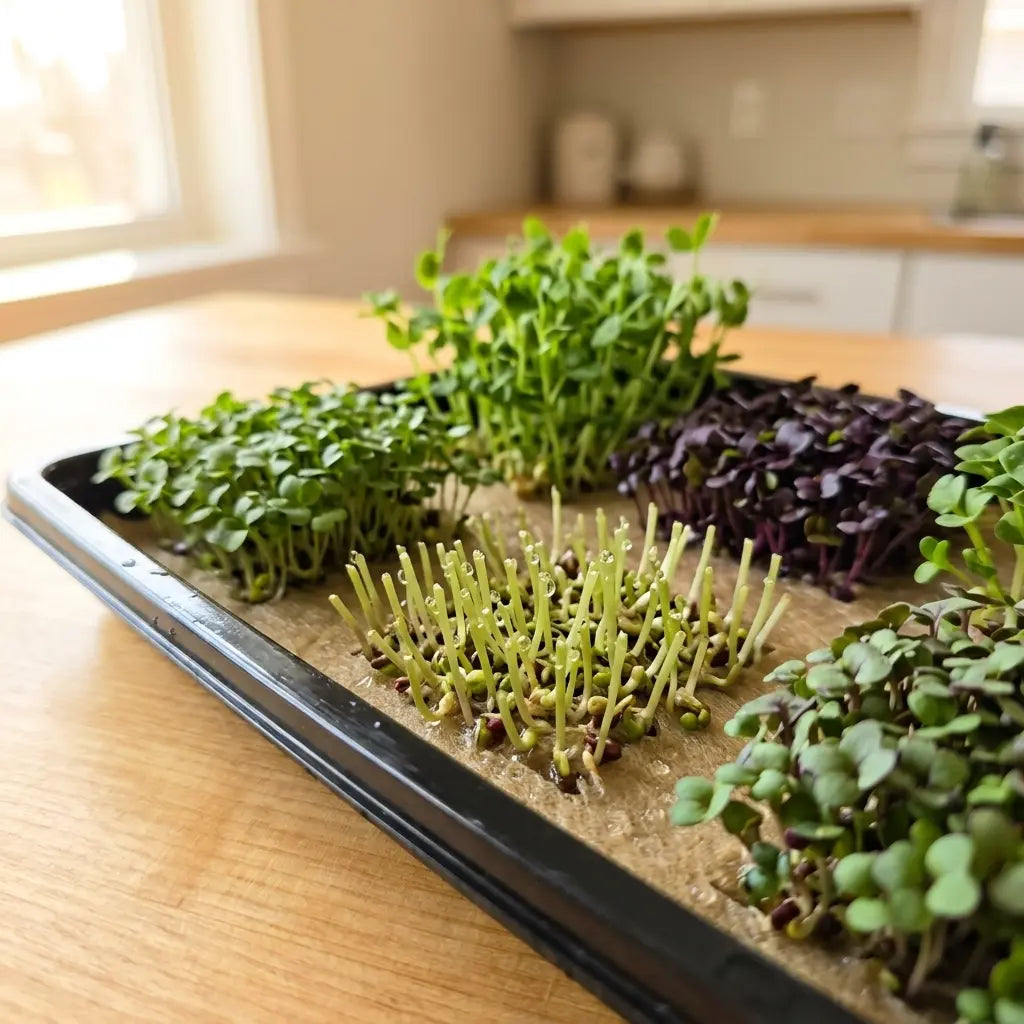
Your microgreens tray looks perfect right up until harvest day. You run clean scissors along the base, cut every plant down to the grow mat, and suddenly you are staring at a tray of bare stems where a lush little forest used to be.
The obvious next question is whether those stems will grow back. If they did, one packet of seeds could feed you salads for weeks instead of days, and reseeding would feel like an unnecessary chore.
Here is the honest answer to do microgreens regrow after cutting: for almost every variety, no. But there is one popular exception that changes the math, and a few tricks that decide whether you get anything at all from a second cut.
Why Most Microgreens Don't Regrow After Cutting
Microgreens are harvested at the cotyledon stage, right as the first true leaves are starting to unfurl. At that age, the seedling has exactly one growing point, called the apical meristem, sitting at the very top of the stem.
When you cut a tray flush with the light brown grow mat, you remove that single growing point along with the leaves. Without it, the plant has no tissue left that knows how to build new leaves. It is not resting. It is finished.
This is very different from a mature herb plant on your windowsill, which has many growing points, an established root system, and stored energy to draw on. A microgreen seedling has none of that. Its entire short life is built around one fast, efficient harvest, not repeated cuttings.
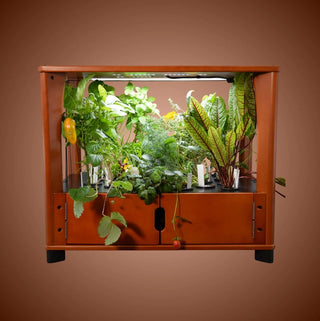
This is also why hydroponic herb systems work on a completely different rhythm. A hydroponic basil plant keeps multiple growing points and a real root system for months, so pruning it encourages more growth instead of ending it. Microgreens are engineered for one clean harvest, not longevity.
It helps to think of it less like mowing a lawn and more like cutting a flower from its stem. The flower does not grow back either, no matter how well you water the vase. Most microgreens work the same way, and that is exactly why microgreens regrow so rarely compared to herbs you might snip from a garden bed.
Some growers leave a cut tray sitting under the light for another week, hoping any green stubble will turn into new leaves. In nearly every case, that stubble just yellows and rots, using up tray space and grow mat that could already be growing your next batch.
Why People Think Microgreens Should Regrow
The confusion is understandable. Lettuce, herbs, and other cut and come again greens really do regrow after a light trim, and plenty of gardening advice treats all greens the same way.
Those plants are harvested at a much later growth stage, with an established root system and several sets of true leaves already in place. Cutting the top leaves barely touches their growing points.
Microgreens are harvested at the opposite end of that timeline, just days after germination, specifically because that early stage is when the leaves are most tender and nutrient dense. That same timing is what makes the plant so fragile once you cut it.
Sprouts add another layer of confusion. Sprouts are eaten root, seed, and all, before true leaves even form, so the regrowth question does not really apply to them. Microgreens sit in the middle: past the sprout stage, but nowhere near the maturity that lets a plant bounce back from a cut.
Which Microgreens Regrow After Cutting
The honest, if slightly disappointing, answer is almost none of the common varieties. Once you harvest a tray of these, that tray is done:
- Radish, including Radish Confetti Mix Microgreens
- Broccoli
- Sunflower
- Kale and other brassicas
- Arugula, mustard, and most peppery greens
- Basil and other herb microgreens
This is by design, not a flaw in how you grew them. These varieties are bred to turn stored seed energy into a dense, nutrient-rich harvest in 5 to 10 days. Expecting a second flush from them is a bit like expecting a candle to relight itself after you blow it out.
You may see occasional claims online that kale, cilantro, or pea tendrils regrow under perfect conditions. In practice these results are inconsistent, weak, and not worth planning around. Treat any one-and-done variety as exactly that.
The upside is that reseeding these varieties is quick and cheap. If you harvest a tray correctly the first time, using clean scissors and cutting right at the mat, you already got the maximum yield out of that single cut. Our guide on how to harvest microgreens the right way covers the technique that gets the most out of every tray, regrowth or not.
The Exception: How Pea Shoots Regrow After Cutting
Pea shoots break the rule, at least partly. Pea seeds are large and carry far more stored energy than tiny radish or broccoli seeds. The seedling also grows multiple leaf nodes spaced along a longer stem, instead of one small cluster at the very top.
If you cut a pea shoot tray the right way, leaving the lowest set of leaves in place instead of cutting flush to the mat, the plant can push new growth from those remaining nodes. This is the closest thing to true regrowth you will find in the microgreens world.
People sometimes assume sunflower shoots behave the same way, since both are sold as shoots rather than fine greens. Sunflower seedlings put nearly all of their energy into one thick, single stem topped by two large seed leaves. Cut that stem and there is no side node left to take over, so sunflower shoots do not regrow the way pea shoots can.
Do not expect a repeat of the first harvest, though. The second flush is usually thinner, shorter, and slower to arrive. Most growers see somewhere around 30 to 50 percent of the original yield, and a third cut almost never justifies the wait.
Pea Shoots Field Microgreens Seeds are the variety most people are picturing when they ask which microgreens regrow after cutting. If you want to see the full cycle for yourself, our complete beginner's guide to growing pea shoots walks through everything from seed to second harvest.
How to Get a Second Cut From Pea Shoots
Cut Above the Lowest Leaf Set
Skip your usual flush cut for this one tray. Use clean scissors to snip the pea shoots about half an inch above the grow mat, leaving the bottom leaf pair intact. That small strip of stem and leaf is what produces the second flush.
This works because the lowest leaf pair still carries a small cluster of living tissue capable of producing new growth. Cut any lower than that, flush with the mat, and you remove that tissue along with everything else.
Keep Watering and Light Consistent
The regrowth phase is more fragile than the first grow. Keep the light brown organic grow mat evenly moist without letting it dry out, and keep the tray under the same light schedule you used the first time around.
Watch for the Second Flush, Then Cut Again
Regrowth usually shows up faster than the original grow, often in about half the time. Check daily starting on day three or four after your first harvest, and cut again as soon as the new leaves look full and green.
Know When to Stop and Reseed
If nothing has appeared by day seven, or if the second flush looks pale and sparse, stop waiting. Compost the tray, refresh the grow mat, and start a new batch instead. Chasing a weak third cut almost never pays off.

Tray Economics: Why Reseeding Beats Waiting for Regrowth
Here is the part most guides skip entirely. Even with pea shoots, waiting for a second flush is not always the better deal once you look at the real numbers.
Run the numbers on a single tray. A four dollar packet of pea shoot seeds grown fresh gives you a full, dense harvest in 8 to 12 days. Waiting for a second flush from that same tray adds another 3 to 5 days and gives you roughly a third to a half of that yield, for zero extra seed cost.
Once you account for the extra days your counter space and grow light are tied up, the free second harvest usually works out to a similar cost per gram as just reseeding, sometimes worse. The seed itself was never the expensive part.
This is where a lot of home growers get the math backward. They treat a second flush as free food, when in reality it costs nearly as much time as starting over, for a noticeably smaller harvest. The only real savings is skipping a few minutes of reseeding, which is not much of a savings at all.
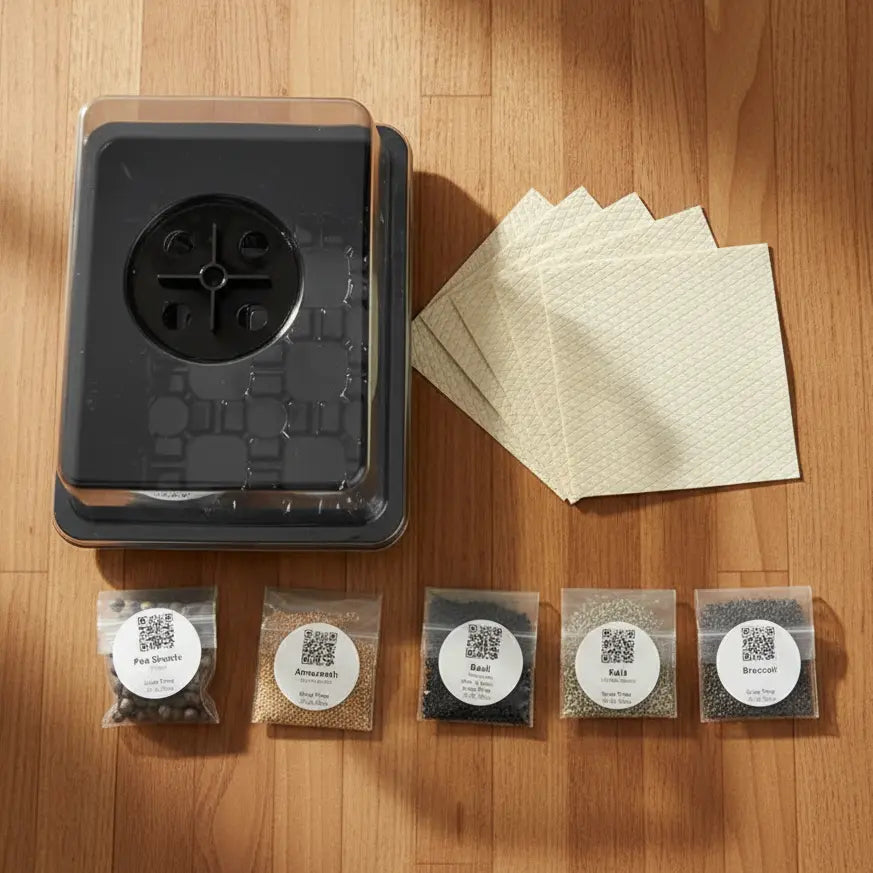
The grow mat itself is inexpensive to replace and rarely the deciding factor either way. The real cost that matters is the days your tray sits on the counter without producing a full-size harvest. Each Aquager kit ships with a light brown organic grow mat sized for a standard tray, which is one less variable to weigh when you are deciding whether reseeding now beats waiting out a second flush.
The Microgreens Starter Kit comes with two trays, so you can let one tray finish out its regrowth while a second tray gets reseeded fresh right away. That way you are never stuck relying on a smaller second harvest for your only supply of greens. Our post on the 5 fastest-growing microgreens is worth a look if turnaround speed matters more to you than stretching a single tray.
FAQ: Microgreens That Regrow, Answered
Do microgreens grow back after cutting?
For almost every variety, no. Radish, broccoli, sunflower, and most leafy greens are cut once and finished. Pea shoots are the main exception, and even they only offer one smaller second harvest.
Which microgreens regrow after cutting?
Pea shoots are the most reliable answer. A few growers report light regrowth from tatsoi or mustard under ideal conditions, but results are inconsistent and rarely worth counting on.
Do radish microgreens regrow after cutting?
No. Radish microgreens have a single growing point and do not produce new leaves once that point is cut away. Reseed a fresh tray for your next batch.
Do broccoli or sunflower microgreens regrow?
No, both are cut-once crops. Their thick single stems and single growing points work the same way as radish, so a second cut will not produce new growth.
How many times can you cut pea shoots?
Usually twice. The first cut is your main harvest. The second, smaller cut comes 3 to 5 days later if you left the lowest leaves intact during the first cut. A third cut is rarely worth the wait.
Why do people think microgreens regrow like lettuce or herbs?
Because lettuce, herbs, and other cut and come again greens are harvested at a much later growth stage, with roots and multiple leaf sets already established. Microgreens are cut just days after germination, before any of that structure exists, so the comparison does not hold up.
The Honest Answer: Do Microgreens Regrow After Cutting?
So, do microgreens regrow after cutting? For nearly every variety, the honest answer is no, and that is by design, not a failure on your part as a grower.
Pea shoots are the one real exception, capable of a smaller second harvest if you cut them correctly and stay patient for a few extra days. Even then, a freshly reseeded tray usually beats the wait once you count the time and yield.
The best habit to build is treating each tray as a single, fast-turnaround harvest rather than a renewable one. Keep seed on hand, reseed the moment you cut, and you will never find yourself waiting around for greens that were never going to come back.
If you need a simple rule of thumb: for pea shoots grown with the lowest leaves left intact, give the tray up to a week to decide. For every other variety, reseed as soon as you harvest and do not look back.

Author: Aquager · Published: July 19, 2026 · Updated: July 19, 2026












0 comments