
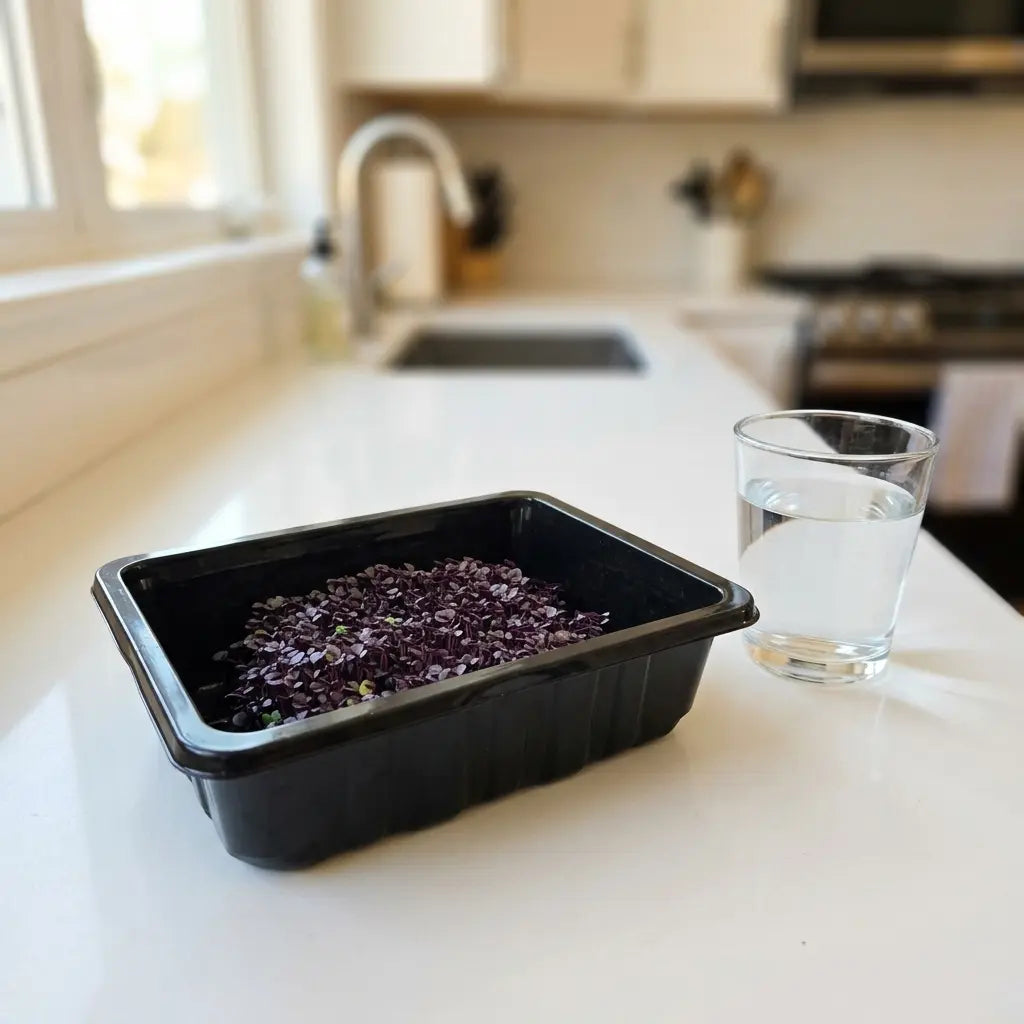
If you're looking for a genuine way to reduce your carbon footprint that doesn't involve giving anything up, growing your own microgreens is one of the few habits backed by real numbers instead of vague Earth Day advice like "recycle more" or "drive less."
Microgreens are one of the rare exceptions to how vague that advice usually is. Because they're harvested at the seedling stage, often within one to two weeks of planting, they use a fraction of the water, none of the pesticides, and none of the shipping miles that a field-grown crop needs to reach a plate.
This isn't a claim that a tray on your counter will single-handedly reduce your carbon footprint to zero. It won't. But the actual numbers behind microgreens are strong enough to stand on their own, without needing exaggeration to make the case.
This guide compares microgreens to conventional field crops across three measurable categories, water use, pesticides, and shipping, then covers how to start growing them yourself in time for Earth Day.
None of this asks you to give something up the way most sustainability advice does. It's a small daily habit that happens to use fewer resources than the alternative it replaces, rather than a sacrifice.
It's also worth being upfront about scale. A single tray on a counter is not going to offset a household's flights or its car use. What it offers instead is a rare case where a small, repeatable habit lines up with real, measurable resource savings, rather than asking you to trust a vague claim.
Microgreens vs Field Crops: The Water Comparison
Field crops lose a significant share of the water they're given. Open irrigation waters a wide area of soil, much of which the plant's roots never touch, and evaporation and runoff claim more before it can be absorbed at all.
Microgreens skip almost all of that loss by design. A small tray with a grow mat holds only as much water as the seeds actually need, delivered directly rather than spread across an open field where most of it never reaches a root.
The scale of the difference comes down to timing as much as delivery method. A field crop like lettuce or spinach is watered for weeks or months before harvest. Microgreens are harvested at the seedling stage, often five to fourteen days after planting, so the entire watering window is a fraction as long.
Multiple studies on indoor and vertical growing put water savings in the range of 90 to 95% compared to conventional field agriculture. The shorter growing cycle of microgreens specifically pushes that figure toward the higher end, with comparisons based on total water used per harvest landing between 93 and 98% less than a comparable field-grown crop.
Agriculture accounts for over 70% of global freshwater use, which is what makes a reduction at this scale meaningful beyond any single kitchen counter. A single tray won't move that number by itself, but the underlying mechanism, a shorter growing window and no open-field evaporation, holds true whether you're growing one tray or running a commercial operation.
It also helps to picture the actual quantities involved. A single microgreens tray typically needs less than half a liter of water total across its entire growing cycle, applied with a spray bottle rather than a hose or sprinkler system. That same footprint of field-grown greens would need irrigation spread across weeks, most of which never reaches the plant at all.
No Pesticides, No Soil-Borne Pests
Most agricultural pesticide use exists to manage pests that live in soil and spread across open fields. Microgreens are grown on a small, enclosed grow mat indoors, which removes almost all of that pest pressure before it becomes a problem worth spraying for.
Home growers almost never need to spray anything. There's no open soil for pests to establish in, no neighboring field for pests to spread from, and no multi-week growing window for an infestation to take hold before harvest.
Weeds fall into the same category. Field crops compete with weeds for water and nutrients throughout the growing season, which is part of why herbicide use is so common in conventional farming. A grow mat has no open soil for weeds to grow in at all, which removes that entire category of chemical input before it becomes a decision.
The short growing window matters here too. Even in the rare case where something does go wrong, a microgreens tray is harvested and finished within one to two weeks, which leaves far less time for a pest or mold problem to develop compared to a crop that sits in a field for a full growing season.
Commercial greenhouse operations growing microgreens at scale can still run into occasional pest pressure, so it isn't accurate to say pesticide use in the industry is literally zero everywhere. But for a home tray on a counter, indoors and isolated from any outdoor growing environment, the conditions that create pest problems in the first place simply aren't present.
Microgreens vs Full-Grown Vegetables: Same Food, Fewer Resources
It's worth comparing microgreens not just to field crops broadly, but to the full-grown version of the same plant, since that's often the more useful comparison for a home grower deciding what to buy.
A head of broccoli takes two to three months in the field to reach maturity, with irrigation, pest management, and harvesting equipment involved the entire time. Broccoli microgreens deliver a concentrated version of the same nutrients in about ten days, using a single tray of water and no equipment beyond a grow mat.
Radish follows a similar pattern. A mature radish plant needs weeks of soil, thinning, and consistent watering to produce a handful of roots. Radish microgreens are ready in five to eight days from a tray that fits on a windowsill.
The nutrients aren't identical between a microgreen and its mature counterpart, but research consistently shows microgreens carry a concentrated dose of many of the same vitamins and antioxidants, sometimes at higher levels per gram than the full-grown vegetable, using a fraction of the water and time to get there.
This comparison also holds for space, which matters if you're weighing microgreens against any form of home gardening rather than just field agriculture. A mature vegetable garden needs square footage most apartments don't have. A microgreens tray needs the same footprint as a dinner plate, which makes the resource savings possible in the first place, since there's simply less growing happening per harvest.

No Shipping: A Different Kind of Carbon Footprint
Most produce travels a long way before it reaches a plate: from a field, to a distribution center, to a truck, to a grocery store shelf. Each leg of that trip adds fuel, packaging, and time, all of which factor into a crop's carbon footprint before it's even been bought.
Microgreens grown at home skip that entire chain. The distance from harvest to plate is measured in feet, not hundreds of miles, since the tray sits on the same counter where the food gets eaten.
That also solves a problem most store-bought greens run into: spoilage. A significant share of store-bought greens gets thrown out before they're used, either because they wilted in transit or sat too long in a refrigerator drawer. Harvesting only what's needed for a specific meal avoids that waste almost entirely.
Packaging is a smaller but related piece. Store-bought microgreens or delicate greens typically come in a plastic clamshell, most of which gets used once and thrown away. A tray growing at home needs no comparable packaging for each harvest, since it's cut fresh as needed instead of bought pre-packaged every time.
None of this requires an all-or-nothing approach. Replacing even a portion of store-bought greens with something grown at home is a real, if modest, way to reduce your carbon footprint, and it's one of the few sustainability changes that also improves what actually ends up on the plate.
Food waste specifically is worth naming directly, since it's a bigger contributor to emissions than most people realize. Produce that spoils before it's eaten still accounted for the water, fuel, and land used to grow and ship it, none of which gets recovered when it ends up in the trash. Harvesting only what you're about to eat removes that waste from the equation almost entirely. For gift ideas built on the same thinking, see sustainable gifts for food lovers.
Start Growing: The Easiest Way to Reduce Your Footprint
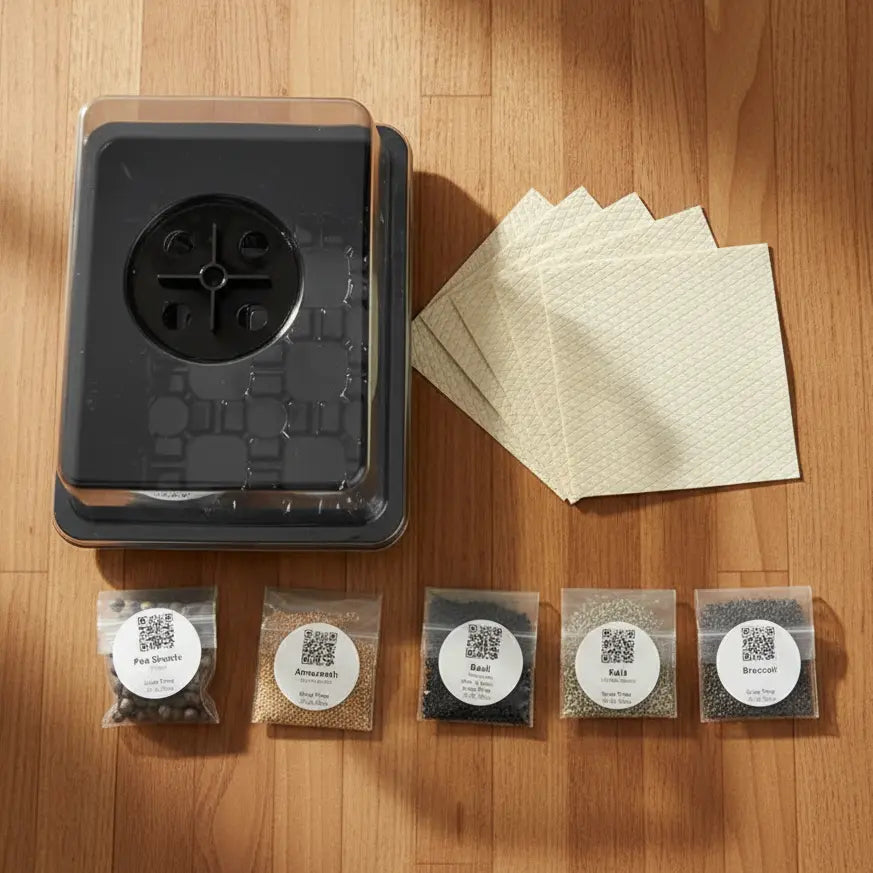
The easiest way to test whether this is worth expanding into a habit is to start with a single tray rather than overthinking the setup. The Microgreens Starter Kit includes the tray, dome, and organic grow mat for $29.99, so the only decision left is which seeds to start with.
Broccoli is a good first pick if nutrition is part of the motivation. The Broccoli Microgreens Seeds are one of the most researched varieties for nutrient density, on top of the water and pesticide advantages that apply to any variety on this list.
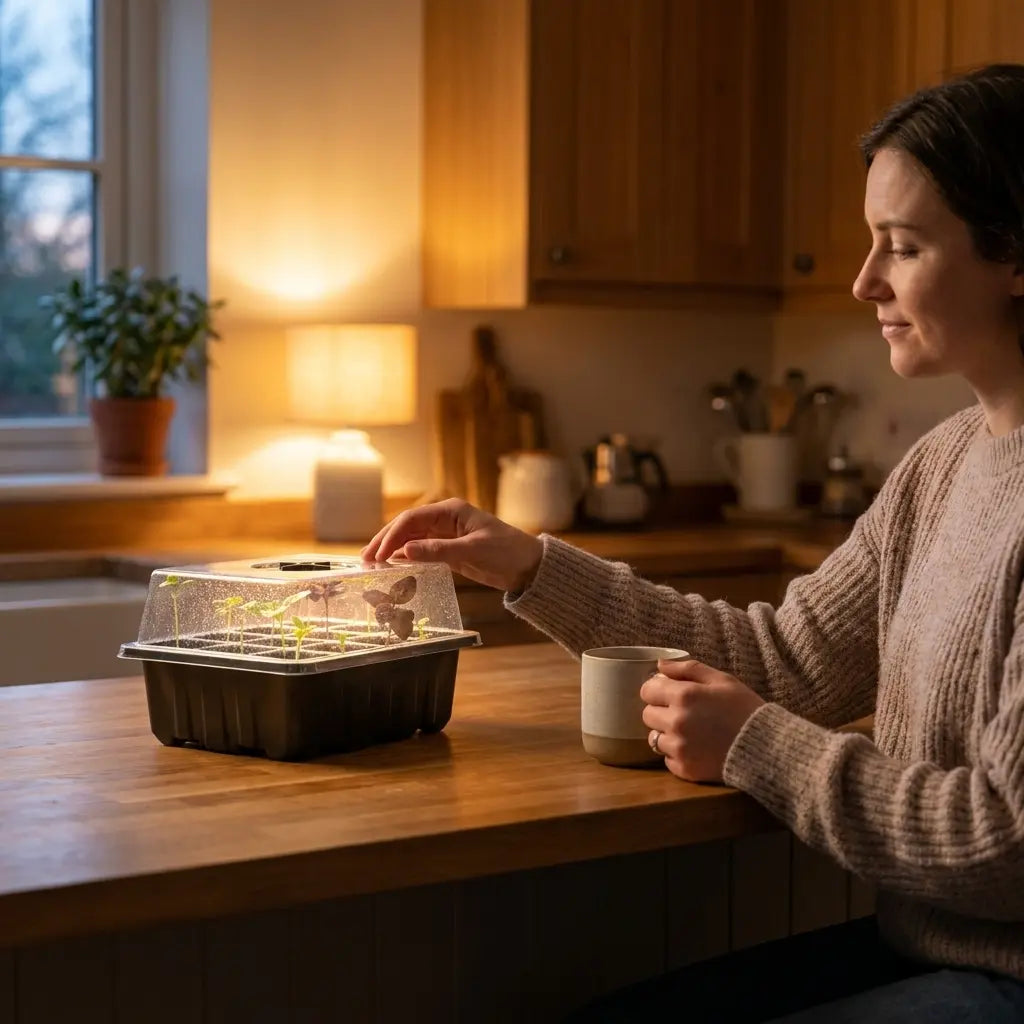
Checking the tray once a day for moisture is typically all the maintenance a small setup needs. That's a lower time commitment than most people expect, and it's a large part of why the water savings hold up in practice rather than only on paper.
If you're brand new to growing anything indoors, our beginner's guide to growing your first tray in 7 days walks through the setup step by step, so there's no guesswork on day one.
Sustainable Microgreens FAQ
How much water do microgreens actually save compared to field crops?
Comparisons based on growing cycle and delivery method put the savings between 93 and 98% less water per harvest, largely because microgreens are watered for days instead of weeks or months.
Do microgreens really need zero pesticides?
Most home-grown microgreens never need any pesticide. Growing on a small, enclosed grow mat indoors removes the soil-based pest pressure that drives most pesticide use in field agriculture.
Is growing microgreens at home actually better for the environment?
It's a real but modest improvement, mainly through water savings, no shipping, and less packaging waste. It's not a substitute for larger-scale environmental action, but it is a genuine one.
How long does it take to see a harvest?
Most varieties are ready in five to fourteen days, which is part of why the water and resource savings are as large as they are compared to a full growing season in a field.
Do I need any special equipment to start?
No. A tray, a grow mat, water, and a bit of light are enough. The Microgreens Starter Kit includes everything needed to start on day one.
Are microgreens as nutritious as the full-grown vegetable?
Often more concentrated per gram, though not identical. Research on varieties like broccoli and radish shows microgreens can carry higher levels of certain vitamins and antioxidants than the mature plant, using a fraction of the water and time.
Does growing microgreens actually reduce my carbon footprint in a meaningful way?
On its own, a small but real amount. The bigger value is in the combination: less water, no pesticides, no shipping, and less food waste all pointing in the same direction, which is rare for a single, low-effort habit.
Conclusion
Earth Day tends to produce a lot of general advice and not much specific data. Microgreens are one of the rare exceptions, with real numbers behind the water savings, the lack of pesticides, and the shipping that never has to happen.

None of this requires treating a kitchen counter as a solution to climate change. What it offers is a genuinely lower footprint way to grow a real portion of your own food, with numbers behind the claim rather than just good intentions.
If you're new to growing anything indoors, our beginner's guide above covers the basics before you start, and our piece on why microgreens are the most nutritious vegetables you can eat is worth a look if nutrition is part of why you're doing this in the first place. And if a full garden still feels out of reach, our guide to growing microgreens with no garden needed covers how little space this actually takes.
Author: Aquager · Published: July 12, 2026 · Updated: October 11, 2026












0 comments