
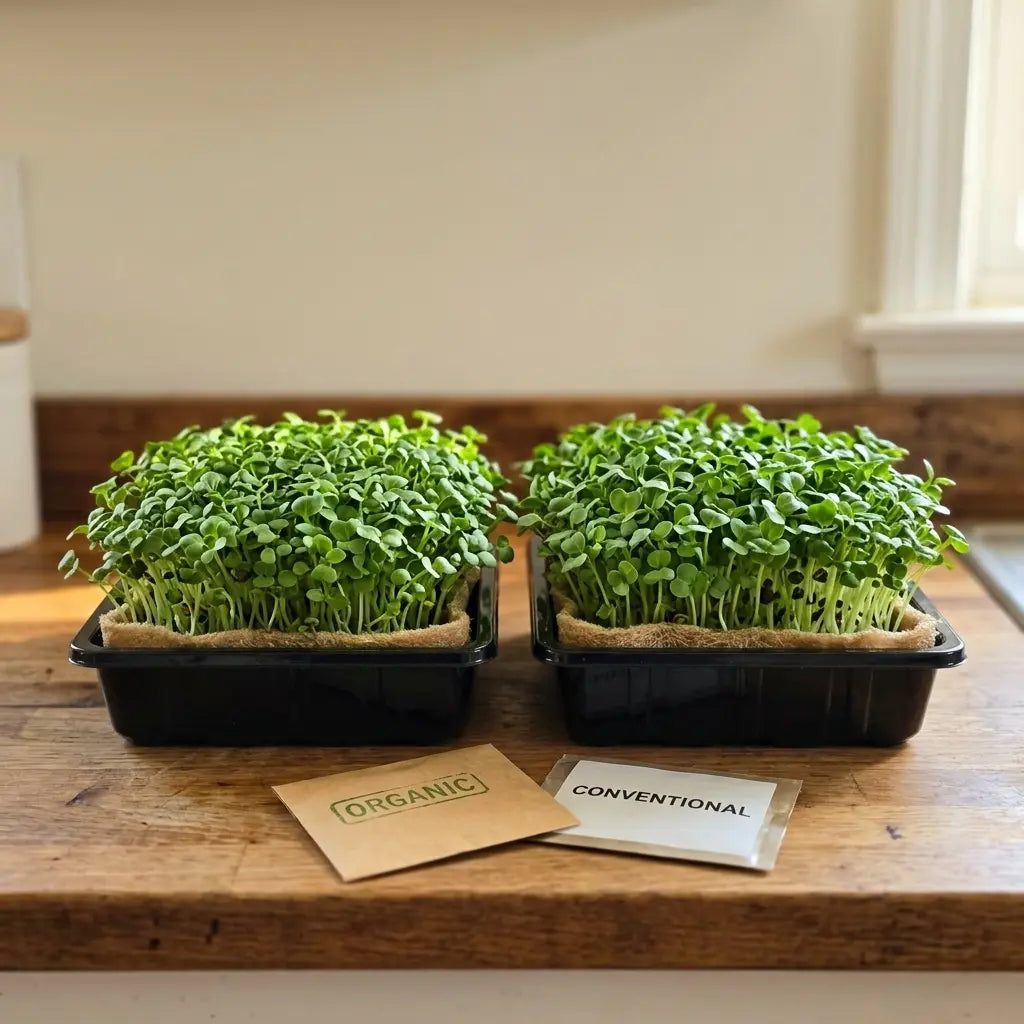
You are standing in front of two seed packets. One says organic. One does not. The organic one costs more, sometimes a little, sometimes double, and you are trying to decide if that is a smart purchase or just a nicer label.
For garden vegetables grown outdoors, that price difference often buys real protection from sprayed pesticides. For a tray of microgreens grown on your kitchen counter, the equation looks a little different.
This guide breaks down the honest price difference between organic and conventional microgreens seed, what that price actually buys you indoors, and where your money genuinely matters versus where it does not. By the end, you should be able to look at any two packets side by side and know exactly which factors are worth paying extra for and which ones are just marketing.
The Price Difference: What Organic Seeds Actually Cost
At most garden retailers, organic seed packets run anywhere from 20 percent to double the cost of conventional seed for the same variety. Certification, testing, and smaller-scale organic seed production all add cost somewhere along the line.
That price gap is not universal, though. Inside our own catalog, Radish Confetti Mix Microgreens, which is organic, and Clover Microgreens Seeds, which is not, are both priced at $3.99. Same tray, same grow mat, same price, regardless of which seed type you pick.
The lesson here is not that organic seed is never worth more. It is that the price difference depends heavily on where you shop, and it is worth checking rather than assuming one label always costs more.
How Store Pricing Actually Breaks Down
It helps to understand where that organic premium comes from before deciding whether to pay it. A meaningful chunk of the extra cost covers certification fees, since organic growers pay annually to maintain their status with an accredited certifying body, and that fee gets spread across every packet they sell.
Smaller-scale seed production is another factor. Organic seed farms tend to be smaller operations than conventional seed producers, so they lack some of the economies of scale that keep large conventional seed costs down.
Testing and traceability requirements add cost too. Organic seed has to be tracked and verified at more points along the supply chain, from field to packet, and that paperwork is not free.
None of this means the premium is unjustified. It just means the extra cost is mostly covering process and paperwork upstream of your kitchen counter, not something that changes what happens once the seed lands on a grow mat indoors. Once you understand that, it becomes easier to judge whether a specific price gap at a specific retailer is worth paying.
Organic vs. Non-GMO: Two Labels That Get Confused
Shoppers often lump organic and non-GMO into the same idea, but they answer different questions. Organic certification covers how a crop was grown, including restrictions on synthetic fertilizers and pesticides. Non-GMO simply means the seed was not genetically modified, regardless of how it was grown afterward.
A seed can be non-GMO without being organic, and in practice, nearly all microgreens seed on the market, organic or not, is non-GMO anyway, since genetically modified seed is rare in the microgreens categories home growers typically buy.
This matters for the price question because a packet labeled non-GMO is not automatically more expensive or more virtuous than a conventional one. If a seed's marketing leans hard on the non-GMO label without also being certified organic, you are likely paying for a label that most microgreens seed already qualifies for by default.
Why the Controlled Indoor Environment Changes the Math
Outdoor organic produce earns part of its price premium from avoiding sprayed pesticides and herbicides used to fight weeds, insects, and fungus over a full growing season. Microgreens never face that problem in the first place.
A tray of microgreens grows indoors, on a grow mat, for 7 to 14 days total. There is no outdoor pest pressure, no weeds competing for nutrients, and no reason to ever spray anything on a tray sitting on your counter, organic seed or not.
This means the biggest reason people pay more for organic outdoors, avoiding pesticide residue, mostly does not apply indoors. Neither an organic nor a conventional microgreens tray gets sprayed with anything during its short life. If you want the fuller picture on this specific point, our post on whether microgreens are pesticide-free goes deeper into exactly why.
So if pesticide avoidance is not the reason to pick organic microgreens seed, the real question becomes whether organic buys you anything else worth paying for.

Where Organic Actually Does Make a Difference: Germination Rate
Organic seed producers are often held to stricter seed testing standards, including minimum germination rate thresholds before a batch can be sold and certified. That does not guarantee every organic packet outperforms every conventional one, but it does tilt the odds.
In practice, a higher germination rate means fewer bare patches in your tray and a more even, dense harvest. A packet that germinates at 90 percent instead of 75 percent fills the same tray with visibly more usable microgreens.
This is a real, practical reason to lean organic when the price difference is small, since a slightly higher germination rate directly affects how much food you actually get out of every tray you plant.
Think of it in terms of cost per usable tray rather than cost per packet. A $3.99 packet that fills 90 percent of a tray is a better deal than a $2.99 packet that only fills 70 percent, even though the second one looks cheaper on the shelf. Bare patches are wasted growing space you already paid for, whichever seed type left them behind.
Germination rate is also something you can check yourself before committing to a brand long term. Soak a small test batch of 20 to 30 seeds between damp paper towels and count how many sprout within the expected window. A rate consistently above 85 to 90 percent is a good sign regardless of whether the packet says organic or conventional.
Phytonutrient Content: Is Organic Really More Nutritious?
Some research suggests organically grown produce can carry modestly higher levels of certain phytonutrients and antioxidants, a difference some researchers attribute to plants producing more of their own defensive compounds without synthetic fertilizer support.
The research on this is genuinely mixed, and the effect size, when it shows up at all, tends to be small. It is not a dramatic nutritional gap, more a modest edge that varies by crop and growing conditions.
For microgreens specifically, the variety you choose usually matters far more than the organic label. A nutrient powerhouse like red amaranth or broccoli will out-nutrition a milder organic variety by a wide margin. Our full microgreens nutrition comparison across all 18 varieties is a better lever to pull if nutrition is your main goal.
Treat the phytonutrient argument as a small tiebreaker, not a headline reason to pay significantly more for organic seed.
It is also worth remembering that microgreens as a category already deliver an outsized phytonutrient punch compared to their mature-plant counterparts, often several times higher concentrations of vitamins and antioxidants per gram. Against that backdrop, the organic-versus-conventional gap is a small adjustment on top of an already strong baseline, not the difference between a nutritious food and a non-nutritious one.
A Simple Framework for Deciding
If you want a quick way to decide without re-reading all of the above every time you shop, use this three-question checklist.
First, how big is the price gap at this specific retailer? If organic costs about the same or only slightly more, the germination advantage alone makes it the easy choice. If it costs noticeably more, move to the next question.
Second, does this variety show a real germination difference between the organic and conventional options you are comparing? If you have grown both before and noticed bare patches with the conventional packet, that is worth paying to fix. If germination has been solid either way, the price gap buys you less.
Third, does the pesticide-free argument even apply here? For anything grown outdoors and eaten raw, yes. For a tray grown indoors on a clean mat with just water, as covered above, that argument mostly falls away, so it should not be the deciding factor for microgreens specifically.
Answer those three questions honestly and the choice usually becomes obvious, rather than defaulting to whichever packet has the more reassuring label.
So Is the Price Difference Worth It?
Here is the honest verdict. The classic case for organic, avoiding pesticide exposure, mostly does not apply to microgreens grown indoors on a clean mat, since neither seed type ever gets sprayed during the grow.
What organic can genuinely offer is a modestly higher and more consistent germination rate, plus a small, debated edge in phytonutrient content. Both are real, but neither justifies paying double.
If a retailer prices organic seed only slightly higher, the germination benefit alone often makes it worth choosing. If the premium is steep, conventional seed grown in the same clean indoor setup will still give you a safe, healthy tray of microgreens.
Growers who go through several packets a month feel this math the most, since a small per-packet premium compounds fast over a year of regular planting. For occasional growers planting a tray here and there, the total dollar difference over a year is small enough that picking whichever variety and seller you trust most matters more than the organic label itself.
At Aquager, we priced our organic and non-organic microgreens seeds the same on purpose, so you never have to choose based on cost. The Radish Confetti Mix and Clover Microgreens Seeds sit side by side at the same $3.99, so the decision comes down to flavor and variety, not budget.
FAQ: Organic vs. Conventional Microgreens
Do organic microgreens taste different from conventional ones?
Not meaningfully. Flavor differences between microgreens varieties come from the variety itself, like radish versus basil, far more than from whether the seed was organic or conventional.
Are conventional microgreens safe to eat?
Yes. Grown indoors on a grow mat with just water, conventional microgreens are never sprayed with pesticides, herbicides, or fungicides, the same as organic ones.
Does organic seed germinate better than conventional seed?
Often modestly better, thanks to stricter testing standards organic seed producers tend to follow, though quality varies by brand regardless of the organic label.
Is the pesticide-free label meaningful for microgreens grown at home?
Less than it sounds. Since neither organic nor conventional trays are ever sprayed indoors, the pesticide-free claim is really describing the growing method, not a special property of organic seed.
Which Aquager microgreens seeds are organic?
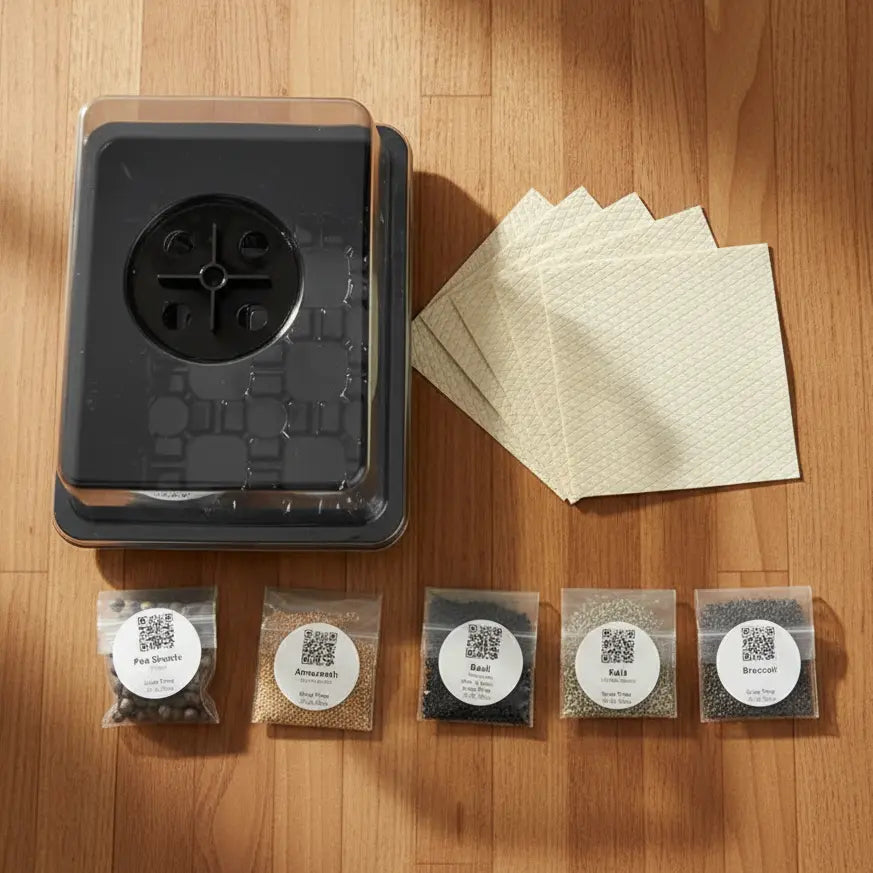
Most of our microgreens seeds are organic by default, including radish, broccoli, sunflower, and pea shoots. Clover and Basil Lemon are our current non-organic options, both priced the same as the organic line.
Is non-GMO the same thing as organic?
No. Non-GMO only means the seed was not genetically modified, while organic covers the entire growing process. Most microgreens seed on the market is non-GMO regardless of whether it carries an organic label.
Should I pay more for organic microgreens seed if the price gap is large?
Not automatically. Check whether the germination rate is actually different between the two options first, since that is the main practical benefit organic offers indoors. A large price gap without a noticeable germination difference is harder to justify.
The Bottom Line
The price difference between organic and conventional microgreens seed is real, but the reason people usually pay it, avoiding pesticides, does not apply to a tray grown indoors on a clean mat.
What is left is a small germination advantage and a debated nutrient edge, both worth a modest premium but not a doubled price tag. If you are getting started, our guide to growing your first tray indoors in 7 days works the same whichever seed type you choose.
Pick the variety you actually want to eat first, then let price and germination rate settle any tie between organic and conventional.

Author: Aquager · Published: July 19, 2026 · Updated: July 19, 2026














0 comments