
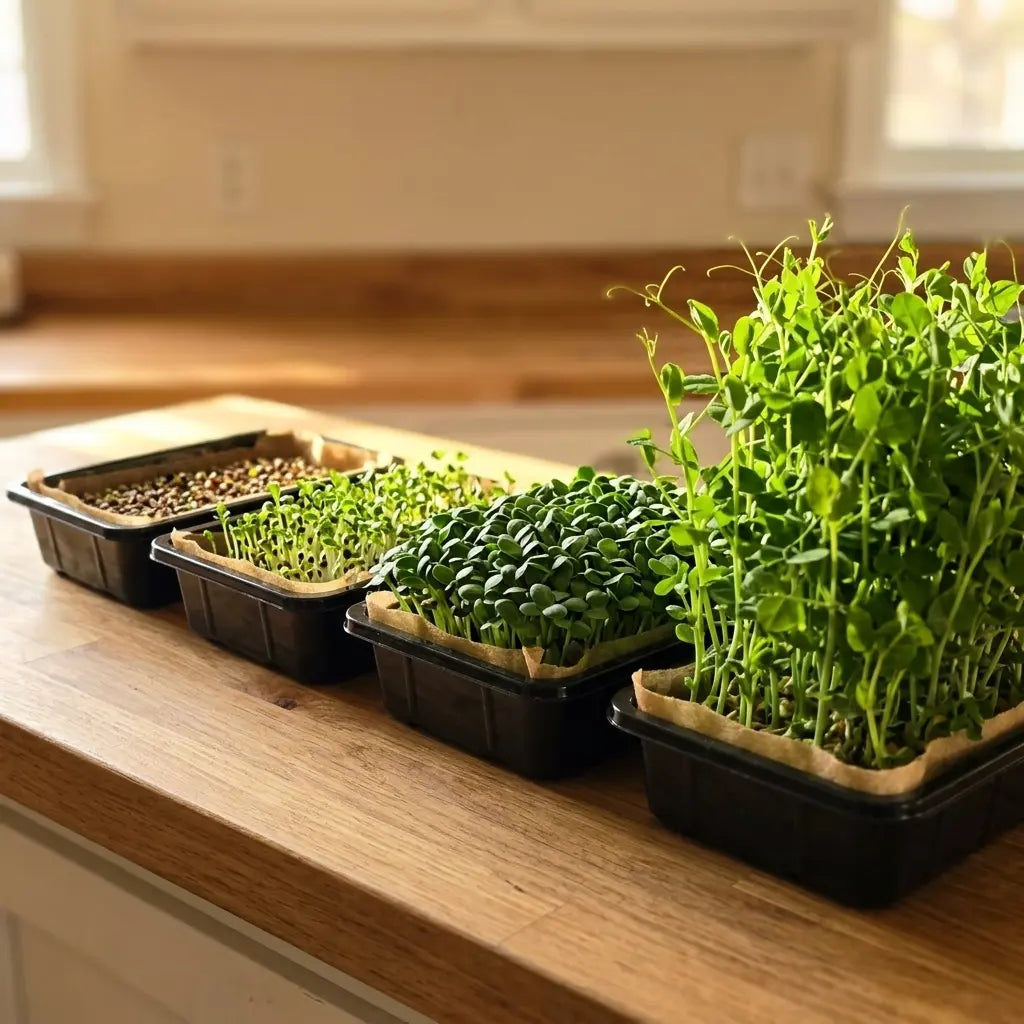
You plant one tray, wait patiently for a week, and suddenly you have more fresh microgreens than you can eat before they start to fade. Then the tray is empty, and you are back to store-bought greens for another week while a new batch grows.
This feast or famine cycle is the single biggest thing separating beginners from people who always have fresh microgreens on hand. The fix has nothing to do with growing faster. It is about timing.
A simple microgreens planting schedule, where you start a new tray every 5 to 7 days instead of one tray at a time, turns an occasional harvest into a steady, continuous one. This guide walks through exactly how to set that schedule up.
If this sounds familiar, the good news is that the fix is almost entirely a scheduling change, not a growing skill you are missing.
The Problem With Planting One Tray at a Time
Most beginners plant a single tray, grow it out, harvest it, eat their way through it over a few days, and only then think about starting the next one. That gap between trays is where the famine part of the cycle happens.
Since most microgreens take 7 to 14 days from seed to harvest, planting one tray at a time means going a week or two with nothing ready, followed by a sudden surplus you have to rush to use before it wilts.
The surplus phase has its own cost too. Microgreens taste and look best within a few days of harvest, so a giant one-time batch often means eating fast to avoid waste, or watching some of it go limp in the fridge before you get to it.
Meanwhile, the gap week usually gets filled with store-bought microgreens or skipping them entirely, which defeats a lot of the point of growing your own in the first place.
None of this is a sign you are doing anything wrong. It is just what happens when growing and harvesting are treated as one single event instead of an ongoing rhythm. The moment you stop planting trays one at a time, the whole cycle smooths out on its own.
This Technique Has a Name: Succession Growing
Outdoor gardeners have used this idea for generations under the name succession growing, planting new rows of lettuce or beans every week or two instead of all at once, so the harvest never stops.
The same logic works just as well on a kitchen counter. Instead of rows in a garden bed, you are staggering trays on a shelf, each one a few days behind the last.
Microgreens actually make succession growing easier than almost any other crop. A garden bed succession plan can take months to play out, while a microgreens rotation completes an entire cycle in one to two weeks, so you see the payoff almost immediately.
That short cycle also means mistakes are cheap to fix. If one tray in your rotation gets timed wrong, you are only a week or so away from correcting course, not an entire growing season.
The result is a continuous harvest. There is always one tray ready to cut, one tray filling in, and one tray just getting started, so you never have an empty stretch or an overwhelming glut again.
How to Build Your Microgreens Planting Schedule
Pick Your Interval: 5 to 7 Days
Most home growers land on a new tray every 5 to 7 days. That interval roughly matches how long it takes to eat through one tray's harvest, so the next one is ready right as you finish the last.
If you eat microgreens daily in larger amounts, a 5 day interval keeps up better. If it is more of an occasional garnish, stretching to 7 or even 10 days between plantings still works fine.
Track your first two or three trays for a week or two before locking in an interval. Real usage almost always looks a little different than what you expect on paper.
Choose 2 to 4 Trays to Rotate
You do not need a dozen trays running at once. Two to four trays, each a few days apart in age, is enough to keep a steady supply without turning your counter into a full-time operation.
Two trays is the minimum for a real rotation: one growing while one is being harvested and reseeded. Four trays gives you more buffer and lets you grow more than one variety at a time. See the tray math breakdown below if you want a more precise number for your household instead of a general range.
Label Every Tray With Its Start Date
Write the planting date directly on each tray, or on a small label stuck to the side. Once you have two or three trays going at slightly different ages, they get hard to tell apart by eye alone.
A simple paper schedule taped near your grow space, listing which tray was started when and when it is due to be cut, removes the guesswork entirely. Some growers prefer a small whiteboard or a note on their phone instead of paper. Whatever method you use, the goal is the same: never have to guess which tray is older just by looking at it.
Match Varieties to Your Schedule
Fast growers make the easiest staggering targets since their short cycle keeps your rotation moving quickly. Our guide on the 5 fastest-growing microgreens is a good starting point for picking varieties that fit a tight 5 to 7 day planting rhythm.
Slower varieties like sunflower can still work in a rotation, just space their plantings out further apart than a fast grower like radish or broccoli to match their longer cycle.
How Many Trays Do You Actually Need?
The honest answer depends on how much you actually eat, not on how many trays sound impressive. Start by estimating how many days it takes your household to go through one full tray's harvest.
If one tray lasts your household about a week, a single rotation of two trays, staggered five to seven days apart, keeps a steady supply without any excess. If you go through a tray in three or four days, you likely want three trays in rotation instead.
A simple formula helps here: divide the days it takes to eat one tray by your planting interval, then round up. Eating a tray in 6 days on a 6 day planting interval means two trays. Eating it in 12 days on the same interval means only one tray is really necessary, and staggering barely matters.
It is easy to start with too many trays out of enthusiasm. Begin with two, track how quickly you actually go through the harvest for a couple of weeks, and adjust the count from there instead of guessing upfront.

A Sample 3-Week Staggered Schedule
Here is what a simple rotation looks like in practice, using Radish Confetti Mix Microgreens as the example variety, since radish is fast, forgiving, and ready in about 7 to 10 days.
Day 1: plant Tray A. Day 6: plant Tray B, five days behind Tray A. Day 8: harvest Tray A, then immediately reseed it as Tray C. Day 11: harvest Tray B, then reseed it as Tray D. From here, the cycle just keeps repeating.
Once you are two or three cycles in, you always have one tray within a day or two of harvest, and reseeding becomes a quick, automatic habit rather than something you have to plan around each time.
Once the radish rotation feels automatic, try layering in a second variety on its own offset schedule. Broccoli microgreens run on a similar timeline to radish, so the two can share the same rotation rhythm without much extra math.
A two-variety week might look like this: Monday, plant Radish Tray A. Wednesday, plant Broccoli Tray A. The following Monday, harvest and reseed Radish Tray A. Wednesday, harvest and reseed Broccoli Tray A. Every day of the week now has something either being harvested, growing, or freshly planted.
Scaling this up is mostly a matter of tray count. The Microgreens Tray (Set of 6) gives you enough trays to run a full staggered rotation across two or three varieties at once, rather than juggling a single pair back and forth.
Common Staggering Mistakes to Avoid
Starting too many trays at once is the most common misstep. It feels productive in the moment, but it usually means five trays hit harvest day together, right back to the original feast or famine problem.
Inconsistent watering across trays at different stages is another one. A newly seeded tray and a nearly mature one do not need identical care, so treating every tray exactly the same can leave one too dry or too wet.
Skipping the harvest day workload is easy to underestimate too. Cutting, rinsing, and reseeding a tray only takes a few minutes, but if it keeps getting pushed back a day, the whole schedule slowly drifts out of rhythm. Our guide on how to harvest microgreens the right way covers a quick, repeatable process that keeps harvest day from becoming a chore.
Using a different grow mat quality or age across trays in the same rotation can throw off timing too, since an older or lower quality mat may hold water differently than a fresh one. Keeping mat quality consistent removes one more variable from an already moving schedule.
Forgetting to restock seed is another quiet schedule-breaker. Running low mid-rotation forces a skipped planting day, which then pushes every tray after it a few days late. Keep at least one extra packet of your main variety on hand.
FAQ: Staggered Microgreens Planting
How often should I start a new tray of microgreens?
Every 5 to 7 days works well for most households. Adjust shorter if you eat microgreens daily, or longer if you only use them occasionally.
Can I stagger different varieties together?
Yes. Many growers rotate two or three varieties with similar grow times, like radish and broccoli, so each tray in the rotation adds some variety along with the timing.
How many trays do I need for a continuous harvest?
Two trays is the minimum for a basic rotation. Three or four gives you a more comfortable buffer and room to grow more than one variety at once.
What happens if I miss a planting day?
Nothing serious. Just plant the next tray as soon as you remember and treat that as your new start date. The schedule bends easily since it is based on intervals, not a fixed calendar.
Do I need special equipment to stagger plantings?
No special equipment is required, just enough trays to keep two or more staggered at once and a simple way to track start dates, even if that is just a sticky note on each tray.
Does staggered planting work with just one grow light or window spot?
Yes, as long as there is enough room for two or more trays at once. Staggering is about timing, not needing multiple light sources or setups.
The Bottom Line: Plant Continuously, Harvest Continuously
A microgreens planting schedule is less about complexity and more about habit. Start a new tray every 5 to 7 days, label it, and let the rotation carry itself once it is running.
Within a few cycles, you stop thinking about it as a schedule at all. It just becomes the normal rhythm of always having a tray a day or two from ready.
The households that stick with this longest are rarely the ones with the most complicated system. They are the ones who picked a simple interval, wrote it down somewhere they would actually see it, and kept going.
If you are still getting comfortable with the basics, our guide to growing your first tray indoors in 7 days is worth mastering before adding a second tray into the rotation.
Prefer a slower pace? The 2027 Microgreens Growing Challenge keeps it to one tray and one new variety per month.

Author: Aquager · Published: July 19, 2026 · Updated: October 24, 2026













0 comments