
If you’ve ever bitten into a microgreen and felt an unexpected rush of heat, you already know that not all microgreens are mild. A handful of radish microgreens on a taco has more bite than most hot sauces achieve at half the volume. Mustard microgreens can make your eyes water. And arugula — the most misunderstood of the three — delivers a complex, peppery-nutty heat that changes character depending on how you use it.
The source of that heat isn’t capsaicin — the compound responsible for pepper heat. It’s an entirely different chemical family called glucosinolates, and the way they work in your mouth is distinct in ways that matter for cooking. Understanding the difference makes you a better cook and helps you choose the right variety for your kitchen.
This post ranks the three spiciest microgreens you can grow at home, from boldest to most complex. Each one gets a full profile: heat level, flavor character, grow time, and the dishes where it performs best. By the end you’ll know exactly which one to start with — and which ones to add once you’re hooked.
How Spice Works in Microgreens (It’s Not Capsaicin)
Pepper heat — the kind from jalañeos, chilis, and hot sauce — comes from capsaicin, a compound that binds to the same receptors in your mouth that detect actual heat. It creates a burning sensation by tricking your nervous system.
Microgreen spice is chemically different. The heat in mustard, radish, and arugula microgreens comes from glucosinolates — sulfur-containing compounds stored in the plant cells. When tissue is damaged by chewing, an enzyme called myrosinase converts glucosinolates into isothiocyanates. These isothiocyanates are the active spicy compounds — and they work by triggering a sharp, sinus-clearing sensation rather than a lingering burn.
This is why spicy microgreens feel different from pepper heat. The hit is immediate and bright — it rises into your sinuses, clears your head, and dissipates relatively quickly. It’s closer to wasabi or fresh horseradish than to jalañeo. And because the conversion requires enzymatic activation, cooking destroys the effect: myrosinase is heat-sensitive, so cooked spicy microgreens lose most of their heat. They perform best raw, as finishers.
#1 — Mustard Microgreens: The Hottest, Fastest Spicy Microgreen
Heat level: 🌶️🌶️🌶️🌶️🌶️ (5/5)
Flavor profile: Horseradish-forward, sharp, sinus-clearing, bold
Grow time: 5–7 days
Best for: Sushi, ramen, deviled eggs, steak, oysters, cold noodles
Mustard microgreens are the undisputed heat champion of the microgreen world. One bite delivers an immediate, nose-clearing rush that’s closer to fresh horseradish or wasabi than anything in the pepper family. The heat peaks fast and dissipates within 20 to 30 seconds, leaving a clean finish that doesn’t linger and doesn’t build the way capsaicin does.
The flavor behind the heat is complex: there’s a mustardy bitterness underneath the spice, with a faintly earthy, green note. It’s a bold variety — one where a small quantity makes a significant impact. A pinch on a deviled egg changes the entire dish. A few stems across a piece of raw fish elevates it to something restaurant-quality.
Why mustard works where it works: The sharpness of mustard microgreens cuts through fat and rich flavors in a way that no other microgreen does. It’s the same reason mustard has been a condiment for centuries — the compounds that create the heat also act as flavor amplifiers, making surrounding flavors more vivid and defined. Mustard microgreens deliver that effect in a fresh, living form.
Grow time and difficulty: Mustard is also one of the fastest microgreens you can grow — 5 to 7 days from seed to harvest. Small seeds, reliable germination, no soak required. It’s one of the varieties featured in our guide on The 5 Fastest-Growing Microgreens (Harvest in 7 Days or Less).
Best dishes:
- A pinch on raw oysters or sashimi
- Scattered over ramen just before serving
- Folded into tuna or egg salad for heat without the bulk
- Layered on a roast beef or pastrami sandwich in place of prepared mustard
- Topping for deviled eggs at the moment of serving
→ Mustard Microgreens Seeds — $3.99 (includes organic grow mat)
#2 — Radish Confetti Mix: Sharp, Peppery, and Visually Stunning
Heat level: 🌶️🌶️🌶️🌶️ (4/5)
Flavor profile: Sharp, peppery, bright, slightly bitter, clean finish
Grow time: 5–7 days
Best for: Tacos, burgers, avocado toast, Asian noodle dishes, charcuterie boards
Radish microgreens hit differently than mustard — the heat is there immediately, but it’s sharper and more defined rather than sinus-clearing. Think of it as a clean, bright pepper heat with no horseradish depth. It adds a punch without the complexity of mustard, which makes it more versatile as an everyday ingredient.
The Confetti Mix is a blend of multiple radish varieties — some producing green stems, others red, purple, or white — creating a tray that’s as striking visually as it is bold in flavor. On a plate, radish confetti microgreens are one of the most photogenic garnishes you can grow. On a taco, they replace both chopped radish and salsa in a single topping.
Why radish microgreens work everywhere: The sharpness of radish cuts through rich, fatty dishes — burgers, avocados, egg yolks — in the same way that a squeeze of lemon does for fish. It provides contrast rather than heat for heat’s sake. And because radish microgreens are more approachable than mustard for most palates, they’re the variety that converts the most skeptics into repeat growers.
Grow time and difficulty: Equally fast at 5 to 7 days. Small seeds, no pre-soaking needed, reliable germination across the color varieties in the Confetti Mix. The color variation (some stems purple, some red) can make early growth look uneven — it isn’t, it’s just genetic variation. All varieties reach harvest at the same time.
Best dishes:
- Radish microgreens on fish tacos (peppery contrast to lime and cream)
- Scattered across a burger or smash burger in place of sliced radish
- On avocado toast with flaked salt and olive oil
- Used in Asian-inspired cold noodle dishes alongside sesame and scallion
- Arranged on a charcuterie board alongside cured meats and sharp cheese
→ Radish Confetti Mix Microgreens Seeds — $3.99 (includes organic grow mat)
#3 — Arugula Microgreens: Complex, Peppery, and Surprisingly Versatile
Heat level: 🌶️🌶️🌶️ (3/5)
Flavor profile: Peppery, nutty, slightly bitter, complex, earthy finish
Grow time: 7–10 days
Best for: Pizza, pasta, caprese, grain bowls, egg dishes, flatbreads
Arugula microgreens are the most misunderstood of the three. They’re the mildest in terms of glucosinolate-driven heat — but in terms of flavor complexity, they’re arguably the most interesting. Where mustard is about heat and radish is about sharpness, arugula is about depth.
The flavor profile has three distinct layers: an initial peppery bite, a nutty middle note, and a slightly bitter finish. That bitterness is less pronounced than in full-grown arugula — the microgreen version is more balanced, which is why many people who dislike mature arugula actually enjoy arugula microgreens. The flavor moderates significantly at the cotyledon stage.
Why arugula microgreens are the Italian kitchen’s secret: In Italian cooking, arugula is used as a finishing green — scattered raw over pizza straight from the oven, draped across pasta, laid over a caprese just before serving. Arugula microgreens do all of that with a more delicate texture and a less aggressive bite. They’re the variety that makes a simple dish look and taste restaurant-quality with almost no effort.
Grow time and difficulty: Slightly slower at 7 to 10 days. One note: arugula seeds are mucilaginous — they become sticky and gel-like when wet, which can cause clumping. Spread them while dry on the grow mat rather than after soaking.
Best dishes:
- Scattered across a pizza fresh from the oven (classic Italian finish)
- On a caprese salad with burrata, tomato, and basil
- Draped over pasta — cacio e pepe, aglio e olio, or a simple butter sauce
- Layered on a flatbread with ricotta and prosciutto
- On eggs — particularly fried eggs on toast with olive oil and flaked salt
→ Arugula Microgreens Seeds — $3.99 (includes organic grow mat)
Spicy Microgreens at a Glance
| Mustard | Radish Confetti | Arugula | |
|---|---|---|---|
| Heat level | 🌶️🌶️🌶️🌶️🌶️ | 🌶️🌶️🌶️🌶️ | 🌶️🌶️🌶️ |
| Flavor | Horseradish, bold | Sharp, peppery | Peppery-nutty, complex |
| Grow time | 5–7 days | 5–7 days | 7–10 days |
| Best use | Raw finish, rich dishes | Everyday garnish | Italian / egg dishes |
| Difficulty | Easy | Easy | Easy (dry seed tip) |
Which Spicy Microgreen Should You Start With?
Start with radish if: You want the most versatile everyday ingredient. Radish Confetti microgreens go with the widest range of dishes, look the most dramatic on a plate, and deliver real heat without requiring much adjustment to how you already cook. Best first spicy microgreen for most people.
Start with mustard if: You already love wasabi, horseradish, or strong mustard condiments and want a microgreen that makes an immediate, impressive impact. Mustard is the boldest choice — the one you grow to show people what microgreens can really do. Also the fastest, which means fast gratification.
Start with arugula if: You cook Italian food regularly, or you want a spicy microgreen that blends seamlessly into dishes rather than announcing itself. Arugula is the most culinary of the three — the one professional cooks reach for when they want elegance rather than heat as a statement.
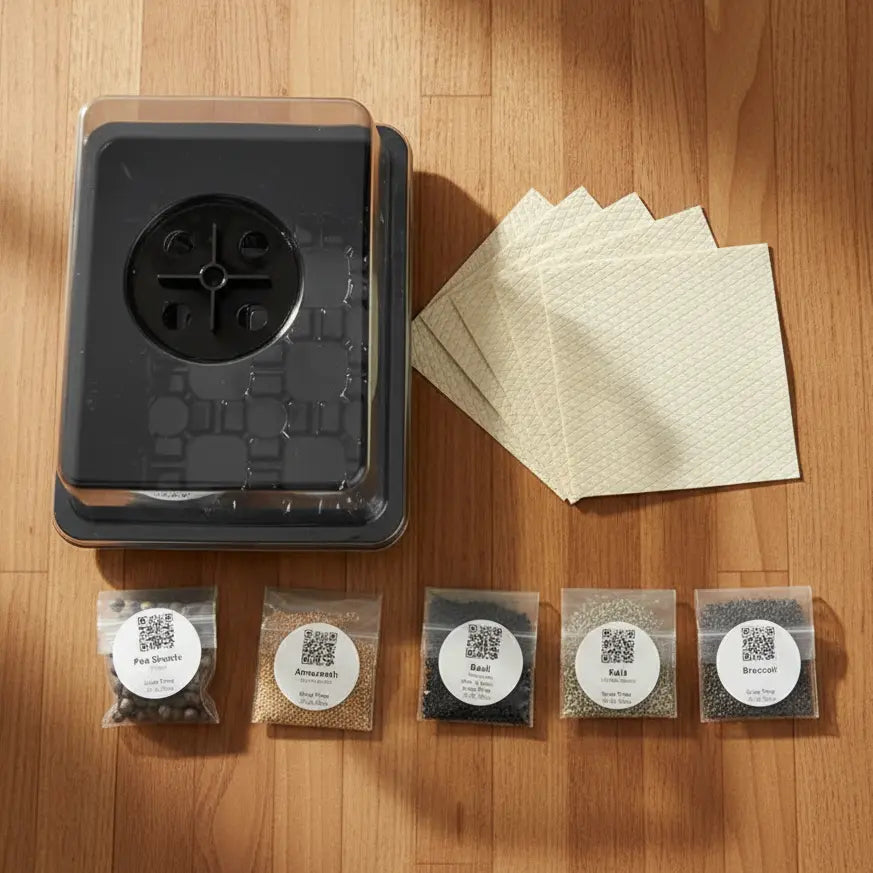
The honest answer: get all three. Each one occupies a different flavor niche. With three packs at $3.99 each, you can stagger your plantings and have a rotating supply of all three varieties. The Microgreens Starter Kit — $24.99 — includes the tray, dome, and grow mat to get started. Each seed pack includes an additional mat.
Frequently Asked Questions
What makes microgreens spicy?
The heat in spicy microgreens — mustard, radish, and arugula — comes from glucosinolates, sulfur-containing compounds that convert to isothiocyanates when plant tissue is chewed or cut. This creates a sharp, sinus-clearing sensation similar to wasabi or horseradish, distinct from capsaicin (pepper heat), and dissipates more quickly.
Do spicy microgreens lose heat when cooked?
Yes. The myrosinase enzyme that activates the spicy compounds is deactivated by heat above approximately 140°F. Always use spicy microgreens raw — as a topping or garnish added after cooking, never in the heat of the pan.
Which microgreen is the spiciest?
Mustard microgreens are consistently the hottest, with the highest concentration of glucosinolates and the most pronounced sinus-clearing heat. Radish Confetti is close behind. Arugula microgreens are the mildest of the three, with more flavor complexity than raw heat intensity.
Are spicy microgreens nutritious?
All three are nutritionally dense. Glucosinolates are associated with antioxidant and anti-inflammatory activity — the same chemical family includes sulforaphane, studied for cancer prevention in broccoli microgreens. Radish and arugula microgreens are also good sources of vitamins C and K. See our full breakdown in Microgreens Benefits: The 7 Most Nutritious Varieties, Ranked by Science.
How long do spicy microgreens take to grow?
Mustard and radish both reach harvest in 5 to 7 days — among the fastest microgreens available. Arugula takes 7 to 10 days. All three are straightforward grows with no special equipment required beyond a tray, grow mat, and seeds.
Can I grow all three at the same time?
Yes — and it’s the best approach. Stagger the plantings by 5 to 7 days so you’re harvesting one variety while the next is mid-cycle. With three trays rotating, you’ll have a fresh spicy variety every week indefinitely.
Grow All Three — Your Kitchen Will Thank You
The best argument for growing spicy microgreens is how dramatically they change everyday cooking with almost no effort. A plain fried egg becomes a restaurant plate when you add arugula microgreens and flaked salt. A store-bought taco becomes something worth talking about with radish confetti across the top. A seared piece of salmon becomes a dish with presence when finished with mustard microgreens and a squeeze of lemon.
All three are among the easiest microgreens to grow — fast cycles, reliable germination, minimal equipment. For a complete beginner’s walkthrough, start with How to Grow Microgreens at Home: The Complete Beginner’s Guide.
Pick one to start, or grab all three and build the rotation immediately. The Microgreens Starter Kit gets you the tray and mat; each seed pack includes an additional grow mat so you’re covered for the first three plantings with no additional purchases.
Author: Aquager Team · Published: June 1, 2026 · Updated: September 12, 2026 · Reviewed: September 12, 2026 (Phase 2)















0 comments