
Broccoli microgreens have been at the center of cancer prevention research for over two decades — yet most people have never heard of them. While you'd need to eat nearly 1.5 pounds of mature broccoli to get a meaningful dose of sulforaphane, a small handful of broccoli microgreens delivers the same amount. That's not a marketing claim. It's the finding of one of the most-cited plant nutrition studies ever published, out of Johns Hopkins University.
This post covers what the science actually says — specifically about sulforaphane, breast cancer research, and the biological mechanisms involved. It also explains how to grow broccoli microgreens at home so you can add this compound to your diet in the simplest, most concentrated way possible.
One important note before we start: this article is not medical advice. Dietary research shows associations and biological mechanisms — it does not replace working with your oncologist or healthcare provider. What it does is give you well-grounded, research-backed information to make informed choices about what you eat.
What Is Sulforaphane?
Sulforaphane is a sulfur-rich compound found in cruciferous vegetables — broccoli, cauliflower, kale, Brussels sprouts, and cabbage. Of all these vegetables, broccoli contains the highest concentration. And of all the stages of broccoli's life cycle, the seedling stage — between 3 and 10 days old — contains the most, by a wide margin.
Here's the mechanism: broccoli seeds and sprouts store glucoraphanin, a stable precursor compound. When plant tissue is damaged — by chewing, cutting, or crushing — an enzyme called myrosinase converts glucoraphanin into sulforaphane. It's the plant's chemical defense system, and it turns out to be remarkably beneficial for human biology.
Sulforaphane belongs to a class of compounds called isothiocyanates. The property that drew serious scientific attention: sulforaphane activates Nrf2, a protein that switches on the body's Phase 2 detoxification enzymes — the cellular cleanup crew that neutralizes carcinogens before they can damage DNA.
Sulforaphane Benefits: The Johns Hopkins Research
In 1997, researchers at Johns Hopkins University published a landmark paper in the Proceedings of the National Academy of Sciences demonstrating that three-day-old broccoli sprouts contain 20 to 50 times more glucoraphanin than mature broccoli plants. The lead researcher, Dr. Paul Talalay, had spent decades studying Phase 2 detox enzymes — enzymes that the body uses to identify and neutralize harmful compounds before they interact with DNA.
The mechanism works in two stages. First, sulforaphane enters cells and activates the Nrf2 signaling pathway. Nrf2 then migrates to the cell nucleus and switches on a cascade of genes responsible for producing Phase 2 enzymes — including glutathione S-transferases and quinone reductase. These enzymes bind to carcinogens, neutralize their reactivity, and tag them for excretion.
The National Cancer Institute has funded multiple subsequent studies on glucosinolates and isothiocyanates. Research specifically examining sulforaphane and breast cancer has explored several mechanisms: its effect on estrogen metabolism, its ability to inhibit breast cancer cell proliferation in laboratory conditions, and its role in supporting the BRCA1 pathway — a gene critically involved in DNA repair.
It's important to be precise here. Most sulforaphane research has been conducted in cell cultures and animal models, with some human clinical trials underway or completed for other cancer types. The research is mechanistically compelling and scientifically serious. It does not yet constitute a clinical recommendation for cancer prevention. But it does provide strong biological plausibility for why regular consumption of sulforaphane-rich foods is a reasonable dietary priority.
Broccoli Microgreens vs. Mature Broccoli: Why the Difference Is So Large
The reason broccoli microgreens pack so much more sulforaphane comes down to where the plant stores its energy and defense compounds. In the seedling stage, glucoraphanin is highly concentrated in the cotyledons — the first leaf-like structures that emerge from the seed. The plant has not yet distributed its resources across stems, leaves, and root systems. All that biological firepower is condensed into a tiny structure.
As the plant matures over weeks and months, those concentrated compounds get diluted across a much larger body of plant material. The total amount of glucoraphanin in the plant increases slightly, but the concentration per gram drops dramatically.
Research has demonstrated that broccoli sprouts and microgreens can contain anywhere from 10 to 100 times more glucoraphanin per gram than mature broccoli, depending on variety and growing conditions. The most commonly cited figure — 20 to 50 times — comes from the original Talalay research on three-day-old sprouts. Microgreens harvested at 7 to 10 days maintain very high concentrations, typically in the 20 to 40 times range.
In practical terms: a one-ounce serving of broccoli microgreens delivers the glucoraphanin equivalent of approximately 1 to 1.5 pounds of full-grown broccoli. Most people cannot eat 1.5 pounds of broccoli daily. Most people can top a salad with a handful of microgreens.
For a deeper look at the full nutritional profile — including vitamins, minerals, and antioxidants beyond sulforaphane — see our guide on Broccoli Microgreens Benefits: Sulforaphane, Nutrition, and Why They're Worth Growing.
How to Eat Broccoli Microgreens to Preserve the Sulforaphane
There is one critical thing most articles get wrong about eating broccoli microgreens for sulforaphane: heat destroys the enzyme that makes it.
Myrosinase — the enzyme that converts glucoraphanin into sulforaphane — is heat-sensitive. Temperatures above approximately 140°F (60°C) deactivate it. Cooking broccoli microgreens significantly reduces their sulforaphane output, even if the glucoraphanin itself survives.
The rule: eat them raw, or add them after cooking.
This doesn't mean avoiding warm food. It means adding the microgreens after your food comes off the heat. A few ideas that work well:
- Scatter broccoli microgreens on a warm grain bowl or roasted vegetable plate after serving
- Use them as a topping on scrambled eggs after plating
- Layer them on sandwiches and wraps at the table
- Stir them into soup after ladling — residual heat is low enough to preserve the enzyme
- Blend them raw into smoothies with fruit or yogurt
One useful technique for cooked dishes: a small pinch of raw mustard powder. Mustard contains its own myrosinase enzyme. Adding raw mustard powder to cooked broccoli can partially restore sulforaphane conversion. This isn't necessary when eating raw microgreens, but it's a practical tool for other preparations.
The Easiest Way to Grow Broccoli Microgreens at Home
Growing broccoli microgreens at home requires no outdoor space, no soil, and no gardening experience. The entire process takes 7 to 10 days.
Step 1 — Soak the seeds. Soak broccoli microgreens seeds in water for 4 to 8 hours before planting. This kickstarts germination and speeds up the process.
Step 2 — Prepare your tray. Place a damp organic coconut coir grow mat in your microgreens tray. The mat holds moisture evenly and supports roots without any mess.
Step 3 — Spread the seeds. Scatter the soaked seeds across the mat in a single, even layer. Dense but not piled — broccoli seeds are small and need good coverage.
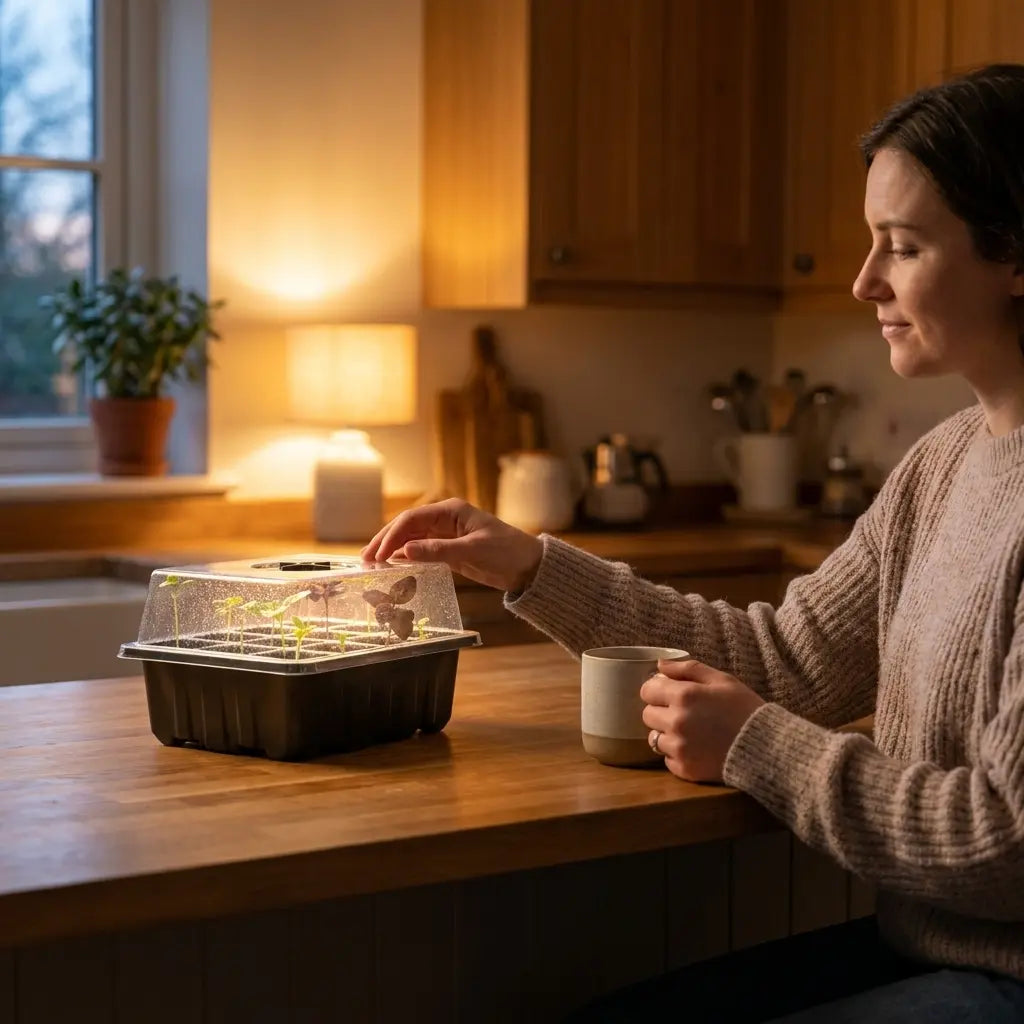
Step 4 — Cover and blackout. Stack a second tray on top or use a dome to block light for the first 3 to 4 days. Darkness pushes the seedlings upward, building strong stems.
Step 5 — Water from below. Add a small amount of water to the bottom of the tray once daily. Bottom-watering prevents mold — never mist the seeds from above.
Step 6 — Let them green up. After the blackout phase, move the tray to bright indirect light or a windowsill. Within 3 to 4 more days, the cotyledons will reach 1 to 3 inches and turn a deep, rich green.
Step 7 — Harvest. Cut just above the mat with clean scissors. Rinse and use immediately — fresh microgreens have the highest enzyme activity.
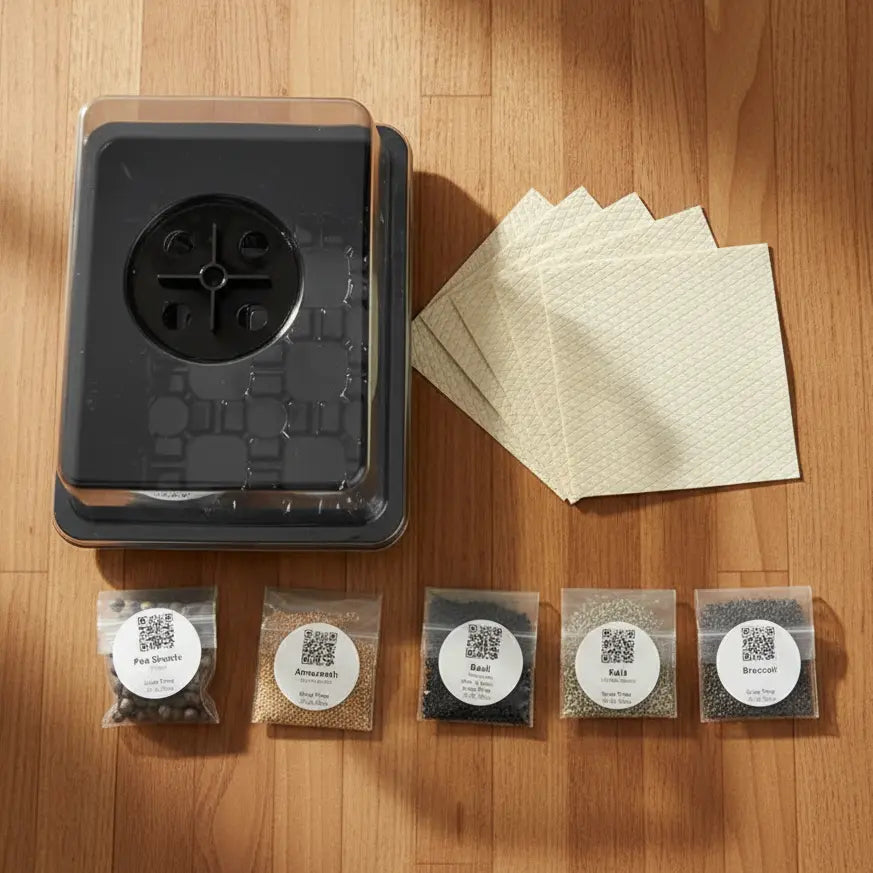
The Microgreens Starter Kit from Aquager includes the tray, dome, and organic grow mat — everything you need except the seeds. Pair it with Broccoli Microgreens Seeds and you're ready to go. The cost per tray works out to roughly $4 to $6 total in seeds and mat. Store-bought broccoli microgreens, when available, run $6 to $10 for a small clamshell — and they're never as fresh.
Frequently Asked Questions
How much sulforaphane is in broccoli microgreens?
Broccoli microgreens typically contain 20 to 50 times more glucoraphanin per gram than mature broccoli, based on the Johns Hopkins research. A one-ounce serving eaten raw is estimated to deliver sulforaphane equivalent to roughly 1 to 1.5 pounds of cooked broccoli. Exact amounts vary by seed variety, growing conditions, and preparation.
Are broccoli sprouts the same as broccoli microgreens?
Related, but different. Sprouts are grown entirely in water and harvested at 2 to 3 days. Microgreens are grown in a medium like coconut coir and harvested at 7 to 10 days when the cotyledons are fully developed. Both are highly concentrated in glucoraphanin. Microgreens are grown in a more controlled environment, which reduces the food safety concerns associated with water-only sprout cultivation. Read more in our guide on Microgreens Benefits: The 7 Most Nutritious Varieties, Ranked by Science.
Can eating broccoli microgreens prevent breast cancer?
Sulforaphane has demonstrated anti-cancer activity in cell and animal studies, and epidemiological data shows associations between cruciferous vegetable consumption and reduced cancer risk. However, this research does not constitute a clinical recommendation. Eating broccoli microgreens is a well-supported dietary practice — it is not a proven cancer prevention strategy and should not replace screening, medical treatment, or discussions with your healthcare provider.
How often should I eat broccoli microgreens?
There is no established recommended dose for sulforaphane. Most researchers studying health outcomes have used daily or near-daily consumption in their protocols. A practical, sustainable approach for most people is 1 to 2 ounces several times per week — easy to achieve if you grow a continuous supply at home.
Does cooking destroy sulforaphane in broccoli microgreens?
Yes. The myrosinase enzyme that converts glucoraphanin to sulforaphane is deactivated by heat above approximately 140°F (60°C). Always eat broccoli microgreens raw, or add them as a topping after your food is off the heat.
The Bottom Line
The sulforaphane research on broccoli microgreens is among the most compelling in plant nutrition science. The Johns Hopkins findings have been published in top-tier peer-reviewed journals and replicated by researchers worldwide. The mechanism — Phase 2 enzyme upregulation via Nrf2 — is well understood and well documented.
Broccoli microgreens offer a practical, high-concentration way to incorporate this compound into your daily diet. No supplement. No complicated protocol. Just a handful of fresh greens on whatever you're already eating — grown in about a week, at home, for a few dollars per tray.
A complete guide to getting your first tray growing is here: How to Grow Broccoli Microgreens at Home: The Complete Step-by-Step Guide.
The Microgreens Starter Kit includes the tray, dome, and organic grow mat — everything you need to get started today.
Author: Aquager Team · Published: June 1, 2026 · Updated: September 11, 2026 · Reviewed: September 11, 2026 (Phase 2)












0 comments