
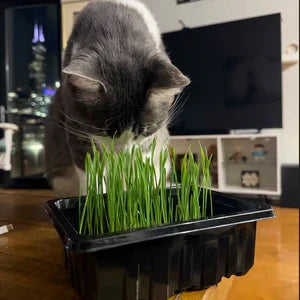
Your cat is not being dramatic when they tear into the houseplants. They're following a biological instinct that goes back millions of years, one that apartment life has made nearly impossible to satisfy.
Indoor cats crave grass. Not because they're confused, and not because they're hungry. Fresh grass supports their digestion, helps them pass hairballs, and delivers trace nutrients they simply can't get from kibble. The problem is that most indoor cats have no access to it, so they improvise with whatever green thing is within reach.
A cat grass kit solves this completely. In about seven days, you can grow a lush tray of fresh wheatgrass on any counter or windowsill, give your cat exactly what they're looking for, and save your ferns in the process.
Why Indoor Cats Need Grass (The Biology Behind the Behavior)
Wild cats eat grass instinctively and regularly. Researchers believe the behavior serves several overlapping functions, all of which become more pressing in an indoor environment where a cat's digestive system gets little help from their surroundings.
Hairball clearance. Cats groom themselves constantly, swallowing loose fur in the process. That fur needs somewhere to go. Grass provides indigestible fiber that moves through the gut and helps the stomach expel what it can't process, reducing the frequency of hairballs and the discomfort that comes with them.
Digestive enzyme support. Wheatgrass contains folic acid, a B vitamin that supports the production of hemoglobin and aids cellular function. Some veterinary researchers also note that fresh grass contains enzymes not found in processed cat food, which may support gut motility and overall digestion.
Mild laxative effect. Grass fiber gently stimulates intestinal movement. For cats that eat dry food exclusively, this additional fiber source can make a meaningful difference in regularity and comfort.
Instinctive grazing behavior. Beyond the physical benefits, access to a growing tray of grass gives indoor cats something they're neurologically wired to seek: a live plant to interact with. Cats that have regular access to cat grass tend to show less destructive plant-eating behavior and appear more relaxed.
The takeaway is simple: this isn't a luxury. It's something your cat's body is built to want, and something their indoor environment consistently fails to provide.
Fresh-Grown vs. Pet Store Cat Grass: Why It's Not the Same Thing
Walk into any pet store and you'll find small plastic pots of cat grass, usually a clump of pale, slightly wilted grass in a bit of soil, priced at $5 to 8. It looks like the right thing. It isn't.
Here's what you're actually getting from a pet store tray:
- Grass that was grown weeks ago under commercial conditions, then shipped and shelved
- Nutrient content that degrades rapidly after harvest, most of the folic acid and active enzymes are gone before your cat touches it
- Soil that may contain fertilizer residues or pesticide treatments you can't verify
- A product that lasts 2 to 3 days before it yellows, wilts, and gets thrown away
Home-grown cat grass is the opposite on every count. When you grow a fresh tray yourself, your cat gets:
- Maximum nutritional value, eaten at peak potency, within days of sprouting
- No soil, no fertilizers, no unknowns, just seeds, water, and a clean grow mat
- Grass that lasts 10 to 14 days at full freshness, far longer than anything from a pet store shelf
- A living, interactive plant your cat can graze from naturally, on their own schedule
The cost difference is just as significant. A single pet store tray costs $5 to 8 and lasts a few days. A pack of Wheatgrass Cat Grass seeds grows multiple trays for $7.99.
How to Grow Cat Grass in 7 Days (Step-by-Step)
Growing cat grass at home requires no gardening experience, no outdoor space, and no special equipment. You need seeds, a tray, a grow mat, water, and a spot with any reasonable light. A windowsill works perfectly, but even a countertop away from direct sun will do.
What You'll Need
- Wheatgrass Cat Grass seeds, pre-measured and ready to sow
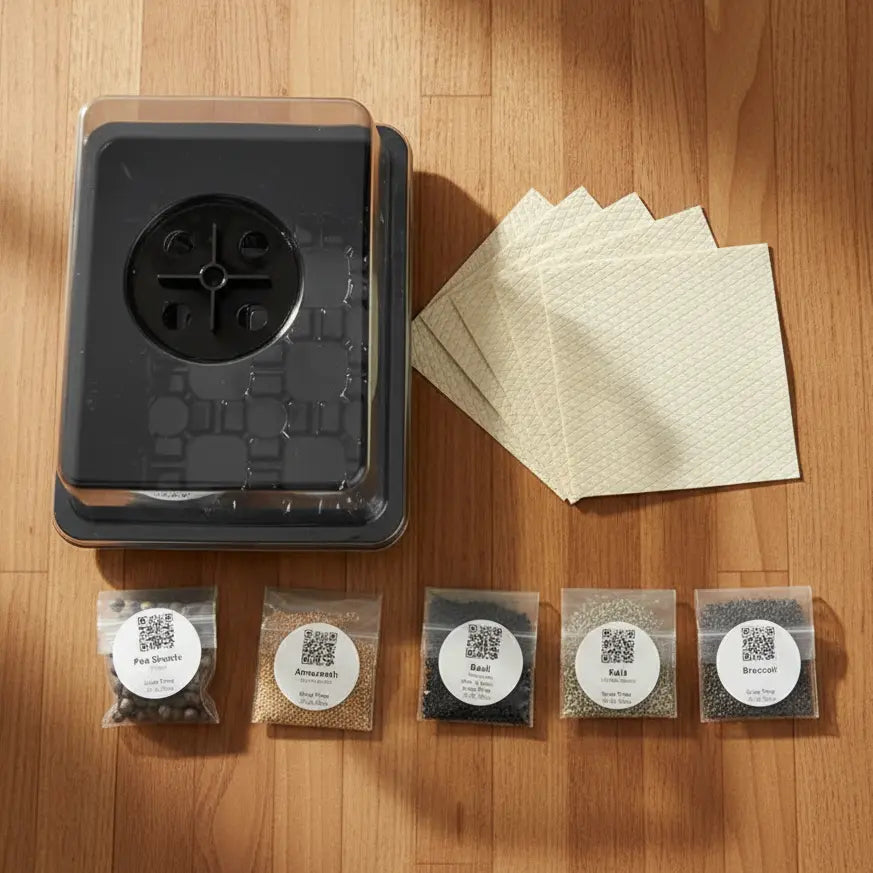
- A grow tray with a humidity dome (the Microgreens Starter Kit includes both, plus a grow mat)
- An organic grow mat or a thin layer of growing medium, this replaces soil entirely
- A small spray bottle or watering can with a gentle pour
The Grab & Grow Cat Grass Kit is the easiest way to start: the seeds are pre-seeded directly onto the grow mat, so there's no measuring, no mess, and no setup beyond adding water.
Soak and Sow the Seeds (Day 1)
Rinse your wheatgrass seeds in cool water and let them soak for 8 to 12 hours. This softens the seed coat and dramatically speeds up germination. After soaking, drain the seeds and spread them evenly across your moistened grow mat in the tray. Cover with the humidity dome.
Wait for Germination (Days 2 to 3)
Keep the mat moist but not waterlogged. Mist once in the morning and once in the evening. Within 48 hours, you'll see small white sprout tails emerging from the seeds. Keep the dome on to hold in humidity.
Remove the Dome (Day 4)
By day four, sprouts are typically 1 to 2 inches tall and ready for airflow. Remove the dome and move the tray to your chosen spot. A bright windowsill is ideal, but indirect light works too. Continue misting daily.
Watch the Grass Green Up (Days 5 to 6)
The grass turns deep green as chlorophyll develops. Growth accelerates noticeably. By day six, many trays are already 4 to 5 inches tall.
Serve the Grass to Your Cat (Day 7)
Fully grown cat grass is typically 5 to 8 inches tall by day seven, deep green, and at peak nutrient density. Place the tray where your cat can access it freely and let them graze on their own schedule. Most cats investigate immediately.

Ongoing maintenance: Mist the base of the tray, not the grass itself, daily to keep the roots moist. A single tray typically stays fresh and viable for 10 to 14 days. When it starts to yellow, start a new tray. The whole process takes about 5 minutes of active effort across the week.
For a more complete look at the growing process, the guide to growing microgreens at home walks through tray setup, watering technique, and troubleshooting in more detail. Cat grass follows the same basic approach.

Cat Grass vs. Catnip: What's the Difference?
These two plants come up together so often that cat owners frequently assume they're the same thing, or at least interchangeable. They're not: they work very differently in a cat's body and serve different purposes.
| Cat Grass (Wheatgrass) | Catnip | |
|---|---|---|
| Plant family | Poaceae (true grass) | Lamiaceae (mint family) |
| Active compound | Chlorophyll, folic acid, fiber | Nepetalactone |
| Effect on cats | Digestive support, hairball clearance | Euphoric response, rolling/vocalizing |
| Duration | Ongoing, cats graze daily | Short bursts, 5 to 15 minutes |
| Who responds | Nearly all cats benefit | ~50 to 70% of cats respond (genetic) |
| Best use | Daily health support | Enrichment, play, stress relief |
Cat grass is the everyday health tool. Wheatgrass provides fiber and nutrients that support your cat's gut on a routine basis, something worth having out and accessible at all times.
Catnip is the enrichment tool. The nepetalactone compound in fresh catnip triggers a short-lived euphoric response in cats that carry the relevant gene, roughly half to two-thirds of the cat population. It wears off quickly and leaves most cats in a calm, relaxed state afterward.
The two work beautifully together. Many cat owners grow a wheatgrass tray for daily grazing and keep a pot of Catnip nearby for play sessions and enrichment. Because catnip is also a member of the mint family and can be grown indoors year-round, it fits naturally into the same growing rotation as cat grass.
If you're new to growing either, the microgreens you can't mess up post covers the simplest varieties for beginners, cat grass and catnip are both on the list.
Frequently Asked Questions
Is wheatgrass safe for cats?
Yes, wheatgrass (Triticum aestivum) is completely safe for cats and is one of the most widely recommended cat grasses by veterinarians. It's soft, digestible, and free from any compounds that cause toxicity. Avoid ornamental grasses and anything treated with pesticides or herbicides; home-grown is always the safest option.
How much cat grass should my cat eat?
Cats self-regulate. They typically nibble a few blades, stop, and return throughout the day. There's no need to limit access. Most cats naturally eat the right amount and will simply stop when they've had enough. If a cat eats an unusually large amount and vomits, that's often the intended effect (clearing something from the stomach) rather than a sign of a problem.
What if my cat ignores the tray?
Some cats need a few days to investigate a new item before interacting with it. Place the tray where your cat already spends time, near their food, their bed, or their favorite resting spot. Lightly brushing the grass so it releases its scent can also trigger interest. Most cats come around within a day or two.
Can I grow cat grass without a kit?
You can. Any shallow container, some moisture-retaining medium, and wheatgrass seeds will work. That said, a purpose-built cat grass kit takes 2 minutes to set up instead of 20, produces more consistent results, and requires no improvising. For most people, the kit is the faster and more reliable path.
How often should I grow a new tray?
A tray of wheatgrass stays fresh for 10 to 14 days. Starting a new tray on day 7 of the current one's life means you always have a fresh tray ready when the old one is done. Many owners stagger two trays a week apart to ensure continuous supply.
What's the fastest-growing cat grass variety?
Wheatgrass is one of the fastest-growing microgreens overall, typically ready in 7 days. For comparison, the fastest growing microgreens guide covers other rapid varieties, though few match wheatgrass for speed and ease.
Give Your Cat What Their Body Is Asking For
Your cat is drawn to grass for the same reason they groom, hunt, and sleep in sunbeams. It's biology. A fresh tray of wheatgrass isn't a novelty. It's a simple, inexpensive way to support their digestion, reduce hairballs, and give them something they genuinely need.
Growing it takes a week and about five minutes of actual effort. The Grab & Grow Cat Grass Kit makes it even simpler: seeds pre-loaded on the grow mat, ready to go with nothing to measure or mix. Add water. Wait seven days. Let your cat do the rest.
If you want to build a full growing rotation (cat grass one week, catnip the next, maybe some herbs for yourself), the Microgreens Starter Kit gives you everything you need to keep it going indefinitely.
Author: Aquager Team · Published: May 27, 2026 · Updated: August 25, 2026 · Reviewed: August 25, 2026 (Phase 3)













0 comments