
Kwanzaa is celebrated December 26 through January 1, organized around seven principles — the Nguzo Saba — each assigned to one of the seven nights. The feast of Karamu, held on December 31, is the culinary center of the celebration: a communal table of traditional dishes, shared across family and community. Kwanzaa food is intentional food. It is chosen, prepared, and shared with purpose.
Two of the seven principles have particular resonance in the kitchen. Kujichagulia — self-determination: the right to define yourself, name yourself, create for yourself and speak for yourself. Ujamaa — cooperative economics: to build and maintain your own businesses, to support each other, to keep resources circulating within the community. Both, when followed honestly, ask a question that is also a question about food: where does what you eat come from, and who controls it?
This post takes that question seriously. It traces the relationship between Black communities and food sovereignty in the United States, connects specific microgreen varieties to African and African-American food traditions, and makes the case that growing your own food at home is one of the most direct expressions of Kujichagulia available to anyone with a windowsill.
Food Sovereignty and the Black American Table
Food sovereignty — the right of communities to define their own food systems — has never been equally distributed in the United States.
At the turn of the 20th century, Black farmers owned approximately 14 percent of American agricultural land. By 2017, that number had fallen to less than 2 percent. The decline was driven by documented discrimination in USDA loan programs that persisted well into the late 20th century, land loss through legal manipulation and outright theft, and structural pressures from industrial agriculture that made small family farming economically untenable. The Black farming infrastructure that once represented genuine food self-reliance was dismantled over generations.
The effects run downstream. Food deserts — neighborhoods with limited access to fresh, nutritious food — are disproportionately concentrated in majority-Black urban and rural areas. The grocery stores present in these neighborhoods typically stock less fresh produce at higher prices than those in wealthier areas. The gap is filled by packaged and processed food that carries its own long-term costs.
None of this is destiny, and none of it is new. The response to these conditions, historically and in the present, has always included growing food. Community gardens, urban farming collectives, rooftop plots, seed-saving networks, and kitchen gardens. The tradition of Black food self-reliance is as old as the conditions that made it necessary — and it is still active. See our post on Kwanzaa and growing food as self-determination for the winter solstice connection.
Kujichagulia in the Kitchen
Self-determination applied to food doesn't require land. It doesn't require a backyard, a community garden plot, or even a fire escape. It requires a surface and a window.
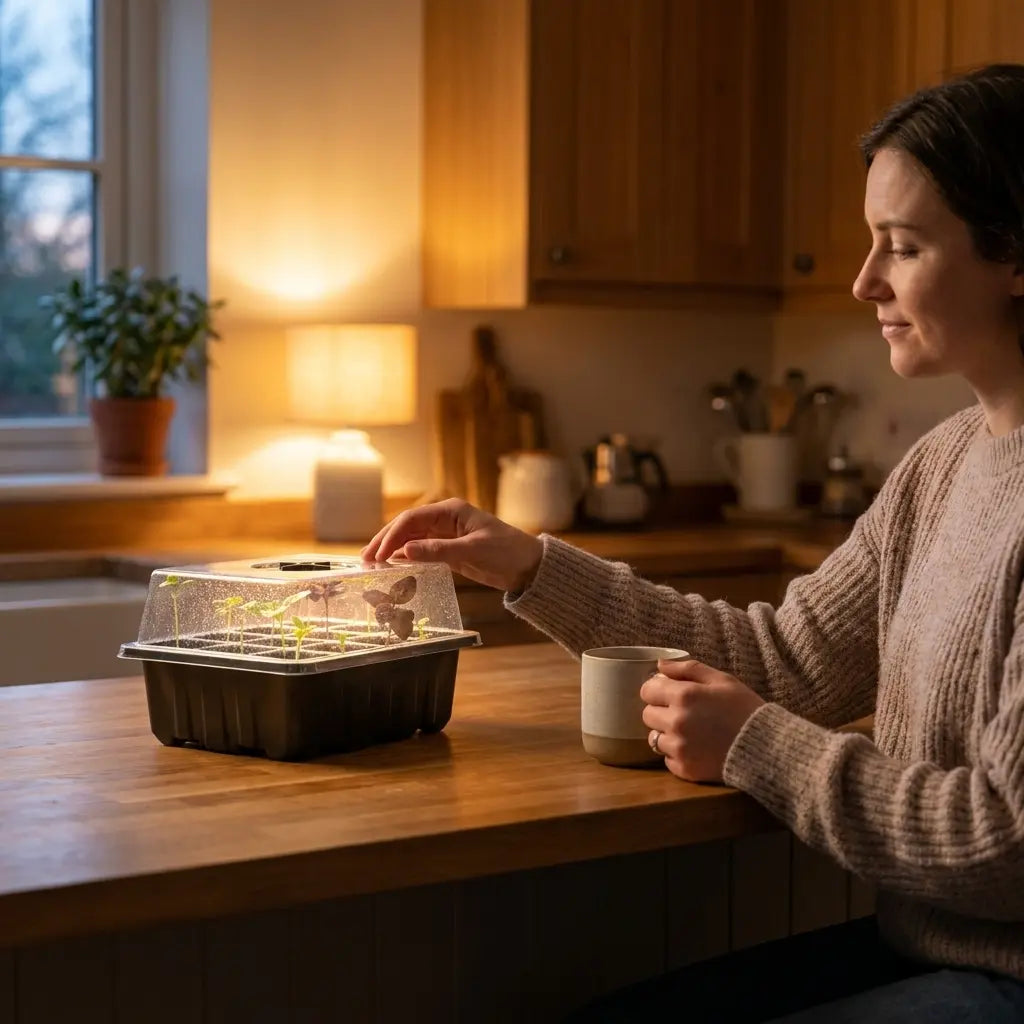
Microgreens grow on a kitchen counter or windowsill, in a tray smaller than a sheet of paper. They don't need soil. They don't need grow lights. They harvest in 7 to 14 days, depending on variety, and yield greens that research has shown to contain 4 to 40 times the nutrient density of their mature counterparts. The full nutritional case is in the Microgreens Benefits guide, but the short version is: per square inch, per dollar spent, microgreens are one of the most efficient sources of fresh food a household can produce.
For a family in a neighborhood with limited fresh produce access, a tray of microgreens on the kitchen counter is not a symbolic gesture. It is a functional one. Two or three trays in rotation means fresh greens on the table every week of the year, grown without pesticides, harvested the day they're eaten.
That's Kujichagulia working at its most immediate scale. Choosing to produce some of your own food — however modest the beginning — is a daily practice of not accepting what the nearest supply chain decides to offer you.
Varieties with African and African-American Roots
The connection between specific crops and African and African-American foodways isn't metaphorical. Several of the most culturally significant ingredients in Black American cooking have direct ties to West African agriculture — connections maintained across the Atlantic and through centuries of adaptation in the American South.
Amaranth. Amaranth has been cultivated across sub-Saharan Africa and the Americas for thousands of years, predating European contact in both regions. It was a dietary staple in multiple pre-colonial civilizations — used as a grain, a leafy green, and a ceremonial plant. As a microgreen, Amaranth Garnet Red grows in vivid magenta and deep burgundy, with a mild earthy flavor that works in grain bowls, rice dishes, and alongside braised preparations. It's the most visually striking variety in this group, and the one with the deepest roots in the agricultural traditions this post is honoring.
Pea shoots. Black-eyed peas are one of the most symbolically significant foods in African-American culture. Brought from West Africa, where the cowpea was a long-established dietary staple, they sustained enslaved people and became embedded in Southern foodways and seasonal traditions. Hoppin' John — black-eyed peas, rice, and greens — has Kwanzaa and New Year's associations for many Black Southern families. Pea shoot microgreens are the young greens of the pea plant: sweet, delicate, curling tendrils that work over rice, alongside beans, and in the broths and stews that form the backbone of Southern cooking.
Kale. Collard greens are foundational to African-American Southern cooking, and the lineage runs directly to West Africa, where leafy Brassica-family greens were dietary staples for centuries. The long-cooked pot of collards — braised in seasoned liquid until the greens collapse and the pot likker deepens — is one of the most distinctly African-American preparations in the entire culinary tradition. Kale Kalefetti Mix microgreens are in the same botanical family: a blend of red, green, and frilled kale shoots with a mild, slightly earthy flavor. They won't replace a slow-cooked pot of collards. Nothing does. But they bring that lineage to salads, grain bowls, and quick preparations in a form that's ready in a week.
Mustard and sunflower. Mustard greens run deep in Southern Black cooking, braised in the same pot-likker tradition as collards. As a microgreen, mustard is the sharpest variety available — genuinely peppery, with forward heat that cuts through rich, fatty, or sweet dishes. Sunflower microgreens are the most substantial: nutty, thick-stemmed, satisfying in a way that smaller varieties aren't. Sunflower has agricultural roots across West African and Indigenous American traditions, and as a microgreen it's one of the most forgiving varieties to grow at home.
Starting Your Kitchen Garden
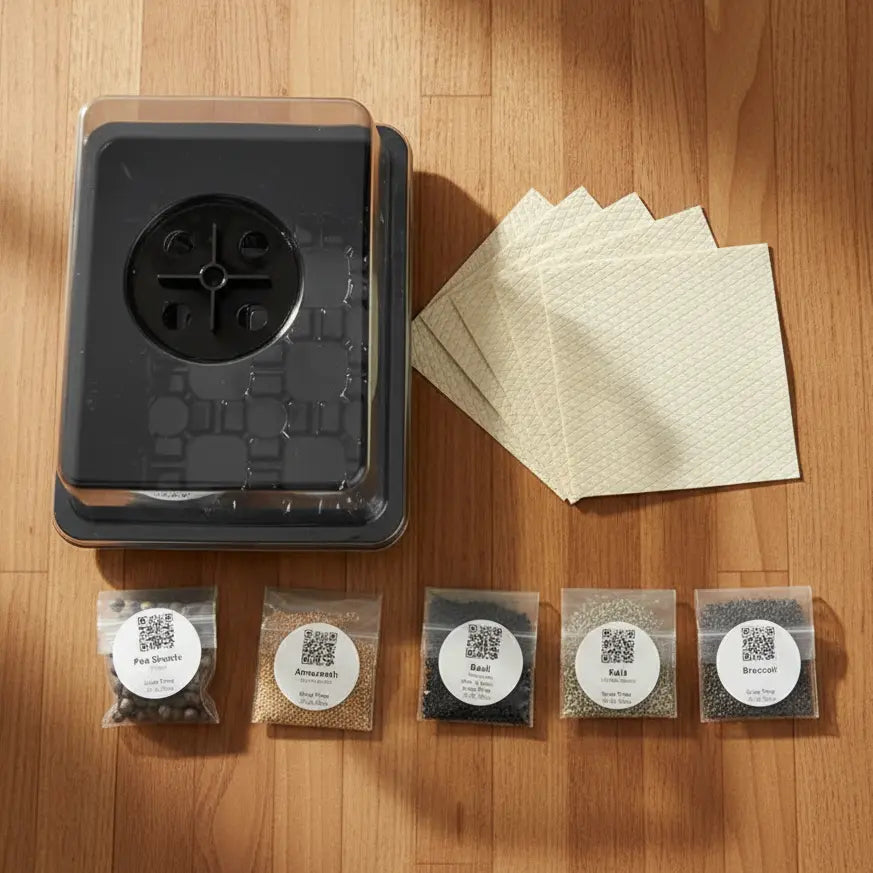
The entry point is straightforward. The Microgreens Starter Kit includes everything needed to grow a first tray: a growing tray, humidity dome, and organic grow mat. Add whichever seed pack you want to start with. Plant on day one, mist once a day, harvest on day seven to ten.
For a Kwanzaa kitchen garden specifically, amaranth and pea shoots are the two most resonant starting points. Amaranth grows fast and the color is dramatic — deep magenta stems that photograph well and look deliberate on a Karamu table. Pea shoots are generous and forgiving, and their connection to black-eyed pea foodways gives them a cultural weight that makes them worth growing even if you've never bought them in a store.
Plant before December 16 and you'll have fresh greens ready for Karamu on December 31. Both varieties keep well in the refrigerator for several days after harvest, so there's no need to time the planting exactly. For more on how the pesticide-free organic mat system works, the guide to organic microgreens covers the full growing setup.
Ujamaa and the Economics of Home Growing
Ujamaa asks where your resources go and who benefits from them.
A microgreens kit is a durable purchase — a tray and dome used over and over, with seed refills that cost a few dollars per harvest. Over time, the cost per serving of home-grown greens is a fraction of what pre-packaged microgreens cost at a grocery store. The economic loop is tight: seeds, tray, water, harvest, food on the table. Nothing extracted, nothing wasted.
This isn't a claim about solving structural food inequity — no single product does that. It's a claim about what is available at the scale of one kitchen: a practice of food self-sufficiency that reduces dependence on supply chains you don't control, lowers the weekly cost of fresh produce, and keeps the economic decision-making inside the household.
The broader cooperative economics of Ujamaa point outward: supporting Black-owned businesses, building community food networks, contributing to urban farming collectives. The kitchen garden is one starting point within that larger practice. For a more detailed look at what home growing actually costs versus buying at a store, the guide to growing your own food at home walks through the comparison directly.
Frequently Asked Questions
Which microgreens are most connected to Kwanzaa traditions and African-American cooking?
Amaranth (ancient African cultivation, vivid magenta color for Karamu presentations), pea shoots (connected to black-eyed pea foodways and Hoppin' John), Kale Kalefetti Mix (Brassica family, same lineage as collard greens), and mustard (deep roots in Southern Black cooking). Amaranth is the most visually striking; pea shoots are the most forgiving for beginners.
How long before Kwanzaa do I need to start growing?
Plant 9 to 12 days before you need the greens. For Karamu on December 31, start planting December 19 to 22. If you want greens for all seven nights, plant a second tray around December 26 — it'll be ready for the final nights of the celebration.
Is home growing more affordable than buying greens at the store?
Yes. A seed pack and grow mat cost a few dollars and yield a full tray. Pre-packaged microgreens in stores typically run $4 to $8 for a small container, often less than the yield from one home-grown tray. After the initial kit purchase, each harvest costs the price of one seed refill.
Eight Principles. Seven Nights. One Kitchen Counter.
Kwanzaa was founded on the idea that celebration and action are not separate — that honoring culture means living the principles, not just observing them. Kujichagulia and Ujamaa both have practical dimensions that extend into the kitchen, into what you grow, what you buy, and where the resources go.
A kitchen garden won't resolve the structural conditions that have shaped Black communities' relationship with food in America. That requires policy, land access, and collective action at a scale no windowsill practice touches. But a tray of amaranth on a kitchen counter during Kwanzaa is a real thing: food you grew yourself, connected to traditions that run deeper than any supply chain, ready for the table you set.
Start planting before the first candle is lit.
Author: Aquager · Published: June 10, 2026 · Updated: October 11, 2026












0 comments