
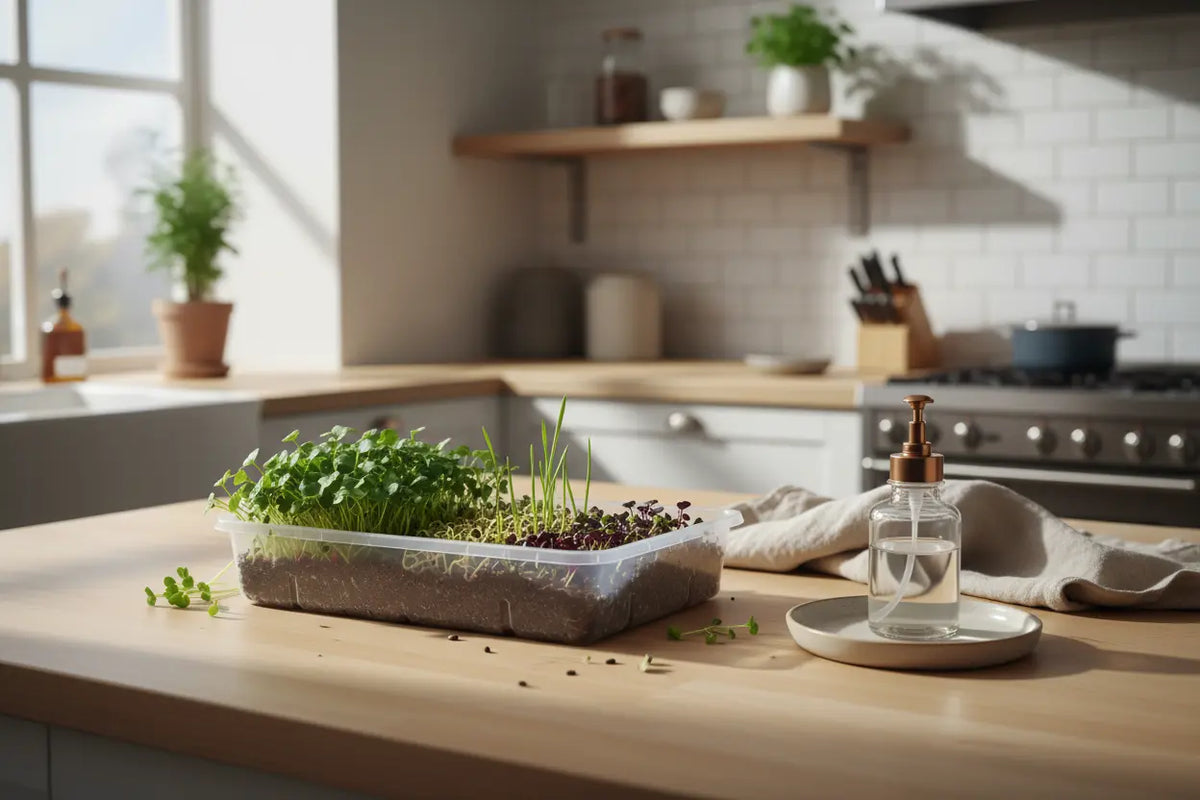
Most people skip growing food in December for the same two reasons: they will be traveling, and they will forget. Both worries are fair. Neither one holds up well against a tray of microgreens.
A microgreens tray is not a houseplant. It lives for about two weeks, asks for a few minutes a day, and does not pile up needs while you are gone. If you plan the timing, even a busy or travel-heavy holiday season fits around it.
This guide covers what the daily work really looks like, how to time a tray around a trip, and what to do when you get home.
Are Microgreens Really Low Maintenance?
Yes. A microgreens tray takes about 15 minutes to plant, no more than about 5 minutes a day while it grows, and about 5 minutes to harvest. There is no soil to manage, no fertilizer, and no long-term care. Each tray is finished in 7 to 15 days, so nothing builds up while you are busy. See our guide to last minute Christmas gifts for food lovers if the calendar is tight.
| Stage | When | What you do | Time |
|---|---|---|---|
| Plant | Day 0 | Soak the mat, scatter the seeds, mist, and cover with the dome | About 15 minutes |
| Dark phase | Days 1 to 3 | Lift the dome, check the mat, and mist if it feels dry | 1 to 2 minutes a day |
| Light phase | Day 4 to harvest | Pour about a cup of water into the outer tray and drain what is left | 2 to 5 minutes a day |
| Harvest | Day 7 to 15, by variety | Cut just above the mat with scissors | About 5 minutes |
Times are typical estimates for one tray. Harvest days follow the Aquager product pages.
Compare that with a houseplant, which can slowly pick up problems from overwatering, root-bound soil, pests, and fertilizer needs over months. A tray has none of those, because it is finished in about two weeks. If you miss a day, the mat dries a little and growth slows. Water when you remember, and the tray usually recovers. Missing several days in a row is different, which is why timing matters. The next sections cover it.
Which Microgreens Are Easiest if My Schedule Is Unpredictable?
Pea shoots and radish are the best picks. Pea shoots have large seeds, and they forgive uneven watering better than most small-seed varieties. Radish is a fast, reliable grower with a harvest window of 10 to 15 days. Both are in stock, and each seed pack comes with its own grow mat.
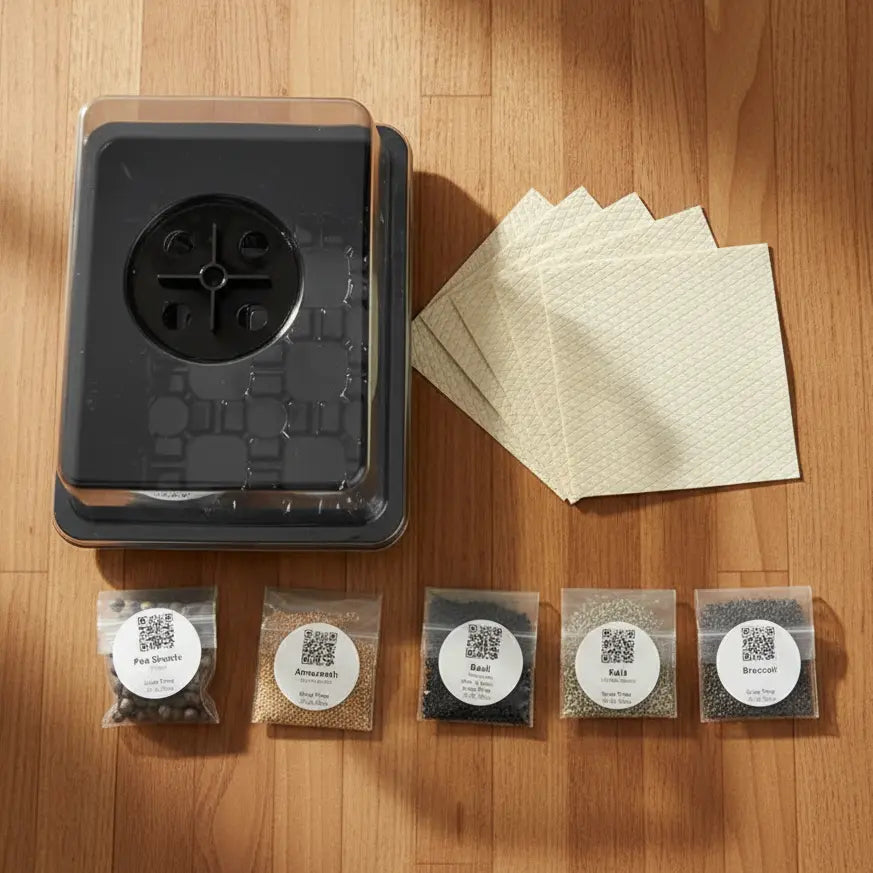
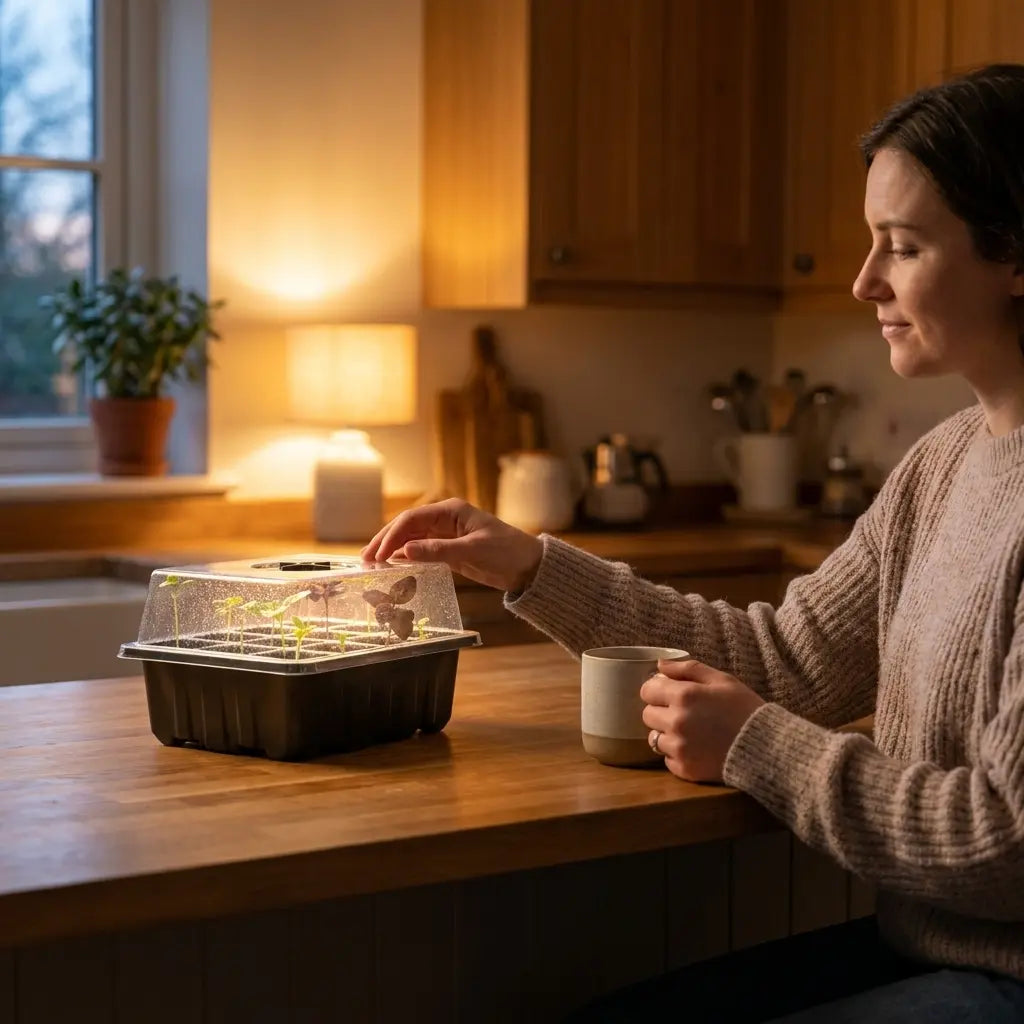
When your week is unpredictable, the usual failure point is a mat that dries out between waterings. The Microgreens Starter Kit ($29.99) helps with that, because its humidity dome holds moisture through the first 3 dark days. It also comes with 2 trays, so you can plant a second batch when you get home without ordering anything new. Pair it with Pea Shoots Field or Radish Confetti Mix seeds ($7.99 each). For more beginner-proof picks, see our guide to microgreens you cannot mess up.
How Does a 7 to 15 Day Cycle Fit Around a Busy Holiday Schedule?
A short cycle fits because the work comes in two small bursts: planting at the start and harvesting at the end. Radish takes 10 to 15 days and pea shoots take 7 to 14 days, according to the Aquager product pages. Between those two moments, daily care takes a few minutes, so a tray can run around a full calendar.

Microgreens also do not build up. Every tray has a clear start and a clear end, so you can stop for a month, come back, and begin again with nothing lost. You can plan a tray to finish just before you leave, or plant the day you return. Once the habit is in place, our planting schedule guide shows how to stagger trays every 5 to 7 days for a steady supply.
When Should I Plant a Tray Before a Trip?
Plant a tray only if you will be home when it is ready, or if you can cut it before you leave. Harvest windows run 7 to 15 days, so a tray started less than a week before a trip will not be ready and will sit unattended. Count the days to your trip first, then use the table below.
| Days until you leave | What to do |
|---|---|
| Fewer than 7 | Do not start a tray. Wait until you are back, then plant. |
| 7 to 14 | Plant pea shoots. Check from day 7 and cut as soon as the seed leaves are open. |
| 15 or more | Plant either variety. Cut at the first ready day and refrigerate before you go. |
| A tray is already growing when plans change | Harvest early. A smaller harvest beats an overgrown tray, and radish can be cut as sprouts in as little as 4 days. |
Cut at the cotyledon stage, when both seed leaves are open and before the first true leaf. Our microgreens harvest guide shows how to spot it. Then keep the greens dry, put them in a container lined with a dry paper towel, and refrigerate.
Temperature matters a lot here. In a 2023 study in the journal Life, packaged mustard microgreens lasted 14 days at 5°C (41°F), but became inedible within a day at 20°C (68°F) or warmer (Dayarathna et al., 2023). Heartier varieties like pea shoots usually hold 7 to 10 days with the method in our microgreens storage guide.

What Should I Do if I Come Home to an Overgrown Tray?
Cut it right away, taste a few stems, and keep what still looks and smells fresh. An overgrown tray is a timing problem, not a failure. Tall stems and a first true leaf mean the greens are past their best, but many are still usable. Compost anything yellow, slimy, or musty.
Then reset. Rinse the tray, add a fresh grow mat, and plant again. The pattern that works best for busy households is simple: harvest before you travel, and plant when you return. If you want a few days of rest first, that is fine too. Microgreens do not mind the wait.
Frequently Asked Questions
How long can microgreens go without water?
A damp mat can get through one missed day, and growth just slows a little. Several missed days in a row is where trays dry out and fail, especially in a heated December home. If you will be gone more than a day or two, cut the tray before you leave or ask someone to water it.
Can someone else water my microgreens while I am away?
Yes, and it is one of the easiest plant-sitting jobs. Once the tray is in the light phase, the sitter pours about a cup of water into the outer tray once a day and drains what is left. Nothing needs measuring, and bottom watering makes it hard to overwater by accident.
What if I am away for two weeks?
Do not start a new tray before a two-week trip unless it will be ready to cut before you go. Cut and refrigerate anything that is ready, leave the tray clean, and plant a fresh one when you return. Pausing is built into the cycle. For the colder months, see our winter microgreens guide.
Are some varieties more forgiving of missed watering?
Yes. Pea shoots forgive uneven watering better than most small-seed varieties, because the large seeds hold up well. Arugula is a bit more sensitive to overwatering than radish or pea shoots. If your schedule is hard to predict, start with pea shoots or radish.
What if I just want to try one tray first?
That is a good way to start. One tray takes 7 to 15 days and a few minutes a day, and the Microgreens Starter Kit plus one seed pack costs under $40. It shows you the real effort before you decide whether to keep going.
Will my herbs be fine while I travel?
Microgreens are the easy case, because a tray is short-lived. Herbs and other plants that live for months need a different plan. Our guide to hydroponics for travelers covers how to keep a hydroponic farm going while you are away.
Is the Holiday Season a Good Time to Start Growing Microgreens?
Yes. A tray fits around holiday plans because it is short, simple, and easy to pause. You do not need a free month to begin. You need one open week to plant, and a plan for when you will harvest.
The system works around your schedule, not the other way around. If you want to try it, the Microgreens Starter Kit has the trays, dome, and mat you need to plant your first tray this week.
Author: Aquager Team · Published: June 10, 2026 · Updated: October 11, 2026 · Reviewed: October 10, 2026 (Phase 2 and 3)












0 comments