
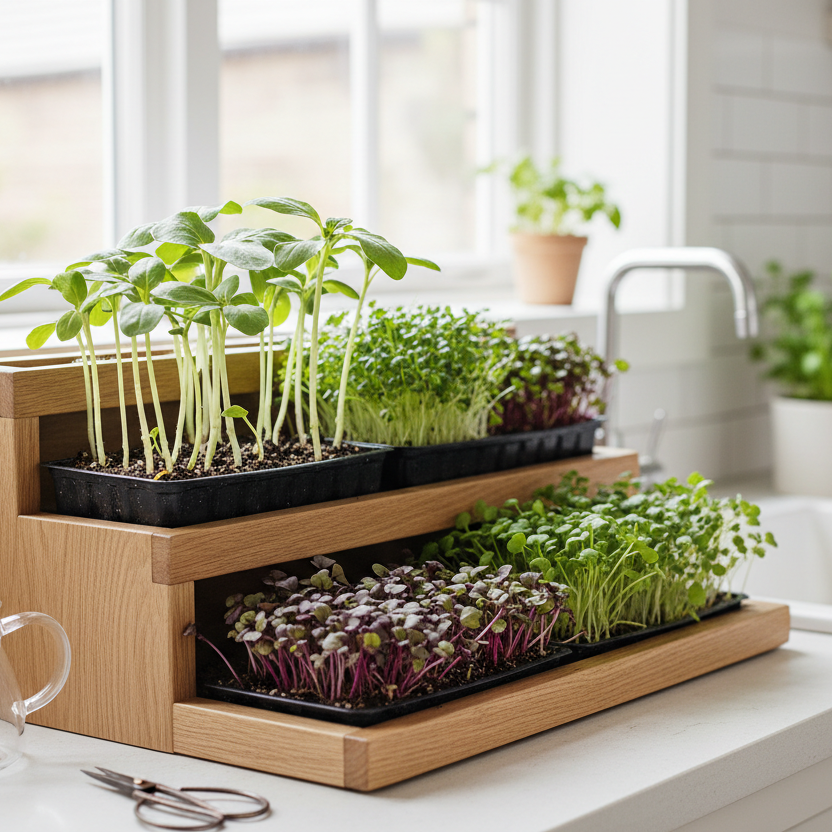
Starting microgreens indoors often feels intimidating at first. Many beginners assume growing food requires long timelines, complicated care, and a high risk of failure—especially if past attempts with houseplants didn’t go well.
Microgreens challenge that assumption.
They are one of the few indoor growing methods where visible progress in under a week is normal, even for complete beginners. When expectations are aligned correctly, the process feels straightforward rather than overwhelming.
In short: if starting microgreens feels hard, it’s usually because of how the process is framed, not because the process itself is difficult.
Why beginners struggle to start microgreens
Most beginner frustration comes from treating microgreens like traditional plants.
People expect slow growth, long-term maintenance, and complex care routines. When those expectations aren’t met, it creates confusion—especially when results appear quickly but don’t match what the grower thought they were “supposed” to see.
Microgreens operate on a compressed timeline. They are harvested early, before plants develop deep roots or complex nutrient needs. When beginners don’t realize this, they often misinterpret normal early growth as a problem or feel unsure whether things are working.
This mismatch between expectation and reality is the most common reason beginners hesitate or give up early.
How to think about starting microgreens indoors
Microgreens are best understood as a short-cycle indoor system, not a long-term gardening project.
Rather than focusing on plant maturity, the focus is on early growth. Most of what happens is driven by energy already stored inside the seed. The role of the grower is simply to create a stable environment and avoid unnecessary interference.
In practice, this means progress happens quickly and predictably. Small changes lead to visible results, which makes it easier to learn and adjust without feeling lost.
This is why microgreens often feel easier than herbs or vegetables: there are fewer variables to manage, and feedback arrives fast.

What “7 days” actually means for beginners
When people hear “start growing in 7 days,” they often imagine a finished harvest.
That’s not always what happens—and that’s okay.
Within the first week, most beginners will see:
- Seeds germinate
- Stems push upward
- Leaves begin to open
- The growing surface visibly fill in
This early stage is important because it confirms that the system is working. For beginners, seeing life emerge quickly builds confidence and removes uncertainty.
The goal of the first week isn’t perfection—it’s confirmation.
Common mistakes that slow beginners down
Early problems with microgreens are rarely about skill. They’re usually about expectations or overreaction.
Some common patterns include:
- Adding water too frequently because growth seems “too slow”
- Expecting harvest-ready greens instead of early development
- Comparing microgreens to houseplants or herbs
- Changing multiple variables at once when something looks off
These mistakes don’t mean failure. They usually mean the grower hasn’t yet internalized how fast—and how briefly—microgreens grow.
If you’re struggling with repeated false starts, that’s often a sign that the underlying concept needs clarification.
When starting microgreens becomes frustrating
Starting microgreens becomes genuinely difficult when confusion replaces curiosity.
This tends to happen when beginners:
- Try to optimize before understanding the system
- Follow conflicting advice without context
- Interpret normal growth stages as personal mistakes
At that point, it’s easy to feel like you’re “bad at growing,” even when nothing is actually wrong.
This happens because of a deeper issue — Explained Here

What to do next if you feel stuck
If starting microgreens has felt unclear or discouraging, the next step isn’t pushing harder or adding complexity.
It’s stepping back and understanding:
- What microgreens actually are
- Why they grow quickly
- Where beginners most often misinterpret progress
- How expectations shape outcomes
For the full explanation and context, see this guide:
👉 Microgreens for Beginners
0 comments