
Arugula microgreens are ready in 7 days and pack more nutritional value per serving than a full head of mature arugula. If you're already eating arugula for the health benefits, growing the microgreen version gives you the same compounds in a more concentrated, faster, and more convenient form.
This post covers the arugula nutrition profile in full — what's in it, what the research says, and why the microgreen delivers it better than anything you'll find at the grocery store. It also addresses the flavor question that holds a lot of people back: arugula microgreens are peppery and complex, but noticeably less bitter than the full-grown leaf. If you've found mature arugula too sharp, the microgreen is worth trying.
Arugula Microgreens vs. Full-Grown Arugula: The Flavor Shift
Full-grown arugula has a reputation for bitterness. The bold, slightly astringent bite that puts some people off comes primarily from erucic acid and a handful of phenolic compounds that accumulate as the plant matures. The older and larger the leaf, the more pronounced these compounds become.
Arugula microgreens are harvested at 7 days — before most of these bitter compounds have time to develop. What remains is the peppery, slightly nutty quality that makes arugula distinctive, without the edge that can overpower a salad or clash with delicate ingredients.
The result is a green that works in more contexts than the full-grown version. Pizza, avocado toast, grain bowls, pasta — dishes where mature arugula would dominate, microgreens complement. They deliver the peppery complexity without the bitterness that needs to be counterbalanced with sweet dressings or fruit.
For people who enjoy full arugula, the microgreen is simply a more concentrated, faster-growing version. For people who've avoided arugula because of the bitterness, it's worth a second chance. Our spicy microgreens comparison shows how arugula sits on the heat scale relative to radish and mustard — if you like moderate heat with less bite, arugula microgreens are the sweet spot.
Arugula Nutrition: What Makes It One of the Best Vitamin K Foods
Arugula has one of the highest vitamin K concentrations of any leafy green — and arugula microgreens deliver this in a more concentrated form than the mature plant.
Vitamin K exists in two main forms. Vitamin K1 (phylloquinone) is found abundantly in leafy greens and is the primary form involved in blood clotting. Vitamin K2 (menaquinone) is found in fermented foods and animal products and is more directly linked to bone mineral density and cardiovascular health. Arugula is a rich source of K1, and regular dietary intake of K1 has been linked to both adequate clotting function and, through conversion in the body, some of the K2 benefits as well.
A single serving of arugula microgreens provides a meaningful contribution toward the recommended daily intake of vitamin K (90–120 mcg for most adults). This matters particularly for bone health: vitamin K activates osteocalcin, the protein that binds calcium to bone matrix. Without adequate vitamin K, calcium circulates in the bloodstream rather than mineralizing bone — which is why vitamin K and calcium work together, not independently.
Among the most nutrient-dense vitamin K foods you can eat, dark leafy greens — especially arugula — consistently rank at the top of research-based comparisons. The microgreen form of arugula concentrates this even further, because the cotyledon stage retains seed-stored nutrients alongside the early photosynthesis products. A full ranking of how arugula compares to other microgreens varieties is in our guide to the most nutritious microgreens, ranked by science.
The Health Benefits of Arugula Microgreens
Glucosinolates and cancer-protective compounds. Arugula belongs to the Brassica family alongside broccoli, kale, and radish. Like all Brassica crops, it contains glucosinolates — sulfur-containing compounds that convert to isothiocyanates when plant tissue is chewed. These compounds are among the most studied in cancer prevention research, with particular attention to their role in activating Phase 2 liver detoxification enzymes. Arugula is particularly high in erucin, a glucosinolate that produces a different isothiocyanate profile than broccoli's sulforaphane — making the two crops complementary rather than redundant.
Nitrates and blood pressure. Arugula is among the highest-nitrate leafy greens available. Dietary nitrates are converted in the body to nitric oxide, a compound that relaxes blood vessel walls and reduces arterial stiffness. Research published in the British Journal of Nutrition and other peer-reviewed journals has consistently shown that high-nitrate greens produce measurable reductions in resting blood pressure in healthy adults, with effects appearing within hours of consumption and maintained with regular intake.
Folate. Arugula is a meaningful source of folate (vitamin B9), which is involved in DNA synthesis, cell division, and the metabolism of homocysteine — an amino acid that, at elevated levels, is associated with cardiovascular risk. Folate is particularly important during pregnancy for neural tube development, but its importance for cardiovascular health makes it relevant for the general population.
Antioxidants and anti-inflammatory compounds. Arugula contains quercetin (a flavonoid antioxidant), chlorophyll, and vitamin C. These compounds work together to reduce oxidative stress — the background cellular damage that accumulates from environmental exposure, processed food, and normal metabolic processes. The combination of glucosinolates, nitrates, and antioxidants makes arugula one of the more nutritionally layered microgreens available.
How to Grow Arugula Microgreens in 7 Days
The growing process for arugula microgreens is almost identical to radish, with one key difference: arugula seeds are small and produce a more delicate stem. Even moisture distribution is especially important.
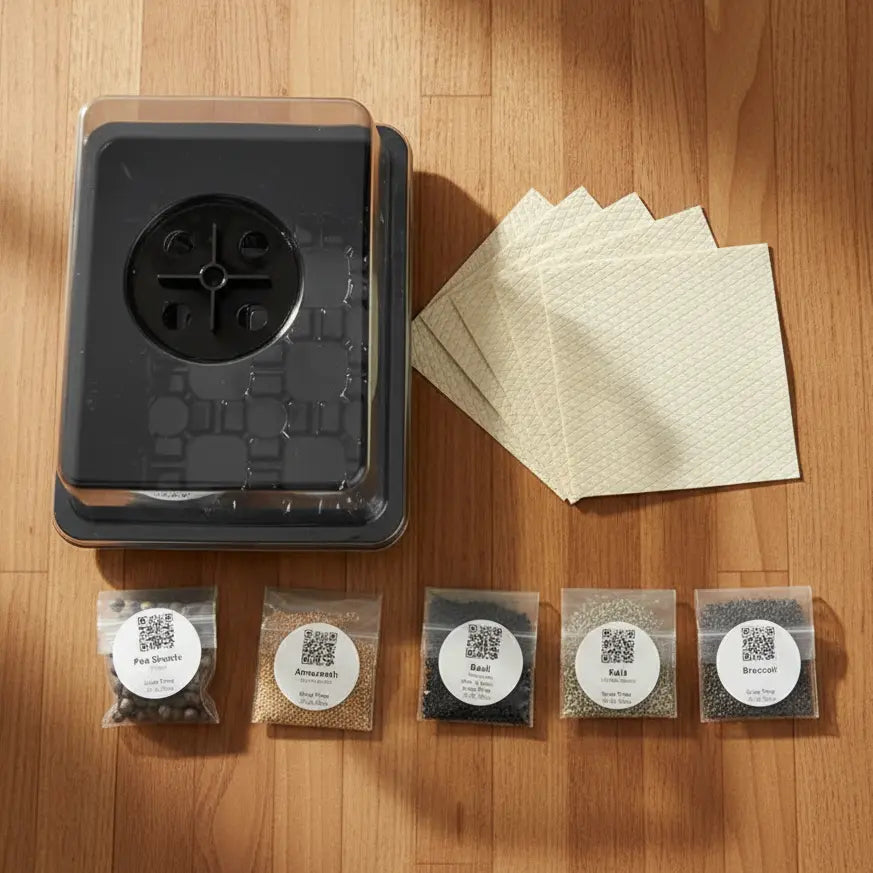
What you need: a grow tray, a coco coir grow mat, and arugula seeds. The Arugula Microgreens Seeds from Aquager include a grow mat in the pack — everything except the tray.
Soak the grow mat until fully saturated, then drain any standing water. Scatter arugula seeds evenly — roughly ¾ to 1 oz per 10×20 tray. Arugula seeds are smaller than radish, so use slightly less. Mist lightly and cover with a humidity dome. Keep in a dark, room-temperature location for 2–3 days.
Once germinated, move to a south-facing window or LED grow light. Remove the dome and switch to bottom-watering. Arugula is slightly more sensitive to overwatering than radish — keep the mat moist but never saturated.
Harvest at day 7 when the cotyledons are fully open. The stems will be slender and bright green, and the flavor is at its best right at this stage — before any bitterness from true leaf development. For a deeper dive on the full growing process, our beginner's guide to growing microgreens walks through every step.
3 Summer Recipe Uses for Arugula Microgreens
Summer is peak season for arugula microgreens. The peppery flavor pairs naturally with warm-weather cooking, and the 7-day grow cycle means you can time your harvest to match whatever you're making. For a broader look at summer microgreens pairings, our guide to microgreens for summer salads covers the full lineup of varieties.
On Pizza After Baking
This is the use that made arugula famous in Italian restaurants — a handful of fresh greens added to a hot pizza the moment it comes out of the oven. The residual heat just barely wilts the arugula, concentrating the flavor slightly and softening the pepper note. Arugula microgreens work even better than full arugula here because the stems are more tender and the flavor is more nuanced.
Use it on: Margherita, prosciutto and fig, burrata, or any pizza with a white sauce base. Add immediately after pulling from the oven. Finish with a few drops of good olive oil and a pinch of flaky salt.
On Avocado Toast
Arugula microgreens are the upgrade that separates good avocado toast from genuinely impressive avocado toast. The pepper note cuts through the richness of the avocado in the same way a squeeze of lemon does — it brightens and sharpens the whole dish.
Use it on: smashed avocado on sourdough with flaky salt, a poached egg, and a layer of arugula microgreens on top. Add a drizzle of olive oil and cracked black pepper. The combination is nutritionally complete enough to work as a full meal.
In Grain Bowls
Arugula microgreens scattered over a warm grain bowl are the peppery finishing element that makes the whole dish feel composed rather than assembled. Unlike mature arugula, which can wilt and become sharp-tasting under warm ingredients, microgreens hold their texture for the length of a meal.
Works particularly well with: farro or quinoa base, roasted cherry tomatoes, white beans, shaved parmesan, and a lemon vinaigrette. The pepper in the arugula plays against the sweetness of the tomatoes and the fat in the cheese.
Frequently Asked Questions
Are arugula microgreens less bitter than full arugula?
Yes, noticeably. The bitterness in mature arugula comes from compounds that accumulate as the plant ages. Harvesting at 7 days, before most of these compounds develop, gives you the peppery complexity without the sharp bitterness. Most people who dislike full arugula find the microgreen version accessible.
How much vitamin K is in arugula microgreens?
Arugula is one of the highest natural sources of vitamin K1 among leafy greens. A typical serving of arugula microgreens (about 1 oz) contributes meaningfully toward the recommended daily intake of 90–120 mcg for adults. Exact concentrations vary by growing conditions and variety.
Can I use arugula microgreens in smoothies?
Yes, though the flavor is strong enough to register. Arugula microgreens work best in green smoothies where other flavors can balance the pepper — try pairing with pineapple, cucumber, and ginger. If you prefer mild smoothie greens, pea shoots or kale microgreens are more neutral options.
How do arugula microgreens compare to radish microgreens?
Both are Brassica-family crops with glucosinolate benefits, but they differ in flavor and profile. Radish is sharper and more immediately peppery, grows in 5–7 days, and has a bolder heat. Arugula is nuttier and more complex, grows in 7 days, and pairs more broadly across cooking applications. The two crops are complementary — many growers run both simultaneously. See our radish vs. mustard vs. arugula comparison for a full breakdown.
Do arugula microgreens regrow after harvest?
No — like all microgreens, arugula doesn't regrow from the same mat after harvest. Start a new tray every 7 days for continuous supply.
Final Thoughts
Arugula microgreens are one of the more nutritionally complex crops you can grow — vitamin K, glucosinolates, nitrates, folate, and antioxidants in a 7-day harvest. They're also one of the most versatile in the kitchen, moving easily from pizza to grain bowls to avocado toast without the bitterness that makes full arugula polarizing.
If you're growing microgreens for the health benefits, arugula earns its place in the rotation. If you're growing them for cooking, the summer months are the ideal time — the peppery flavor pairs naturally with warm-weather ingredients and seasonal produce.
The Arugula Microgreens Seeds include a grow mat and produce your first harvest in 7 days. For the full tray-and-dome setup, the Microgreens Starter Kit has everything together. Either way, you'll have fresh arugula microgreens before the week is out.
Author: Aquager Team · Published: June 4, 2026 · Updated: September 12, 2026 · Reviewed: September 12, 2026 (Phase 2)
















0 comments