
Every January, grocery budgets get a second look. If you want to save on groceries, fresh herbs are an easy place to start, because one small pack of basil costs about $3.49 and it can wilt before you use it all.
Growing herbs at home is a popular answer. But most posts about it skip the hard numbers, like what the lights cost to run or how much plant food you buy in a year. This one shows all of them.
Below is a 12-month cost comparison of store herbs and a countertop hydroponic farm, with every assumption written out so you can swap in your own prices. The result is not a win for everyone. If you buy one herb pack a week, the farm costs more in year one. If you buy two or more, it can come out ahead.
Save on Groceries With Herbs: The 12-Month Result at a Glance
Here is the short version. The table compares what you spend on store herbs against the full first-year cost of a home farm, including the electricity. Electricity is priced at 18 cents per kWh in this table. For the same kind of math on a smaller scale, see our post on what microgreens cost to grow vs buy.
| Herb packs you buy per week | Store cost, 12 months | Home farm, year 1 | Result in year 1 | Result in year 2 |
|---|---|---|---|---|
| 1 pack | $181.48 | $313.52 | Costs $132.04 more | Saves $57.96 |
| 2 packs | $362.96 | $313.52 | Saves $49.44 | Saves $239.44 |
| 3 packs | $544.44 | $313.52 | Saves $230.92 | Saves $420.92 |
The break-even point in year one is about 1.7 packs a week. In year two, the farm is already paid for, so the break-even drops to about 0.7 packs a week. The sections below explain where every dollar comes from.
Every Assumption Behind These Numbers
A cost comparison is only as honest as its assumptions. These are ours, and you can change any of them to match your kitchen:
- Store herbs: one pack costs $3.49 and weighs 0.75 ounces, which is about $4.65 an ounce. We assume you use every leaf you buy, so no waste is counted.
- Home farm: the Chef's Organic Set at $199.99, bought once in month one.
- Electricity: 19 watts, the farm's maximum draw, for all 16 hours the lights are on, plus 5 watts for the air pump during the other 8 hours. Rates of 12, 18 and 30 cents per kWh.
- Plant food: one $9.99 nutrient kit lasts about two months. The starter supply covers the first two months, so year one needs 5 more kits, and later years need 6.
- Seeds: two $17.99 herb seed packs a year to replant basil.
- Water: $5 a year, which is more than a weekly refill of a 13-liter tank should cost.
We left out two things that favor the home farm: store herbs that go to waste, and the chard the farm also grows. We also give the farm no credit for the storage unit in the bundle, even though we count the full bundle price.
The Cost of Fresh Herbs at the Store: What You Really Pay
Store herbs look cheap because each pack is small. A 0.5 to 0.75 ounce pack of basil or parsley often costs between $2.00 and $4.00, so we use $3.49 as a middle price. That works out to about $4.65 an ounce, which is high for a leafy plant.
The yearly total depends on how often you buy. Here is what 52 weeks looks like at $3.49 per pack:
- 1 pack a week: $181.48 a year.
- 2 packs a week: $362.96 a year.
- 3 packs a week: $544.44 a year.
Prices also vary by region and store. If your local pack costs $2.49, one pack a week costs $129.48 a year. If it costs $4.49, it costs $233.48. Check your last few receipts and use your own number.
Waste is the hidden part. Herbs in a plastic pack wilt within days, and anything you do not use is money you spent for nothing. We did not count waste, so the store side of this comparison is the best case for the store.
The Cost of a Hydroponic System: What You Pay Up Front
The big number in the home column is the farm itself. The Chef's Organic Set costs $199.99 in Blonde Maple and the two-tone finishes, and $229.99 in Chestnut Ember. The list price is $279.99. We use the lower $199.99 price in the tables. If you choose Chestnut Ember, add $30.00 to every year-one number.
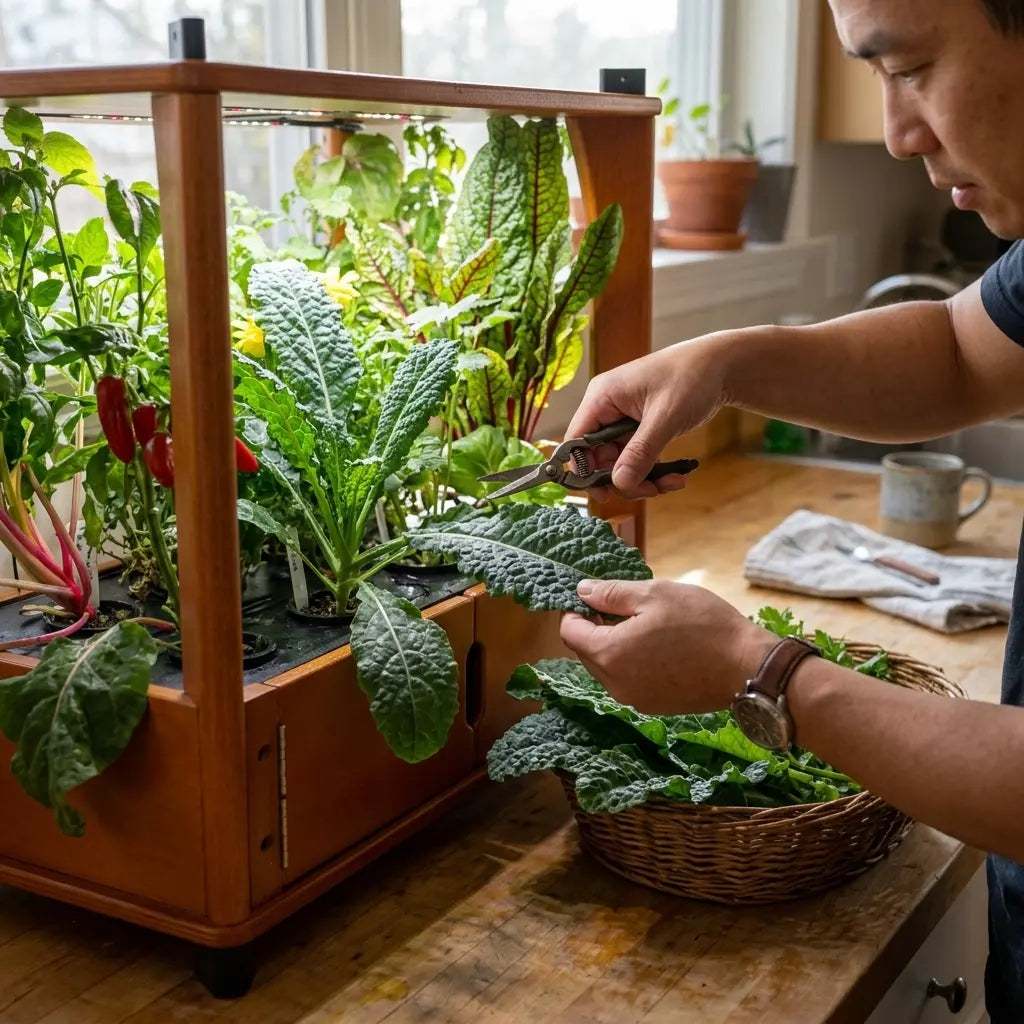
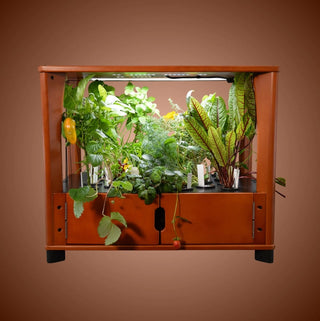
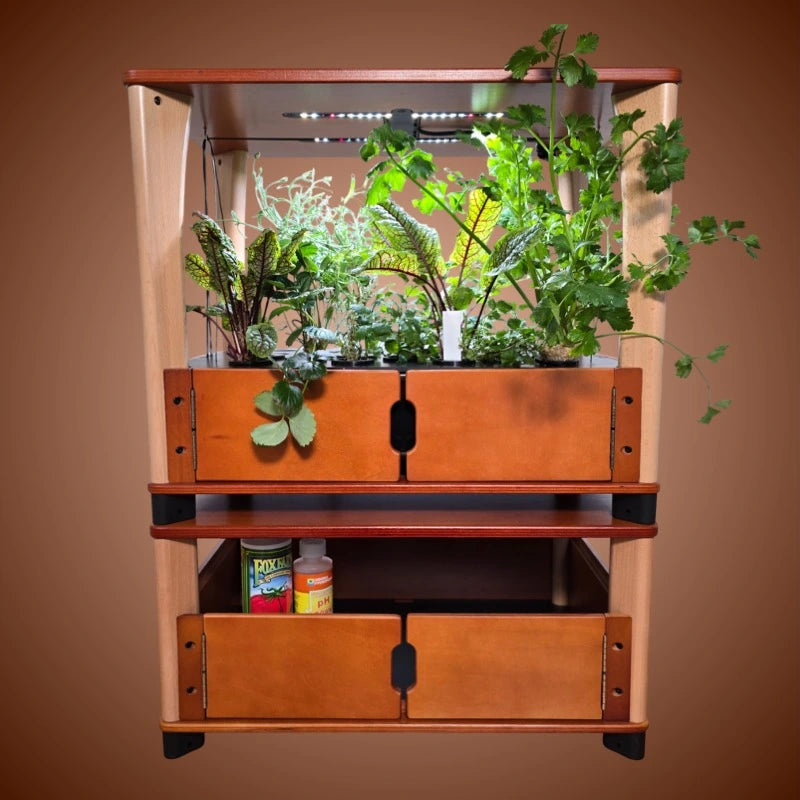
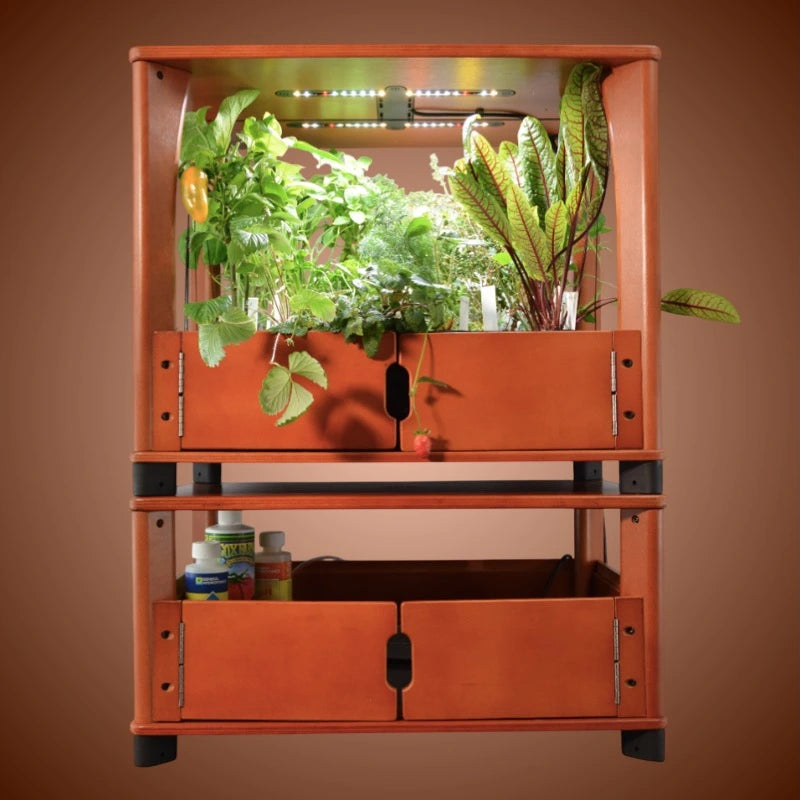
The set is a wooden hydroponic farm built like a small cabinet, with a matching storage unit in the bundle. It comes with 24 plants (a mix of chards and basils), built-in LED lights on a timer, nutrients, a pH kit and an air pump. You add water, and U.S. shipping is free on orders of $40 or more. Still deciding? Read the Home Farm vs Chef's Organic Set comparison.
Nothing else is needed to start, which keeps the up-front cost honest. There is no app and no subscription. The one-year warranty is included.
Hydroponic Electricity Cost: What 19 Watts Really Adds Up To
Lights are the part most people worry about, so here is the math. The farm draws a maximum of about 19 watts. The lights run on a timer, 16 hours on and 8 hours off.
To be safe, we assume the farm pulls the full 19 watts for all 16 light hours, and that the air pump draws 5 watts for the other 8 hours. That comes to about 344 watt-hours a day, or 125.6 kWh a year. Real use is probably a little lower, because the maximum is a ceiling.
Your cost depends on your electricity rate:
- 12 cents per kWh: $15.07 a year, or $1.26 a month.
- 18 cents per kWh: $22.60 a year, or $1.88 a month.
- 30 cents per kWh: $37.67 a year, or $3.14 a month.
Rates differ a lot by state and by season. Look at your latest bill for the exact number, or check the state tables in the EIA Electric Power Monthly. Even at the high end, the lights cost less than a single store herb pack each month.

Running Costs: Plant Food, Seeds and Water
After the farm and the electricity, three smaller costs remain. They add up to more than the lights, so they matter.
Plant food: the biggest running cost
Plants grown in water need nutrients, and they come as a two-part mix. One nutrient kit at $9.99 lasts about two months for one farm. That means 5 extra kits in year one ($49.95) and 6 kits in later years ($59.94).
Seeds: replant a couple of times a year
Basil is a cut-and-come-again plant, but it does not last forever. We assume two replants a year using a Genovese basil seed pack at $17.99 each, which is $35.98. Each pack has 30 seeds and 12 grow mats.
Water: close to nothing
The tank holds 13 liters. If you refilled it fully every week, you would use roughly 180 gallons a year. We count $5, which is generous.
Put it together at 18 cents per kWh. Year one is $199.99 for the set, $22.60 for electricity, $49.95 for plant food, $35.98 for seeds and $5.00 for water. That is $313.52. In year two and after, the set is paid for, so the total is $123.52.
At the low and high electricity rates, year one is $305.99 and $328.59. Year two is $115.99 and $138.59. Between the lowest and highest rate, the electricity rate moves year one by only $22.60.
How Many Herbs Can You Actually Grow?
A cost comparison means nothing if the farm cannot grow enough. So let us check the volume. One pack a week is 0.75 ounces, which is 2.4 pounds a year. Two packs is 4.9 pounds, and three packs is 7.3 pounds. For a side-by-side look, see how Aquager compares with Click and Grow.
University of Florida researchers grew basil in vertical hydroponic towers in a greenhouse. They measured 1.14 pounds of basil per plant, harvested weekly from September to mid-June. At that rate, about 6 plants would cover three packs a week.
A kitchen is not a research greenhouse, so expect less. Still, the set has 24 plants, and the number of plants is not the limit. What limits your savings is how many herbs you actually cook with.
If you want to see which plants are the easiest to keep, our guide to the easiest herbs to grow indoors is a good place to look. Our complete basil guide covers the one herb that drives most of the savings.
When Does a Home Farm Pay for Itself?
This is the question that matters most. Using run-rate costs of $123.52 a year, the farm saves money each month compared to buying herbs. The savings first have to cover the $199.99 you spent up front.
- 3 packs a week: the farm pays for itself in about 6 months.
- 2 packs a week: about 10 months.
- 1 pack a week: about 3.5 years.
What three years looks like
Most people who buy a farm keep it for years, so a longer view is fair. Over three years, the farm costs $560.56 in total: $313.52 in year one, plus $123.52 in each of years two and three.
Store herbs over the same three years cost $544.44 at one pack a week, $1,088.88 at two packs, and $1,633.32 at three packs. That means one pack a week still costs you $16.12 more with the farm. Two packs a week saves $528.32, and three packs saves $1,072.76.
The store price you pay changes this a lot. At $2.49 a pack, two packs a week costs $54.56 more than the farm in year one. At $4.49 a pack, the same habit saves $153.44. So the break-even moves with your local prices.
Here is the plain verdict. If you buy herbs once a week or less, a farm is a nice-to-have, not a money saver. If you buy them two or three times a week, it is a reasonable way to lower your herb spending.
Who Saves the Most With a Home Herb Farm?
The people who save the most are the ones who already cook with fresh herbs often. Think of someone who makes pesto, tomato sauce, salads and stir-fries through the week. They use basil like a staple, and each pack they buy is gone fast.
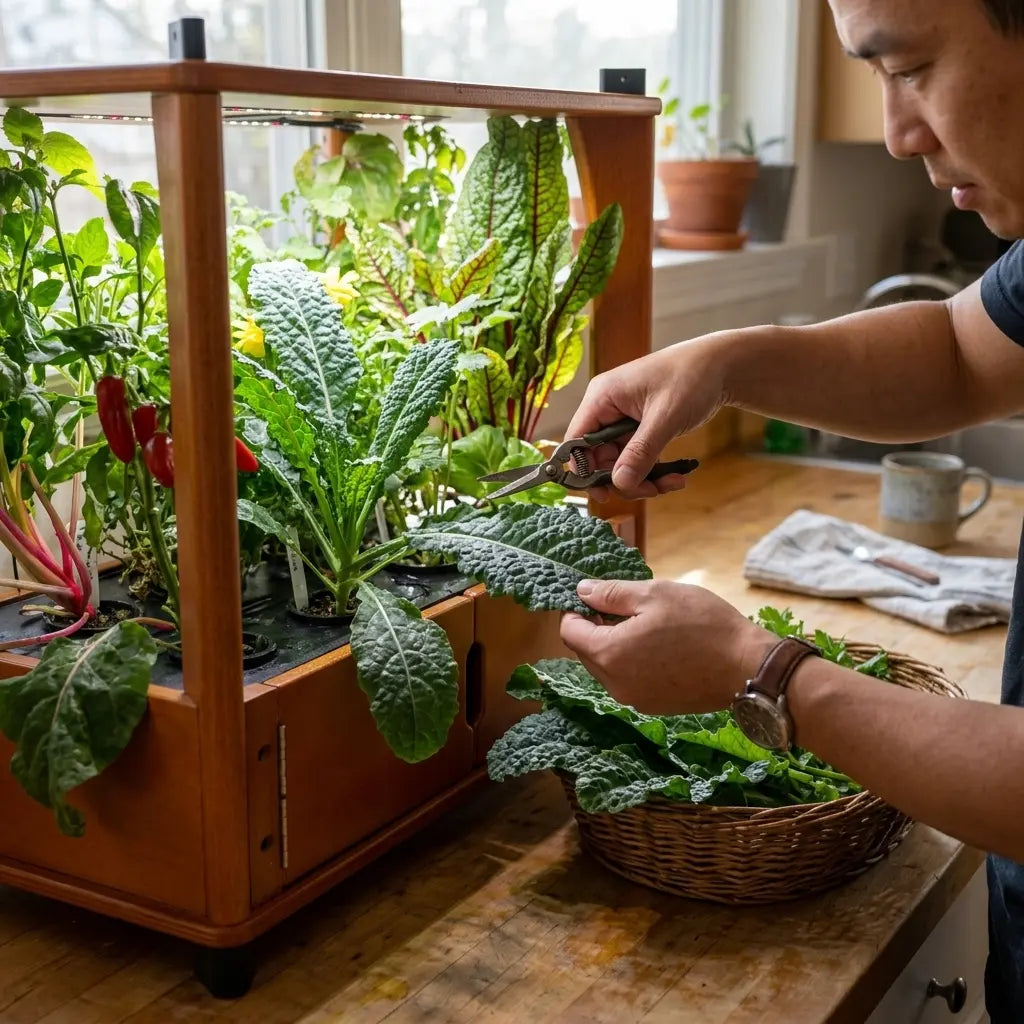
It also helps if you value the extras that do not show in the table. You pick leaves the moment you need them. There is no trip to the store for a single herb, and no half-wilted pack at the back of the fridge.
The Chef's Organic Set is built for that kind of cooking. It stands 22 by 15 by 30 inches and uses about 2 square feet. It takes 60 to 90 minutes to assemble. First sprouts show up in 6 to 9 days, and the first harvest takes 3 to 8 weeks, so plan for a few weeks before the savings begin. The weekly upkeep is about 5 to 10 minutes. For more on the routine, see our guide to getting the most out of your Aquager Home Farm.
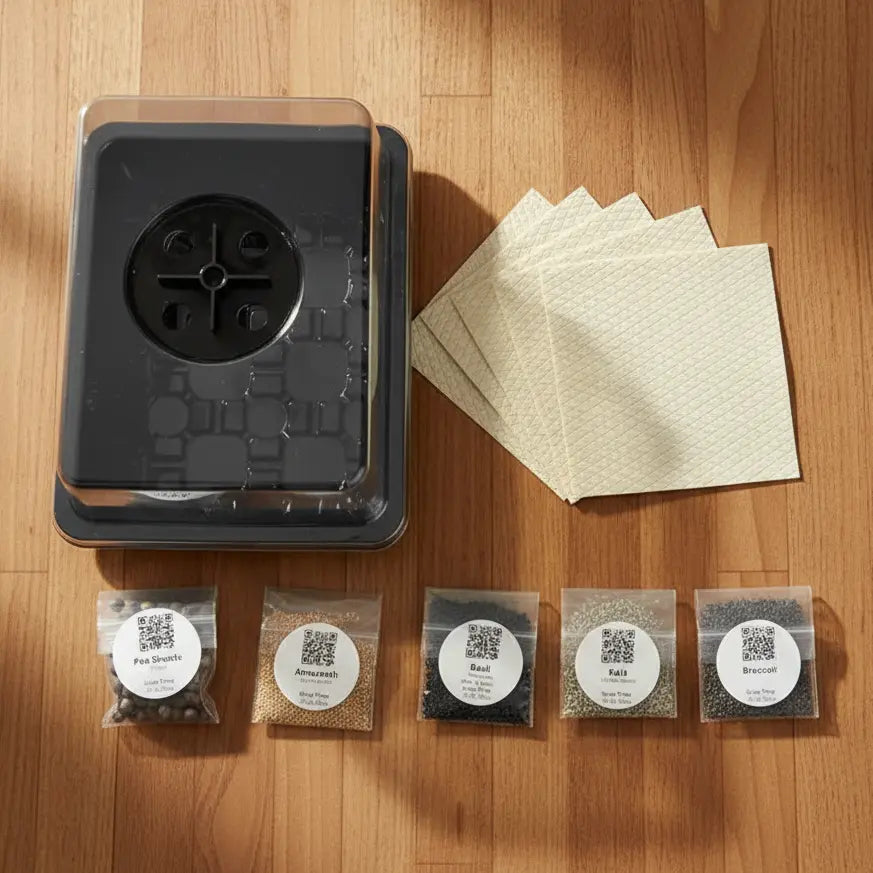
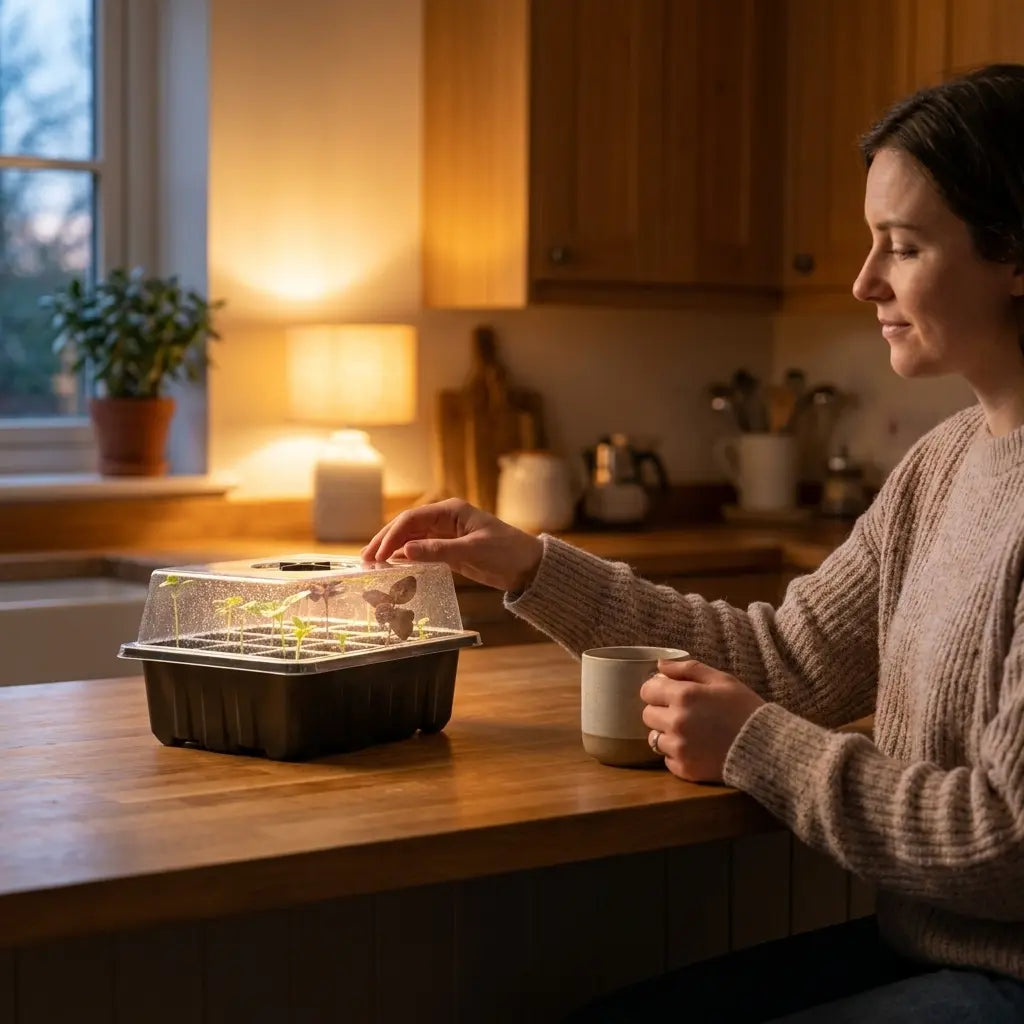
If you are not sure you will use that many herbs, there is a cheaper first step. The Microgreens Starter Kit costs $29.99 and includes 2 trays, 4 compostable mats and 4 seed packs. Harvests take 5 to 25 days, so you learn quickly whether growing food suits your kitchen.
Save on Groceries FAQ: Home-Grown Herbs vs Store Herbs
Is it cheaper to grow herbs at home or buy them?
It depends on how many you buy. In our model, a home farm costs more than store herbs in year one if you buy one pack a week, and saves money if you buy two or more. From year two on, it is cheaper at every level we tested.
How much electricity does a hydroponic farm use?
The Aquager Home Farm draws a maximum of about 19 watts. With a 16-hour light timer, that is about 125.6 kWh a year in our conservative estimate, or $22.60 a year at 18 cents per kWh.
How long do the nutrients last?
One $9.99 kit lasts about two months for one farm. Plan on 6 kits a year after the first year.
Does the cost include the storage unit?
Yes. The $199.99 price is for the full Chef's Organic Set bundle, which includes the matching storage unit. We count the entire price against the herb savings, even though the unit is not a herb cost.
What if my electricity rate goes up?
Not by much in dollar terms. Even at 30 cents per kWh, the farm costs $37.67 a year to run, or $3.14 a month. Going from 18 to 30 cents adds about $15.07 to the farm's yearly cost, which is not enough to flip the result for a regular herb buyer.
What if I only want to try it first?
Start with the Microgreens Starter Kit at $29.99. It costs far less than a farm and shows you how much fresh food you really use. If you like it, a farm is an easy next step.
A Fair Verdict on Saving on Groceries With Home-Grown Herbs
Growing herbs is not a magic way to save on groceries. With a $199.99 farm, $22.60 of electricity and about $86 of plant food and seeds, year one costs $313.52. A light herb buyer will not earn that back for a few years.
But a regular cook can come out ahead fast. At two packs a week, the farm saves $49.44 in year one and $239.44 in year two. At three packs, it saves $230.92 in year one. The lights are a small part of the bill.
Count your own herb packs for a few weeks, plug your prices into the assumptions above, and the answer will be clear. Either way, you now have the full math, not a guess.

Author: Aquager · Published: October 11, 2026 · Updated: October 11, 2026










0 comments