
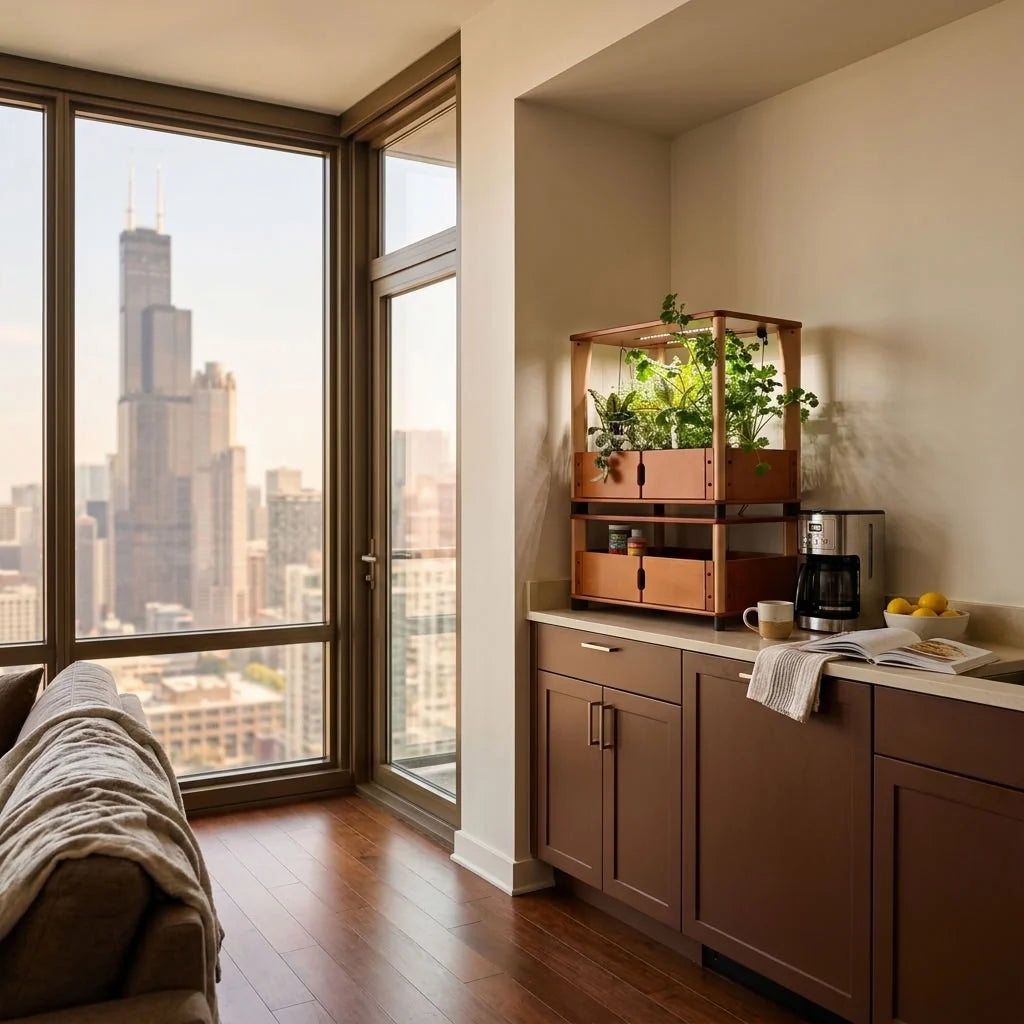
Indoor gardening in Chicago is a different job from gardening anywhere warmer. By the winter solstice, the city gets only about 9 hours and 8 minutes of daylight, compared with about 15 hours and 14 minutes in late June. The January average high is 31.6°F, and the average low is 18.8°F.
That is a hard season for a windowsill pot. Light is weak, glass is cold, and the heating is on. Plenty of Chicagoans give up on herbs and greens until spring.
This guide is for the people who do not want to wait. It covers what a Midwest winter does to indoor plants, four ways to grow through it, what to start in each month from December to March, and how our own Chicago story fits in. See our guide to what to grow indoors in December.
Why Indoor Gardening in Chicago Matters Most in Winter
The National Weather Service publishes 30-year climate normals for Chicago. Here are the numbers that shape a winter garden:
- December: average high 36.6°F and average low 24.4°F.
- January: average high 31.6°F, average low 18.8°F, and 11.3 inches of snow.
- February: average high 35.7°F and average low 21.8°F.
- Whole year: 38.4 inches of snow on average.
Those figures come from the National Weather Service Chicago climate normals for 1991 to 2020. Spring is slow, too. The NWS lists April 21 as Chicago's latest freeze date, according to NBC Chicago, so outdoor planting waits until late April or later.
Put it together and the outdoor season is short. If you want fresh basil in January, the garden has to move inside.
What a Midwest Winter Does to Indoor Plants
Bringing plants inside solves the cold, but it does not solve everything. Three things change for indoor plants between December and February.
Short days and weak light
Daylight in Chicago on December 21 runs from about 7:14 a.m. to 4:22 p.m. The sun also stays low, and a window filters what little light arrives. Plants near a window often stretch toward the glass and grow thin and pale.
Here is how daylight changes across the season, using a standard solar calculation for Chicago:
- December 1: about 9 hours and 23 minutes.
- December 21: about 9 hours and 8 minutes, the shortest day.
- January 31: about 9 hours and 57 minutes.
- March 20: about 12 hours and 6 minutes.
- June 21: about 15 hours and 14 minutes.
So the darkest stretch lasts from early December to early January, and even in late January the days are still short.
The fix is a light you control. A grow light on a timer gives plants the same hours every day, whatever the weather does. Our guide on growing fresh herbs indoors all year, even without sunlight explains how this works.
Cold glass and drafts
A windowsill can be much colder than the middle of the room, especially on a night in the teens. Leaves that touch cold glass can get damaged. Keep plants a few inches back from the window, and away from doors that open to a hallway or the outside.
Radiators, vents and drafty frames
Many older Chicago buildings heat with radiators, and many apartments have a floor vent under a window. A plant sitting on or right beside a heat source can dry out or overheat in a day. A plant sitting in a cold draft from an old window frame has the opposite problem.
Pick a spot that stays at a steady, comfortable room temperature. If your hands feel a draft or a blast of heat there, the plants will feel it too.
Dry air from the heating
Winter heating tends to dry out indoor air. Dry air pulls water from leaves faster, so soil pots can need watering more often. Plants grown in water have an advantage here, because their roots always have a supply.
Chicago Urban Gardening Indoors: Four Setups Compared
Most people who garden in a Chicago apartment end up with one of four setups. Each one works, and each has a trade-off.
- Windowsill pots: the cheapest way to start. In winter, the short days limit growth, and the cold glass adds risk.
- A grow-light shelf: better light, but you build and wire it yourself. You also water by hand, and soil can be messy in a small kitchen.
- Microgreens trays: the fastest option. Harvests take 5 to 25 days, and the trays sit on a counter.
- A hydroponic farm: lights, water and nutrients come in one unit. It costs the most up front and gives the most steady harvest.
If you have never grown anything, start with the fastest option. If you cook with herbs every week, the last option may pay off. Our guide on how to start an indoor garden in an apartment goes deeper on small spaces.

Chicago Hydroponics: Why Water-Based Growing Fits a Long Winter
Hydroponics means growing plants in water with added nutrients, with no soil. For a Chicago winter, that fits for three reasons.
First, the lights are built in. The Aquager Home Farm runs its LEDs on a timer, 16 hours on and 8 hours off, so a gray January day makes no difference. Second, the roots sit in a tank, not in a pot of cold soil near a drafty window. For a head-to-head look, see hydroponics vs soil indoors.
Third, the upkeep is small. The tank holds 13 liters, and the product page suggests a refill about every 7 to 10 days. The weekly work, including refills, a quick pH check and harvesting, takes about 5 to 10 minutes.
What the electricity costs
Lights are the usual worry in winter, when the heating bill is already high. The farm draws a maximum of about 19 watts. If you assume it pulls that full amount for all 16 light hours, plus 5 watts for the air pump the rest of the time, it uses about 125.6 kWh a year.
At 18 cents per kWh, that is about $22.60 a year, or $1.88 a month. Check your own bill for your rate, because it varies by utility.
What to Grow in Chicago From December Through March
Timing matters in winter, because everything grows a little slower. Use the Aquager timelines below to plan around the calendar.
December: start the long crops
Set up a hydroponic farm in early or mid-December. First sprouts appear in 6 to 9 days, and the first harvest takes 3 to 8 weeks. A farm started on December 15 should give you its first harvest between about January 5 and February 9.
January: start the fast crops
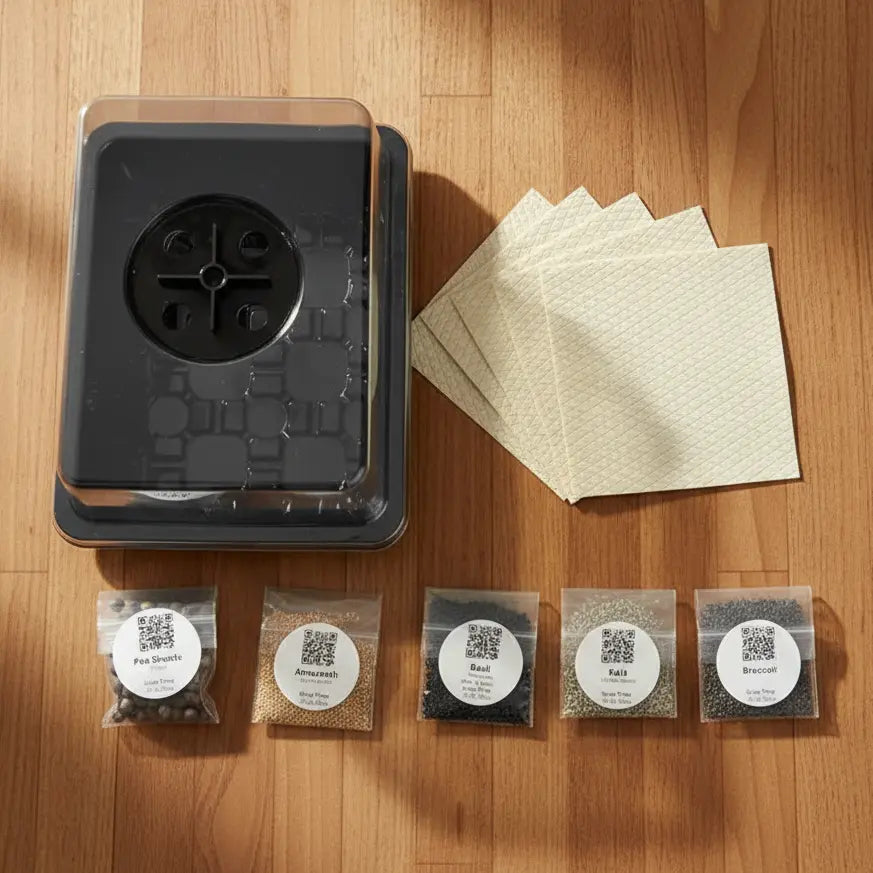
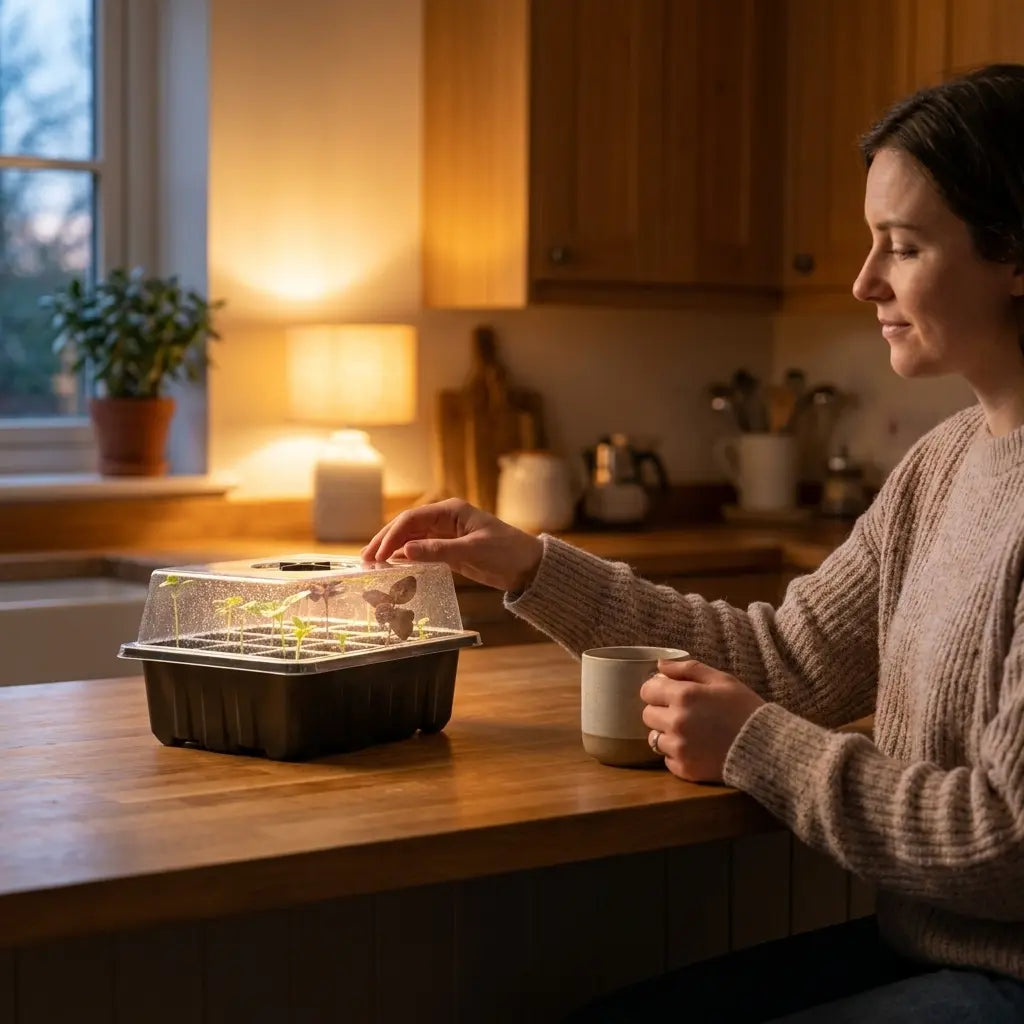
January is the month for microgreens, which take 5 to 25 days to harvest depending on the variety. The Microgreens Starter Kit costs $29.99 and includes 2 trays, 4 compostable mats and 4 seed packs. Our guide on growing microgreens indoors all winter covers the varieties that do best.
February: add herbs for the spring kitchen
Basil is the herb most people want. Genovese basil seeds sprout in 7 to 14 days and are ready to harvest in about 50 days, so seeds started on January 1 are ready around late February. Each pack has 30 seeds and 12 grow mats.
March: keep going as the days grow
By March 20, Chicago gets about 12 hours of daylight, which is three hours more than on the solstice. Outdoor planting still has to wait for the late-April freeze date. So March is a good month to expand your indoor garden, then move seedlings outside later in spring. For timing, see the seasonal calendar for herbs and vegetables.
What a Winter Indoor Garden Costs in Chicago
Budget is a fair question, especially after the holidays. Here are the real numbers for the two Aquager options, using current prices.
- Microgreens Starter Kit: $29.99, which is $5.00 below its $34.99 list price. It includes trays, mats and seeds, so there is nothing else to buy to start.
- Chef's Organic Set: $199.99 in most finishes, down from a $279.99 list price. That is $80.00 less than list.
- Electricity for the farm: about $1.88 a month at 18 cents per kWh, based on the 19-watt maximum.
- Nutrients: a $9.99 kit lasts about two months for one farm.
- Replant seeds: $17.99 for a pack of Genovese basil seeds, which you buy only when you replant.
The farm costs more than the kit at the start, but its running costs are small. To judge the value for your kitchen, compare these numbers with what you spend on herbs and greens each month.
Five Winter Mistakes Chicago Indoor Gardeners Make
Most winter failures come down to a few repeat habits. Here are the five we see most often, and how to avoid them.
- Overwatering soil plants. In low winter light, plants use water slowly, so soil stays wet longer. Check the top inch of soil before you water again.
- Parking plants on a radiator. Heat dries leaves fast. Keep pots a few feet from any heat source.
- Expecting summer growth. Everything grows more slowly in winter. Plan for the longer timelines listed above, not the fastest ones you read online.
- Skipping the dark period. Most plants do well with a regular break from light. The Aquager farm runs 16 hours on and 8 hours off for that reason.
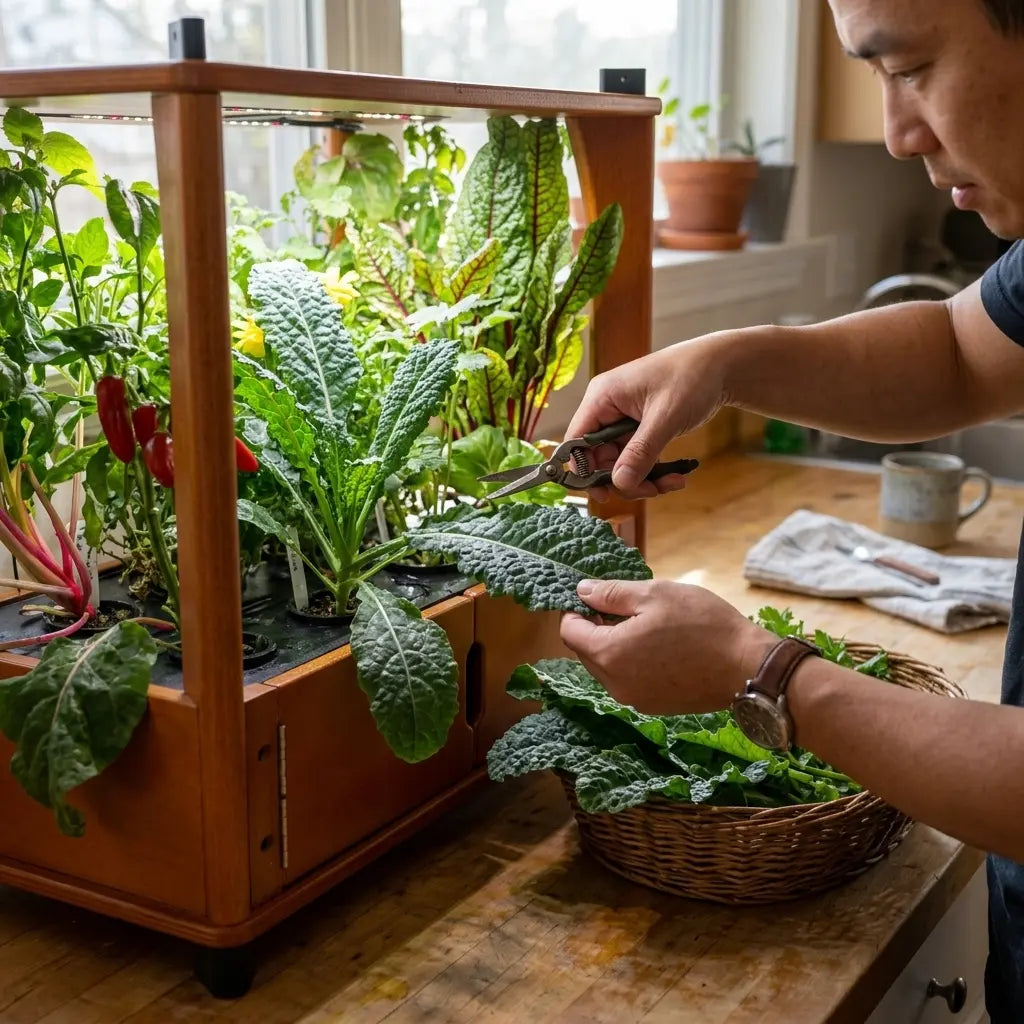
- Harvesting too much at once. Take the outer leaves and leave the center, so the plant keeps growing. A young plant stripped bare grows back slowly.
None of these are hard to fix. Most are about patience and a steady routine, which is why a weekly reminder helps more than any gadget.
A Simple Winter Setup Plan for a Chicago Apartment
Here is a short plan that works for a kitchen, a dining nook or a living room corner.
- Pick a spot away from drafts. Stay away from the front door and the coldest window.
- Find an outlet. Lights and the air pump need power, and the spot should be easy to reach for weekly refills.
- Measure the footprint. The Chef's Organic Set stands 22 by 15 by 30 inches and takes up about 2 square feet.
- Plan 60 to 90 minutes for assembly. Do it on a weekend, with everything unpacked.
- Set a weekly reminder. Refill the water, add nutrients, check pH and harvest.
Our guide on how to get the most out of your Aquager Home Farm walks through the weekly routine in more detail.
Where Aquager Fits In: A Chicago Company, Described Honestly
We are a Chicago-based company, and we have been since 2021. Aquager started as a student-led idea at Illinois Tech, and the Home Farm was developed inside mHUB, a hardware innovation center in Chicago. We also try to be careful about what we claim, so here is what we can back up. Read how Aquager was built at mHUB in Chicago.
- mHUB: the Chef's Organic Set was included in the 2025 mHUB Holiday Gift Guide, published December 1, 2025. We wrote about it in our post on the mHUB gift guide.
- Chicago Tech Scene Map: Aquager is featured on the map curated by Monica Para. We covered it in Aquager on the Chicago Tech Scene Map.
- Illinois Tech: we came through the Pitch Tank program at the Kaplan Institute at Illinois Tech, and we returned to exhibit there. We wrote about it in Two Days, Two Stages.
- Chicago offices: teams ordering 3 or more sets can get free hand delivery to Chicago offices. Dates change by season, so check the Chicago corporate gifts page for the current schedule.
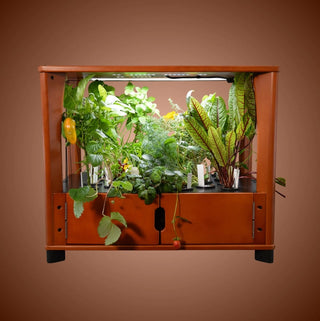
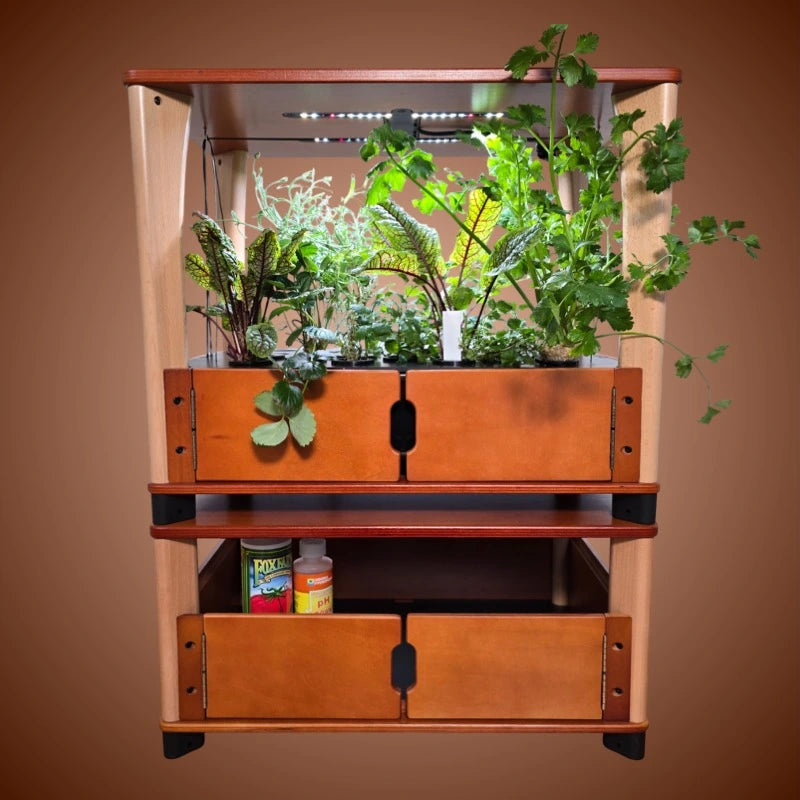
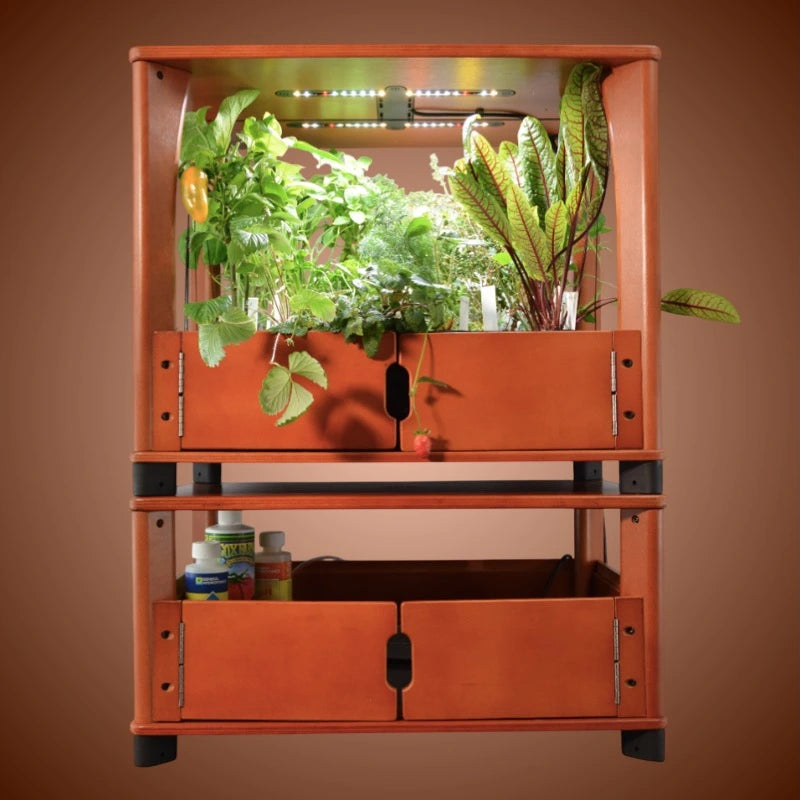
The Chef's Organic Set is a wooden hydroponic farm built like a small cabinet, with a matching storage unit in the bundle, and it is assembled in Chicago. It comes with 24 plants (a mix of chards and basils), LED lights on a timer, nutrients, a pH kit and an air pump. It costs $199.99 in Blonde Maple and the two-tone finishes, and $229.99 in Chestnut Ember. U.S. shipping is free on orders of $40 or more.
Writers covering Chicago food, tech or indoor growing are welcome to reach us at contact@aquagertech.com.
Indoor Gardening Chicago FAQ
Can you grow vegetables indoors in Chicago in winter?
Yes. With a grow light or a hydroponic farm, leafy greens, herbs and microgreens grow well through the winter. Fruiting crops need more light and more time, so start with the leafy ones.
When can you plant outside in Chicago?
The National Weather Service lists April 21 as Chicago's latest freeze date, and the NBC Chicago meteorologist quoted in that story says the last freeze usually comes by the end of April. Many gardeners wait until after that to plant tender crops outdoors.
How much daylight does Chicago get in winter?
About 9 hours and 8 minutes on December 21, the shortest day, by a standard solar calculation. By January 31, it is about 9 hours and 57 minutes.
How much weekly work does an indoor farm need?
The Aquager Home Farm needs about 5 to 10 minutes a week, covering a water refill, a pH check and harvesting.
Is indoor gardening worth it in a Chicago winter?
It depends on how much fresh food you use. If you cook with herbs and greens several times a week, a steady indoor garden saves trips to the store and gives you fresher leaves. If you rarely use them, start small with a microgreens kit first.
What is the easiest thing to start in January?
Microgreens. They take 5 to 25 days to harvest and need only a tray, a mat, seeds and water. The Microgreens Starter Kit has everything in one box.
A Chicago Winter Is Long, But Your Kitchen Can Stay Green
You cannot change the weather, but you can change what grows in your kitchen. A cold January with 9 hours of daylight does not have to mean a winter without fresh herbs and greens.
Start with one tray of microgreens, or plan a hydroponic farm for the new year. Either way, the first harvest will come before the last freeze does.

Author: Aquager · Published: October 11, 2026 · Updated: October 11, 2026












0 comments